

Last updated on September 24, 2026 at 10:48 AM
Affiliate marketing is still expanding, but the measurement problem is getting harder. U.S. spend is forecast to top $14 billion in 2026, Pinterest and Shopee are connecting creator recommendations directly to commerce, and brands are being pushed to prove whether partners influence demand before the last click.
At the same time, paid-media teams are getting clearer guidance on Smart Bidding learning, new AI Max reporting, and the real cost gap between TikTok and Meta. Email remains resilient, fraud and compliance are moving closer to growth operations, and platform-native checkout keeps spreading.
| The Beecommercer Daily Buzz |
| Date: Thursday, September 24, 2026 |
| Brought to you by: beecommercer.com |
Today’s strongest signal is not another new interface. It is the widening gap between what platforms can report and what merchants actually need to know. Affiliate programs can record a conversion without proving incrementality. Social platforms can deliver cheap clicks without proving sales efficiency. Automated bidding can learn from more data while still being judged too early. And a checkout can move into a new surface without changing who owns the underlying customer economics.
That puts more pressure on measurement design, partner governance and channel-specific operating rules. The teams that win will be the ones that know what each channel is supposed to do, what evidence counts as success, and where the data stops being trustworthy.
Let's get into it.
THE BIG STORY
Affiliate Marketing Is Growing — and Last-Click Attribution Is Falling Further Behind
U.S. advertisers are forecast to spend more than $14 billion on affiliate marketing in 2026, up 11.4% year over year, according to an EMARKETER forecast summarized by Affiverse. Retail affiliate spending is expected to rise 10.5%, a faster growth rate than U.S. retail ecommerce sales over the forecast period. The drivers are familiar: value-seeking shoppers, creator partnerships, comparison content, rewards programs and a broader set of discovery surfaces.
The important part is what happens to measurement as affiliate expands. A publisher may introduce a product through a comparison article, a creator may explain it in video, and the final purchase may happen after a branded search, a retargeting ad or a direct visit. The affiliate platform can still record the closing click, but that does not prove which partner created incremental demand. Performance Marketing World’s attribution discussion points to the same operating problem: fragmented journeys, cross-device behavior, privacy limits and overlapping media make a single source of truth harder to maintain.
Pinterest and Shopee are pushing that journey even further upstream. Their new partnership lets eligible Shopee Affiliate creators in Indonesia and Brazil connect their accounts to Pinterest, tag eligible products in Pins and videos, and earn commissions from qualifying purchases. Pinterest says Gen Z now represents more than half of its global user base. In the two launch markets, it also cites year-over-year search growth of 281% for “outfit inspiration” in Brazil and 83% for beauty-product searches in Indonesia. The commercial model is simple: discovery, creator recommendation and affiliate checkout become one connected path.

For ecommerce teams, that changes the job of an affiliate manager. The role is moving beyond coupon policing and commission tables toward partner segmentation, content distribution, incrementality testing and channel overlap. A creator who earns affiliate commission may also need a production fee. A publisher may assist demand without producing the final click. A cashback partner may close sales that would have happened anyway. Those are different economics and should not be evaluated with one attribution rule.
| Operator takeaway: Separate affiliate partners by job-to-be-done. Track discovery partners, comparison/review partners, deal/reward partners and closers differently. Use sub-IDs, partner-specific codes, new-customer rates, assisted-conversion analysis and holdout tests where possible. Keep last-click revenue for operational reconciliation, but do not confuse it with incremental value. |
ECOMMERCE RISK & TRUST
Fraud, Scams and Compliance Are Becoming Growth Operations Problems
A Business Wire release for Safer Ecommerce Day 2026 highlights a set of issues that merchants increasingly have to treat as commercial infrastructure rather than back-office compliance: online fraud at scale, scam disruption across cards and ACH, transaction laundering, platform abuse and regulatory pressure heading into 2027. The release comes from G2 Risk Solutions and promotes an industry event, so it should not be read as an independent fraud benchmark. But the agenda is a useful snapshot of what payments and marketplace teams are prioritizing.
The growth connection is direct. More aggressive fraud controls can reject legitimate customers and depress approval rates. Weak controls can increase chargebacks, payment costs and marketplace risk. Faster checkout can improve conversion while also reducing the time available for manual review. The practical objective is not “maximum fraud prevention”; it is a risk system that protects approval quality, customer trust and contribution margin at the same time.
This matters even more as checkout expands beyond the merchant’s own storefront. Shopify and Meta are extending Shop Pay into Muse, allowing Shopify merchants to participate in agent-assisted checkout. PYMNTS notes that Shop Pay surpassed $400 billion in lifetime accelerated GMV in June. The operational question is not whether the surface is novel; it is whether payment, order, refund, fraud and customer-service data remain reconciled when the buying interface moves elsewhere.

| Operator takeaway: Add fraud and payment quality to the same weekly commerce dashboard as conversion rate. Track authorization rate, false declines, chargebacks, refund abuse, payment-method mix and fraud-loss rate by market and channel. When a new checkout surface launches, test reconciliation and exception handling before scaling acquisition into it. |
PAID SEARCH & BIDDING
Google Ads Is Giving Advertisers More Automation — and More Reasons to Slow Down the Evaluation Cycle
Google has reframed its Smart Bidding learning guidance around a more concrete threshold: learning can take up to roughly 50 conversions or three conversion cycles. That matters because teams often judge an automated strategy after a few days, especially when CPC, conversion volume or impression share moves sharply. If the campaign has not accumulated enough representative conversion feedback, an early verdict can be more about noise than strategy quality.
At the same time, Google is adding visibility into AI Max. A new reporting view is designed to connect the search term that triggered an ad, the creative assets the user saw and the landing page they reached. Google is also expanding its AI Brief beta to Dutch, French, German, Italian, Japanese, Portuguese and Spanish. For advertisers, the reporting change is more important than the branding: the more Google expands matching and asset selection, the more useful it becomes to see the actual query-to-creative-to-landing-page path.
Google is also documenting how advertisers can compare AI Max with Dynamic Search Ads through campaign experiments as DSA moves toward retirement. That is the right mental model for automation changes: use controlled experiments when possible, keep conversion definitions stable, and avoid changing bidding, creative, landing pages and budgets at the same time. Google’s own Think with Google materials are simultaneously pushing an “AI search ROI” narrative; because that content is first-party platform marketing, merchants should validate the claims against their own account-level profit and incrementality data.

| Operator takeaway: Before changing an automated bidding or matching system, write down the test window, conversion-cycle length, minimum data threshold and failure condition. When you compare AI Max, Broad Match, DSA or another expansion mechanism, hold the business outcome constant and inspect query quality, landing-page routing and final-value accuracy — not just platform-reported ROAS. |
CHANNEL ECONOMICS
TikTok Can Be Cheaper Than Meta Without Being the Default Budget Winner
A Metricool study summarized by Marketing4eCommerce analyzed 628,969 campaigns from more than 40,000 advertisers, representing about $471.5 million in ad spend from January through June 2026. In that dataset, TikTok showed lower average traffic and lead costs: CPC was $0.03 versus $0.07 on Meta, CPL was $2.69 versus $6, and CPM was $0.38 versus $0.48. Yet 91.51% of the accounts analyzed ran campaigns only on Meta; just 3.73% used both platforms.
That tension is more useful than a “TikTok wins” headline. The study does not provide a direct sales-ROAS comparison between TikTok and Meta, and Meta performed better in its engagement metric. Cheap clicks can be valuable for discovery, but ecommerce teams ultimately need to connect those clicks to qualified sessions, product engagement, new-customer mix and contribution margin. The right question is where each platform adds incremental reach or demand, not which one has the lowest CPC.
Sensor Tower’s Pathmatics data provides a second view from beauty retail. U.S. beauty-retail ad spend grew 23% year over year from September 2025 to September 2026. Sephora represented 35% of spend among the category leaders, followed by Ulta at 18%. Across the category, Instagram took 22% of spend, Facebook 20%, OTT 15%, Pinterest 10% and TikTok 10%. Beauty specialists leaned more heavily into social, while general retailers such as Target, Amazon and Macy’s put a larger share into OTT. The channel mix reflects the job: discovery and engagement for specialists, broader reach for multi-category retailers.

| Operator takeaway: Build channel benchmarks around business role. For TikTok, Meta, Pinterest and OTT, define whether the campaign is expected to create discovery, harvest demand, retarget, acquire new customers or protect branded demand. Compare cost per qualified visit, new-customer revenue and contribution margin — not CPC in isolation. |
OWNED CHANNELS
Email Still Rewards Relevance More Than a “Perfect” Image-to-Text Ratio
MarketingProfs summarizes a Flodesk analysis of more than three million small-business email campaigns and finds that image-to-text ratio had little impact on average click rates or open rates across emails ranging from 0% to 70% text. The pattern also held across major email providers including Gmail, Yahoo and Outlook. That is a useful counterweight to rigid email-design rules that treat a particular text ratio as a universal deliverability or engagement requirement.
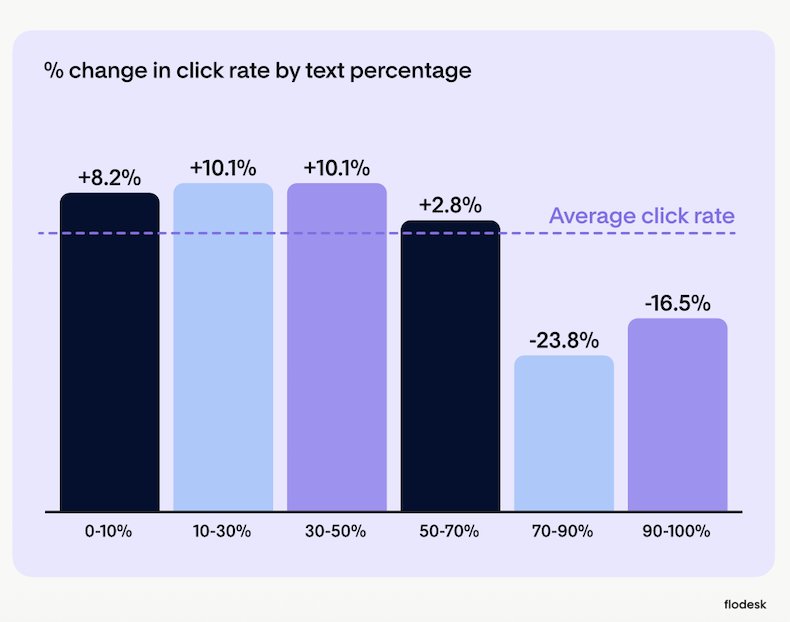
The practical implication is not that design does not matter. It is that the creative mix should serve the message. Product launches, lookbooks and visual merchandising can be image-led; education, replenishment and service messaging may need more text. The stronger levers remain audience quality, subject line, offer, timing, mobile rendering, landing-page continuity and whether the email helps the recipient make a decision.
A separate market-research press release from The Business Research Company estimates the email marketing market at $12.45 billion in 2026, up from $10.78 billion in 2025, and projects $22.09 billion by 2030. Those figures are a commercial market forecast, not an independent industry census, but they reinforce the bigger point: owned retention channels are still receiving investment even as paid discovery fragments across more surfaces.
| Operator takeaway: Stop optimizing email to generic folklore. Segment by customer state, test the offer and creative format against a clear objective, and measure downstream product views, revenue per recipient, unsubscribe rate and repeat purchase — not open rate alone. |
SEARCH MEASUREMENT
New Search Metrics Are Useful — but They Are Still Proxies
Search Engine Journal’s review of recent MIT and Stanford research makes a straightforward management point: automated systems optimize what they are rewarded for. If an SEO agent is judged on pages published, citation share or a visibility score, it can maximize that proxy without necessarily improving qualified demand. The article recommends pairing proxy metrics with outcomes the agent cannot directly manipulate, such as qualified leads, pipeline or branded demand, and keeping human review checkpoints before scaling automated workflows.
Baidu is adding another measurement layer with an AI Traffic Analysis section in its webmaster tools. The planned dashboard includes AI citations, impressions, clicks and an AI CTR metric. One important caveat is that Baidu defines AI CTR as clicks divided by citations rather than clicks divided by impressions. The service is also rolling out in phases and the data was not yet live when Search Engine Journal reported on it. That makes the report useful as a measurement signal, not a new ranking rule.

For international ecommerce teams, the lesson is broader: every platform is inventing slightly different definitions for “visibility.” Those metrics can help diagnose demand and content coverage, but they should not replace revenue, qualified traffic, conversion quality and brand-demand measures. The more automated search becomes, the more important metric governance becomes.
| Operator takeaway: Put every new visibility KPI into a two-column scorecard: proxy metric and business outcome. Define what the metric can and cannot prove before it enters a dashboard. If a vendor or platform introduces a new citation or visibility score, record a baseline first; do not rewrite content strategy around it until you can connect movement to useful customer behavior. |
PLATFORM WATCH
Checkout and Advertising Keep Moving Into New Interfaces
Meta’s Muse has become a fast-growing consumer agent, and the commercial significance is that shopping is moving into assistant-style interfaces. CNBC framed the launch as a potential “ChatGPT moment” for Meta, while other market-intelligence reporting has shown rapid early adoption. Shopify’s Shop Pay integration gives that adoption a direct commerce path, allowing eligible Shopify merchants to participate without building a separate checkout stack for the assistant.

Amazon is responding from the seller side. Reports on its September 23 rollout describe new agentic seller workflows and access for outside assistants beginning with Anthropic’s Claude, extending automation into marketplace operations rather than only consumer discovery. These tools may eventually compress routine seller work such as listing, support and operational tasks, but the near-term value depends on permissions, data quality and how much control marketplaces expose to external agents.
Advertising is moving into assistant interfaces as well. Comscore data cited by Search Engine Journal found sponsored ads in 47% of tracked U.S. desktop ChatGPT conversations about video games and consoles in June, up from 3% in March. The sample is opt-in U.S. PC activity and measures the share of conversations containing a sponsored ad, not user reach or impression share, so the number should be treated as an early placement signal rather than a market-share metric.
| Operator takeaway: Keep these surfaces in a watchlist, not a hype budget. Test when the interface changes transaction control, audience access or measurable demand. Before investing, confirm what products are eligible, what data is shared, who owns checkout, how returns work and whether the platform can support incremental measurement. |
THE SIGNAL
More Automation Makes Operating Discipline More Valuable
The common thread in today’s stories is accountability. Affiliate budgets are growing, but partner influence is harder to credit. TikTok can produce cheaper traffic, but cheaper traffic is not automatically better revenue. Smart Bidding can use more data, but it still needs enough conversion cycles to learn. Email can be highly visual or text-heavy, but the creative ratio matters less than relevance. New checkout surfaces can remove friction, but they also create new reconciliation and risk questions.
For ecommerce teams, the durable advantage is therefore not simply adopting more tools. It is maintaining a clean system of product economics, customer definitions, finalized conversion values, partner roles and channel objectives. That makes every new platform feature easier to evaluate because the business has its own reference point.

| Operator takeaway: Pick one measurement gap to close this week. Reconcile affiliate revenue to new-customer margin, document your Smart Bidding conversion cycle, compare TikTok and Meta on qualified sessions rather than CPC, or add fraud approval quality to your commerce dashboard. Better decisions usually start by improving the denominator before adding another channel. |
The Beecommercer Team