

Last updated on July 20, 2026 at 7:39 AM
A 3D printer buyer is not choosing one machine; they are choosing a technology stack and an ownership workflow. Before checkout, they must compare printing technologies and named models, understand materials and software, verify independent proof, and judge whether setup and support will hold up after the order. Anycubic, which describes its mission and development on its official company page, has built a broad public footprint around that journey.
This case study examines how that footprint captures demand and where trust can still break. Anycubic’s own printer comparison page separates its filament and resin portfolios; representative pages for the Kobra S1 Combo and Photon Mono M7 Pro show why model-level research quickly becomes workflow-level research. The evidence points to one operating lesson: search creates the opportunity, but documentation, third-party proof, community experience, and support clarity decide whether that opportunity becomes confident demand.
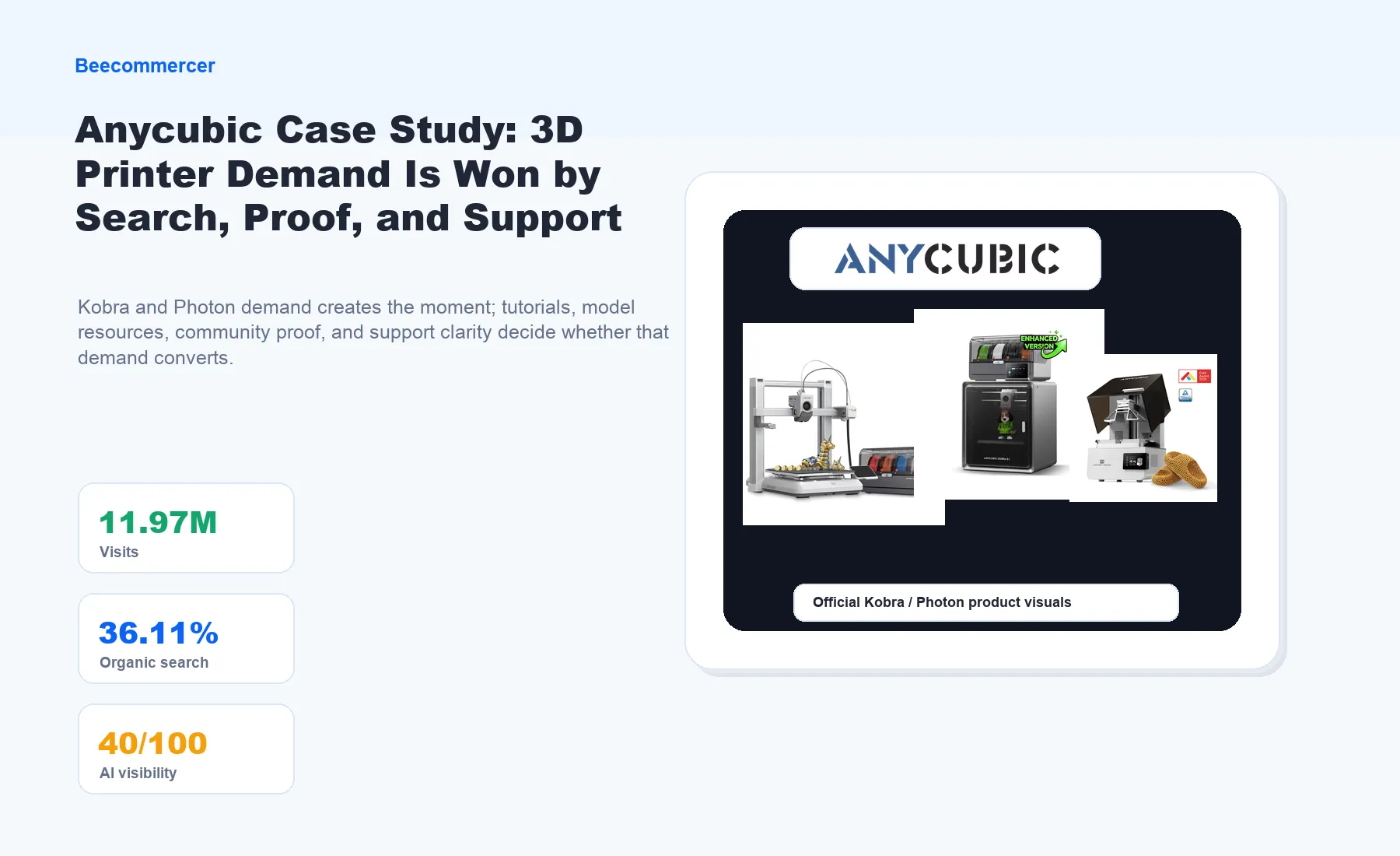
1. Anycubic case study: key takeaways
Four conclusions matter most for ecommerce teams. First, search is a major acquisition surface: Similarweb estimated 11.97 million visits to anycubic.com across December 2025 through May 2026, with organic and paid search contributing an estimated 49.57% together. Second, demand is organized around model families such as Kobra and Photon, then expands into questions about slicers, resin, filament, calibration, files, firmware, and repairs. Third, the proof layer is distributed. Buyers and answer engines can encounter Anycubic through official pages, reviewers, video, Reddit, specialist media, and communities. Fourth, post-purchase information is also pre-purchase information: a visible manual, material guide, returns policy, spare-parts path, or troubleshooting answer can reduce uncertainty before the order.

Source note: Beecommercer analysis of Similarweb’s anycubic.com Website Analysis for December 2025 through May 2026. Similarweb explains its website engagement fields in its website performance documentation. These are third-party estimates, not Anycubic analytics, orders, revenue, conversion, or market share.
The overview should therefore be read as a demand map rather than a scorecard. An estimated 3.78 pages per visit and a 37.10% bounce rate suggest that many visitors do more than touch a single landing page, but they do not reveal which pages caused a purchase. Germany and the United States leading the observed country mix identifies markets worth investigating; it does not prove that either market leads sales or profitability. The practical response is to connect landing-page demand with first-party search-console, commerce, service, and cohort data before allocating budget.
For other technical brands, the reusable idea is a proof architecture. Every launch should create a linked set of assets: a comparison page for selection, a product page for specifications, a guide for workflow questions, a support page for ownership risk, and independent evidence that buyers can verify. That architecture helps one body of knowledge serve SEO, paid search, conversion, customer success, and answer-engine discovery without pretending that one channel caused every result.
2. Traffic scale matters, but search concentration is more actionable
Traffic totals attract attention because they are easy to compare, yet channel concentration tells a more operational story. In the saved Similarweb window, organic search accounted for an estimated 36.11% of visits and paid search for 13.46%. Together they represented 49.57% of the estimated mix. For a considered product, that concentration means the search-results page is part of the storefront: product pages, comparison articles, videos, retailers, forums, and support discussions can all shape the same buying session.
Similarweb’s own data methodology explains why these figures must be qualified. They are modeled from multiple data inputs and are not a substitute for the site’s analytics. They also describe visits, not buyer quality, margin, or lifetime value. A brand could grow estimated search traffic while attracting low-intent troubleshooting visits; it could also have modest traffic but stronger conversion from a narrow, high-value query set.

Source note: Similarweb anycubic.com Website Analysis, December 2025 through May 2026. Channel definitions follow Similarweb’s Marketing Channels documentation. Percentages are modeled visit shares and must not be interpreted as sales attribution.
The strongest operating model is not “SEO versus paid search.” Paid search can expose query language and landing-page gaps quickly; organic pages can preserve useful answers after a campaign ends. Both need the same evidence: clear model differences, honest constraints, compatible materials, setup requirements, delivery terms, and support routes. Teams should segment performance by intent—brand, model, comparison, problem, material, software, and support—then measure downstream outcomes with their own data. That turns a channel estimate into testable work instead of an unsupported revenue claim.
3. Search is the conversion surface
Search demand does not stay at the brand level. A buyer may begin with “Anycubic,” then narrow to “Kobra S1,” “Photon Mono,” “resin printer,” “filament,” a competitor comparison, or a problem such as failed adhesion. Google Trends related queries in the saved worldwide view included Kobra, S1, Kobra S1, Kobra 3, Photon, Photon Mono, resin, filament, and 3D printer terms. That vocabulary reveals a decision path: technology first, model second, workflow next, and reassurance throughout.
Google explains that Trends values are normalized to a 0–100 scale in its guide to how Trends data is adjusted. A value of 100 marks the relative peak within the selected query, geography, category, and time window; it is not a search-volume count. The May peak in this June 2025–June 2026 snapshot therefore shows the high point of relative interest for this particular view, not the number of people who searched, visited, or purchased.

Source note: Google Trends worldwide view for “Anycubic,” June 2025 through June 2026, captured for this case study. Trends is a sampled, normalized index; it is not absolute search volume, site traffic, sales, or demand by country.
This distinction changes content planning. A spike should trigger a query-level review, not a victory declaration. Which model pages gained impressions? Did comparison queries grow? Were visitors looking for purchases, downloads, or repairs? A technical ecommerce team should connect Trends with first-party query and transaction data, then build landing pages around the questions that appear before abandonment. The search surface works when it helps the buyer progress, not simply when it ranks.
4. Kobra and Photon turn model names into demand clusters
Kobra and Photon represent different jobs. Kobra is Anycubic’s filament-based FDM family; Photon is its LCD resin family. That difference changes materials, slicing, ventilation considerations, post-processing, maintenance, and the kinds of failures a buyer must learn to prevent. The official Kobra S1 Combo manual and Photon Mono M7 Pro manual make those workflow differences concrete long before a customer contacts support.

Source note: Beecommercer synthesis of the saved Google Trends related-query view and public Anycubic product and documentation pages. The map is an editorial taxonomy, not keyword volume or conversion data.
That creates a useful page architecture. A brand landing page can define the portfolio; family pages can explain FDM versus resin use cases; model pages can state capabilities and limits; comparison pages can address choice; and guides can answer material, software, calibration, and maintenance questions. Internal links should follow that decision logic. Sending every query to a commercial product page forces the buyer to reconstruct the workflow alone and makes the site’s expertise harder for search and answer systems to interpret.

Source note: Beecommercer editorial classification of observed brand, model, material, software, setup, and support themes. It illustrates intent stages and does not report ranking position, volume, customer behavior, or attribution.
Teams can make this structure measurable by assigning a job to each page. Discovery pages should earn qualified impressions; comparison pages should move visitors to the right family or model; workflow pages should reduce uncertainty and produce assisted product visits; support pages should resolve cases and expose recurring defects. The important metric is progression between intents. A model keyword is valuable because it opens a chain of questions that the brand can answer consistently.
5. Workflow content does the conversion work
A printer’s hardware specification is only one part of its promise. The customer also needs a path from a digital model to a reliable print. Anycubic exposes that path through its Anycubic Slicer Next download, Photon Workshop download, and mobile app download. Its firmware and software hub further connects model ownership to current tools. These pages are conversion assets because they show prospects what operating the product will require.
Material content performs the same function. Anycubic publishes model-specific resin-setting guidance, a resin user manual, and a resin performance comparison. Together, these assets answer different questions: what values to start with, how to handle the material, and which formulation fits the intended output. A buyer who can see that knowledge before purchase has more evidence that the product is part of a usable system.
The content lesson is to publish the complete job, not isolated features. A launch brief should map selection, installation, first output, routine use, consumables, software updates, failure recovery, and replacement. Each topic needs a stable URL, a visible update date, the applicable models, and links to the next action. Anycubic’s Makeronline platform adds the creative side of that system by helping users find models and move from ownership to things worth printing.
For SEO and generative-engine optimization, specificity is more defensible than promotional breadth. “Fast” or “easy” is difficult to verify without conditions. A page that names the compatible printer, slicer version, material, starting settings, environmental assumptions, expected result, and recovery steps gives readers and answer engines a bounded claim. It also creates a maintenance obligation: when software, hardware, or policy changes, linked guidance must change with it.
6. Support content is part of the product
Technical support is often treated as a cost center hidden after checkout. In high-consideration ecommerce, it is also part of merchandising. Anycubic’s public documentation wiki, support portal, and FAQ page let a prospect inspect the ownership path. The existence of a guide is not proof that every case will be solved well, but discoverable documentation reduces ambiguity about where to begin.
Policy clarity matters for the same reason. The official refund policy describes conditions, timing, and responsibilities that may vary by situation and can change. Buyers should read the current policy for their market rather than rely on a case-study summary. For the brand, the opportunity is to connect policy language to product pages, delivery expectations, damaged-item procedures, warranty coverage, spare parts, and escalation routes in plain language.
A strong support content system has three layers. The first prevents predictable mistakes with setup and material instructions. The second helps users diagnose symptoms with model-specific decision trees, error definitions, and safe checks. The third makes human escalation legible: what evidence to collect, where to submit it, what response to expect, and what happens if a part is unavailable. Search data from support queries can then feed product and documentation teams without assuming that content alone fixes hardware or service issues.
Cross-border complexity raises the standard. Language, time zones, regional stock, electrical standards, shipping terms, and local consumer rules can all affect the experience. Machine-translating an English help center is not enough if model names, interface labels, policy scope, and support routes diverge. The best localization preserves technical meaning, identifies the applicable market, and gives local teams a governed way to update high-risk pages.
7. Community proof extends demand—and exposes support risk
Anycubic promotes an official community ecosystem and has run participation programs such as its Maker Challenge. This matters because finished prints, tutorials, and peer advice demonstrate use cases that a specifications table cannot. Community content supplies language, examples, and edge cases that help new buyers imagine ownership.
Independent coverage adds a different kind of proof. Tom’s Hardware’s Kobra S1 review, for example, combines test observations with trade-offs rather than repeating a product page. On Reddit, an owner’s initial Kobra S1 Combo review and a shopper’s Bambu Lab P2S versus Kobra S1 comparison question show how proof and competitive choice coexist in the same conversation.
The risk signals matter just as much. Public threads can include requests for diagnostics, reports of replacement-part difficulty, and unresolved frustration. A thread about an ownership or support issue in an official-brand community, a replacement-parts discussion, and a user’s extended complaint about defects and resolution are individual accounts, not a representative service-quality survey. They nevertheless identify questions a brand should investigate with ticket and return data.

Source note: Directional Reddit community sample collected June 24, 2026, alongside selected public threads cited in the text. It is not a complete Reddit corpus, sentiment study, statistically representative customer sample, defect rate, or warranty-performance measure.
The appropriate response is not to manufacture praise or suppress criticism. Teams should classify recurring questions, answer factual issues with attributable resources, route individual cases to support, and publish a durable fix when a pattern is verified. Community managers should never promise an outcome they cannot control. Product teams, meanwhile, can compare recurring public themes with internal ticket volume, return reasons, part availability, and resolution time. That is how community listening becomes operational evidence rather than a collection of anecdotes.
8. AI visibility turns the proof system into a 90-day plan
Semrush’s June 2026 snapshot assigned Anycubic an AI Visibility score of 40/100 and reported approximately 8.6K mentions, 3.6K citations, and 3.6K cited pages within its tracked environment. Semrush describes the score and report in its AI Visibility Overview documentation. The numbers are useful as a dated benchmark, but they do not mean 40% market share, 40% coverage of every possible prompt, or a Google ranking factor.

Source note: Semrush AI Visibility Overview snapshot, June 2026. Semrush metrics depend on its prompt database, tracked platforms, geography, and collection method; values may change as the database and generated answers change.
The cited-source map is more actionable than the headline score. In the saved view, sources associated with answers about Anycubic included Reddit, YouTube, Anycubic.com, Tom’s Hardware, All3DP, Facebook, Google, Formlabs, and 3DPrinting.com. That mix shows why answer visibility cannot be managed only on the brand domain. It depends on whether clear first-party evidence exists and whether independent sources can test, discuss, or corroborate it.

Source note: Semrush cited-source export for Anycubic, June 2026. The chart shows leading domain-country rows, not eight distinct domains: Reddit appears for both the United States and Germany. Semrush’s AI Visibility features documentation describes the available reports. Appearance in the saved map does not mean every source is authoritative or that every AI answer cites it.
For the first 30 days, a brand can audit evidence rather than chase mentions. Export queries from search, support, marketplaces, and communities; group them by selection, setup, material, failure, policy, and comparison; then map each high-value question to one canonical owned answer. Record the page owner, applicable products and markets, last review date, supporting evidence, and known limitation. At the same time, test a fixed prompt set across relevant answer platforms so the baseline can be reproduced.

Source note: Beecommercer strategic framework informed by the saved Similarweb, Google Trends, Semrush, official-site, and community evidence. The priorities are editorial recommendations, not Anycubic’s internal market plan.
During days 31–60, improve the pages with the highest commercial and support overlap. Add concise answers, comparison tables, compatibility details, version labels, original test evidence where available, policy scope, and links between product, guide, and support pages. Translate the complete decision path for priority markets rather than only the product copy. Invite independent reviewers to test products without scripting conclusions, and make corrections easy when they find a gap.
During days 61–90, measure whether the system is becoming more useful. Track first-party impressions and qualified visits, assisted product journeys, support deflection only where resolution is verified, recurring ticket themes, return reasons, content freshness, independent citation coverage, and the same fixed AI prompt set. Keep platform visibility metrics as secondary indicators. A rising score with stale documentation or worsening support outcomes would not be success.

Source note: Beecommercer synthesis of the public evidence reviewed for this case. The flywheel is a recommended operating model and should not be read as a description of Anycubic’s confidential organization, attribution system, or financial performance.
The underlying principle is simple: publish claims that can be checked, keep them current, and connect them to the questions buyers actually ask. Search visibility, community proof, support trust, and AI citations are not separate campaigns. They are different readings of the same evidence system.
9. FAQ
What is the difference between Anycubic Kobra and Photon printers?
Kobra is Anycubic’s filament-based FDM printer family, while Photon is its LCD resin printer family. The workflows, materials, slicing settings, post-processing, and maintenance requirements differ, so buyers should compare the specific model and use case rather than treating every Anycubic printer as equivalent.
Why is search so important to Anycubic’s growth?
Similarweb estimated that organic search supplied 36.11% of anycubic.com visits and paid search another 13.46% from December 2025 through May 2026. That makes search a major acquisition surface, although the figures are third-party traffic estimates and do not show sales or conversion rates.
What does an AI Visibility score of 40 mean for Anycubic?
In Semrush’s June 2026 snapshot, 40 out of 100 was a normalized benchmark of Anycubic’s presence across the prompts and AI platforms in Semrush’s database. It is not a 40% market share, a Google ranking factor, or a permanent score; the underlying prompt set and results can change.
What can cross-border ecommerce brands copy from Anycubic?
Turn every technical product launch into a connected content system: comparison pages, setup guides, software downloads, material settings, model resources, troubleshooting articles, warranty explanations, FAQs, and third-party proof. This helps the same content support discovery, conversion, ownership, and answer-engine visibility.
10. Full methodology and editorial note
This independent Beecommercer case study uses public information only. The quantitative layer comprises a saved Similarweb Website Analysis for anycubic.com covering December 2025 through May 2026, a worldwide Google Trends view for “Anycubic” covering June 2025 through June 2026, a Semrush AI Visibility snapshot from June 2026, and a directional Reddit community sample collected June 24, 2026. The qualitative layer reviews public Anycubic product, comparison, software, material, community, policy, wiki, and support pages plus selected independent editorial and community examples. Official pages and policies were checked in July 2026 and may change after publication.
Similarweb values are third-party modeled traffic estimates, not Anycubic’s Google Analytics, orders, customers, sales, conversion rate, revenue, profit, or market share. Google Trends is normalized and sampled relative interest, not absolute search volume. Semrush AI Visibility is a vendor-specific, date-stamped view of its tracked prompts and platforms, not universal answer share or a search-ranking factor. The cited Reddit posts are individual public accounts selected to illustrate question types; they are not a complete corpus, statistically representative sentiment measure, defect rate, or service-performance audit.
Product names, policies, software, documentation, prices, availability, warranty terms, and support processes can vary by model, version, market, and date. Readers should verify current details on the relevant official page before making a purchase or operational decision. All frameworks, interpretations, market priorities, and the 90-day plan are Beecommercer editorial analysis. They do not claim access to Anycubic’s internal strategy, customer data, advertising accounts, support tickets, contracts, attribution, unit economics, or financial results, and no causal claim is made between the public indicators and sales.