

Last updated on July 26, 2026 at 10:08 AM
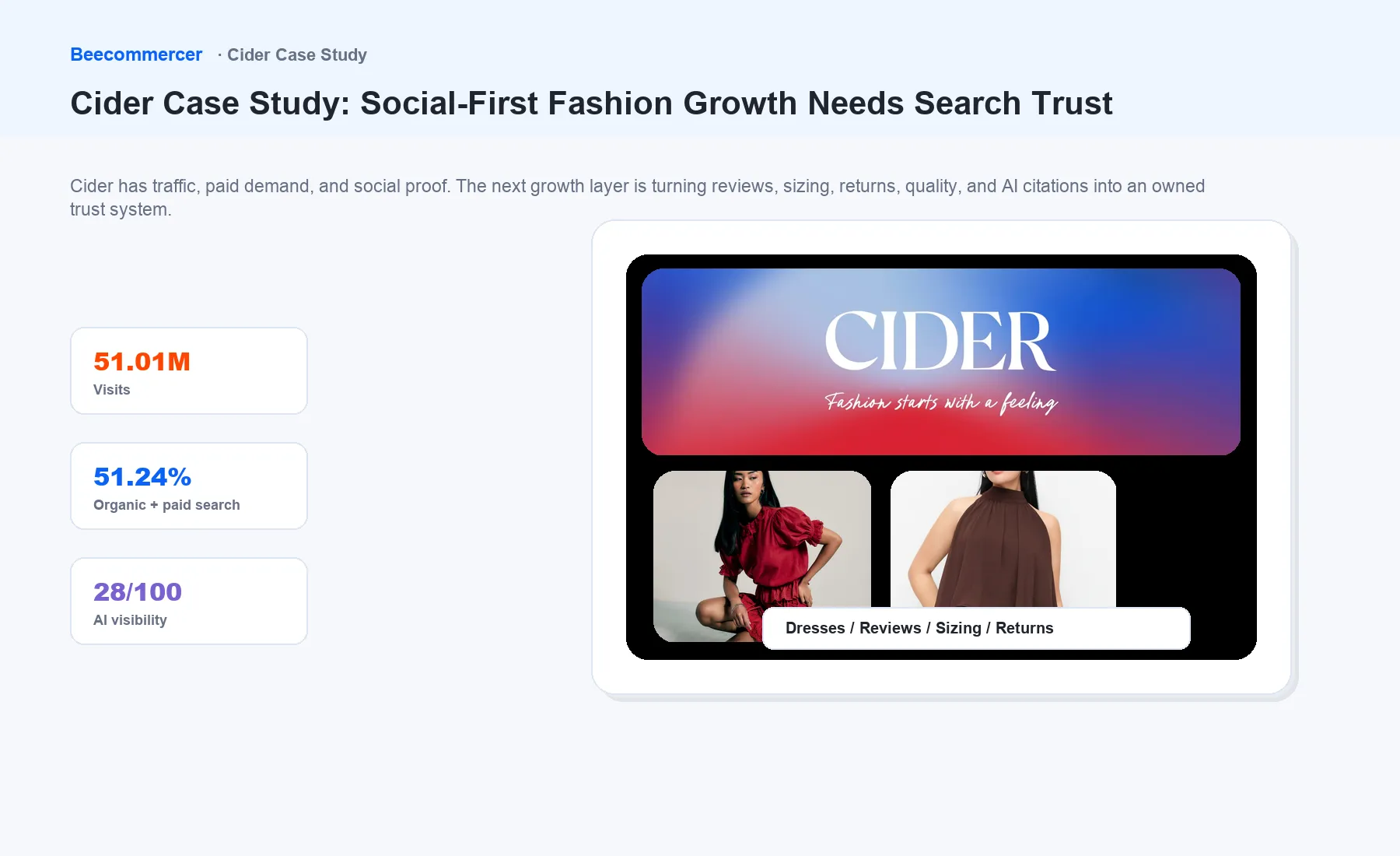
“Is Cider legit?” “How does the sizing run?” “Can I return it?” Those questions reveal the real conversion journey behind a social-first fashion brand. A creator post may win the click, but the order often waits for search, reviews, policy pages, and community proof.
Cider’s visible growth mechanism connects its global storefront, social-first brand positioning, fast-moving new-arrival cadence, and mood-led trend merchandising with paid demand, organic validation, customer evidence, and AI citations. The opportunity is not simply to create more attention; it is to make trust as searchable as style.
1. Ecommerce SEO and GEO key takeaways
- Cider already has destination scale. The site is large enough for SEO, paid search, lifecycle, and merchandising to compound rather than behave like isolated campaign channels.
- Search is a validation layer. Product demand sits beside questions about legitimacy, reviews, sizing, quality, returns, and alternatives.
- Merchandising creates a content graph. The Curve and Plus collection shows how fit, audience, style, and occasion can become connected landing-page clusters.
- Customer proof must be operationalized. Cider’s own community review gallery can support discovery only when reviews, materials, measurements, and use cases are easy to retrieve at product level.
- Trust pages are conversion and GEO assets. The sizing guide, returns and refunds policy, and support center answer the same questions that appear in search and AI responses.
2. Data snapshot and source scope
Similarweb estimates 51.01 million visits to shopcider.com from December 2025 through May 2026, or 8.502 million per month, with 5.83 pages per visit and a 44.41% bounce rate. The United States accounted for an estimated 46.98% of visits, followed by the United Kingdom at 14.38%, Germany at 7.36%, Canada at 4.86%, and France at 4.59%. These are modeled observations, not Cider analytics, orders, revenue, conversion, or market share; Similarweb explains the scope of its metrics in its website performance methodology.
The benchmark bars are scale context only. ASOS, Lulus, Princess Polly, Cider, and Rihoas have different market footprints, storefront structures, marketplace exposure, and measurement coverage. The chart is not a sales league table.
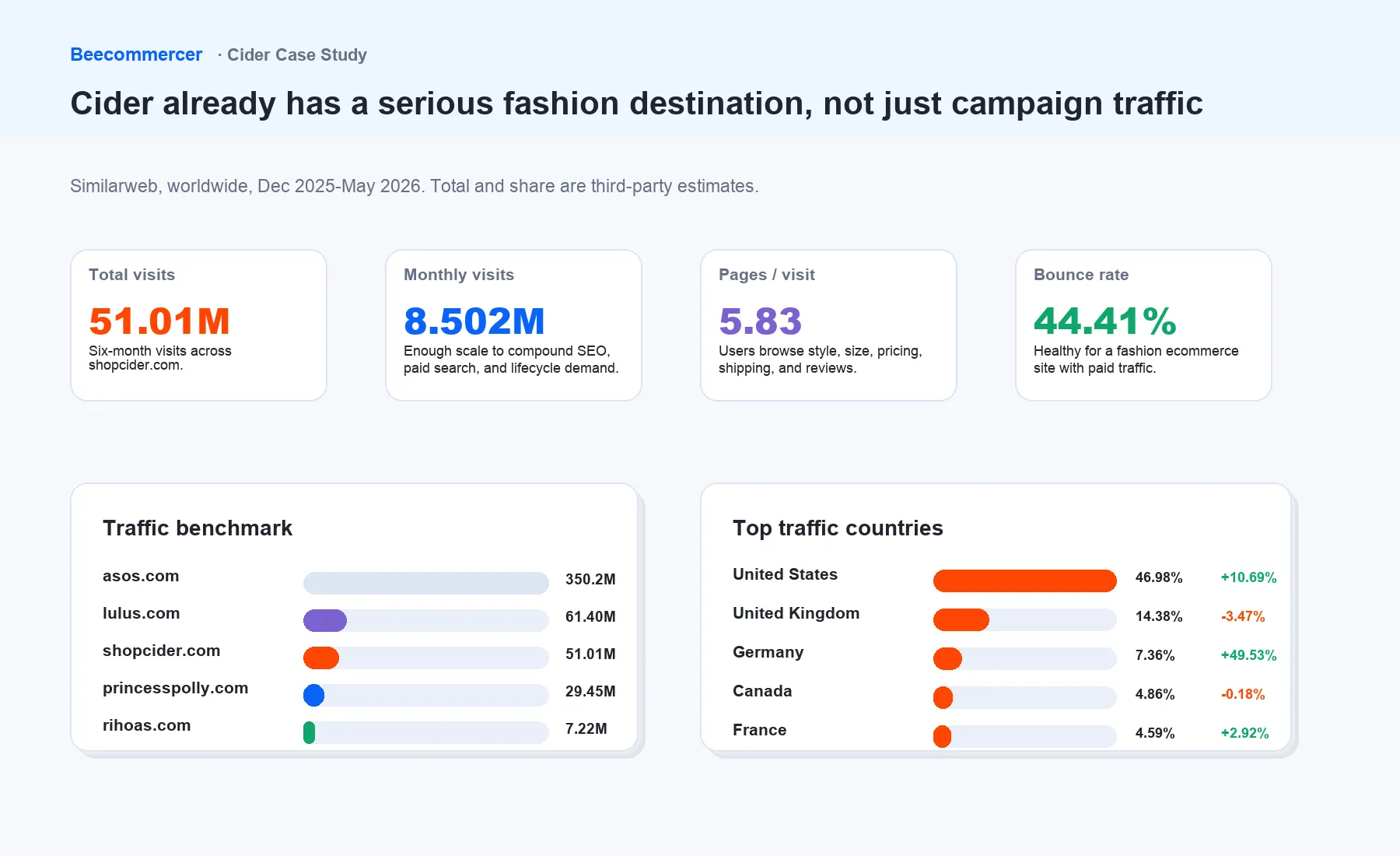
Source / scope: Similarweb Website Analysis, worldwide, December 2025–May 2026. Visits, engagement, benchmark traffic, country shares, and changes are third-party estimates.
The implication is strategic: at this scale, small improvements to category discovery, fit confidence, policy clarity, and repeat purchase can compound across millions of modeled visits.
3. Social discovery creates demand; search must close it
Organic search contributed an estimated 25.08% of traffic and paid search 26.16%. Organic and paid social added 8.62% and 10.09%, while direct traffic contributed 15.22%, display 6.89%, referrals 3.85%, generative AI 2.23%, and email 1.64%. Similarweb defines these buckets in its marketing-channel methodology.
The social mix shows how discovery travels: Facebook represented an estimated 60.78% of social visits, Instagram 22.94%, Pinterest 6.74%, YouTube 6.61%, Reddit 1.58%, and other sources 1.36%. Cider’s Instagram, TikTok, Pinterest, and YouTube are inspiration surfaces; the commercial job of the site is to preserve that desire while resolving fit and purchase risk.
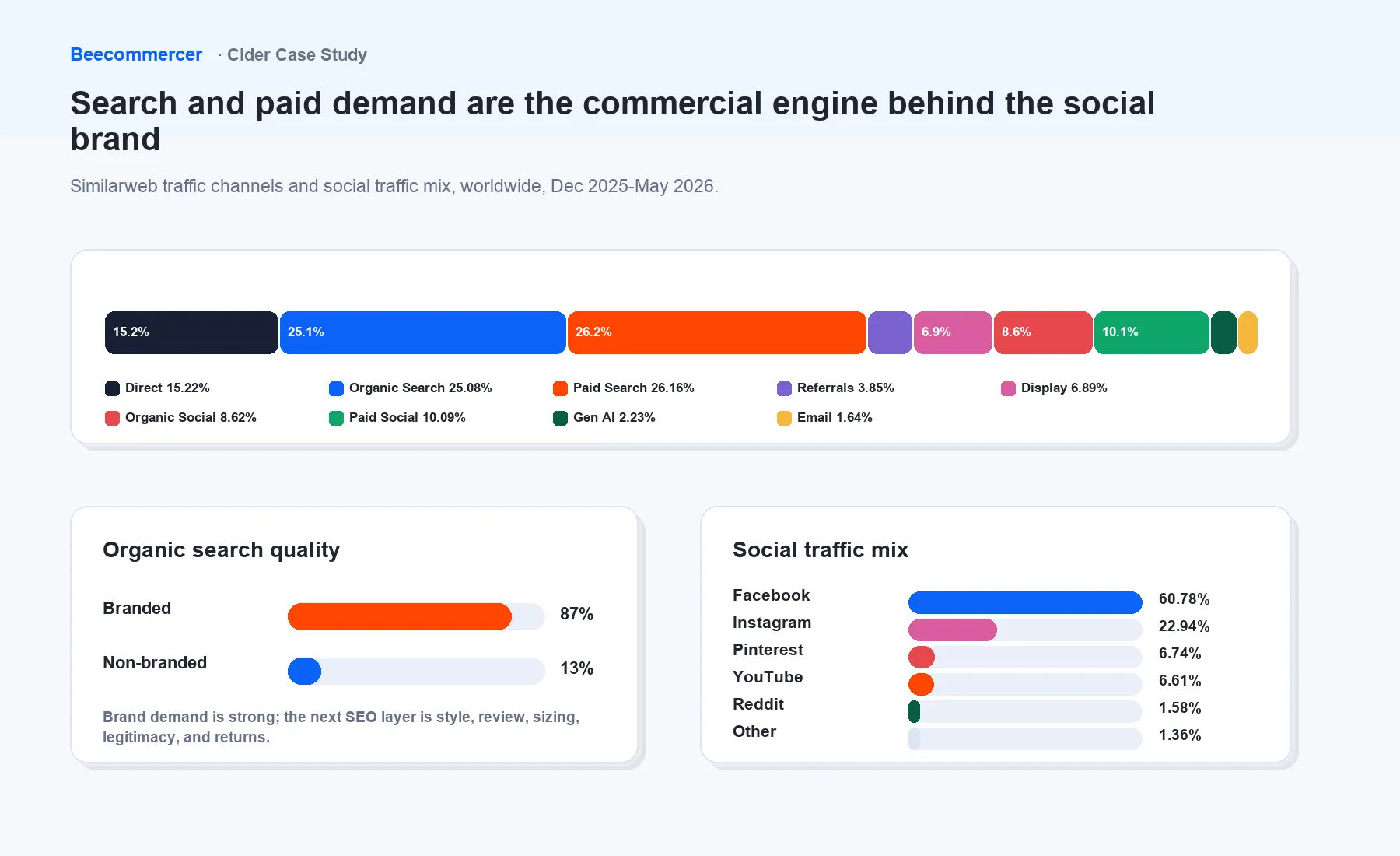
Source / scope: Similarweb Marketing Channels, Social Traffic, and organic branded/non-branded estimates, worldwide, December 2025–May 2026.
For operators, the split argues for one connected plan: creators and paid media generate demand, while search, product pages, policies, and lifecycle channels close and retain it.
The mobile path matters too. Cider’s iOS app and Android app extend merchandising and loyalty, while the official shipping page and order tracker resolve high-intent questions. Operators should connect those surfaces with consistent product, delivery, and policy facts rather than treat them as separate customer journeys.
4. Search demand combines product discovery with legitimacy checks
The Google Trends export for “cider clothing” shows a worldwide weekly index from June 2025 through June 2026, with a peak of 100 on November 23, 2025. The United Kingdom indexed at 100, Ireland 86, Australia 72, Canada 69, Jamaica 57, the United States 54, New Zealand 47, and the United Arab Emirates 25. Readers can inspect the underlying Google Trends query; Google’s data FAQ explains that values are normalized relative interest, not absolute search volume.
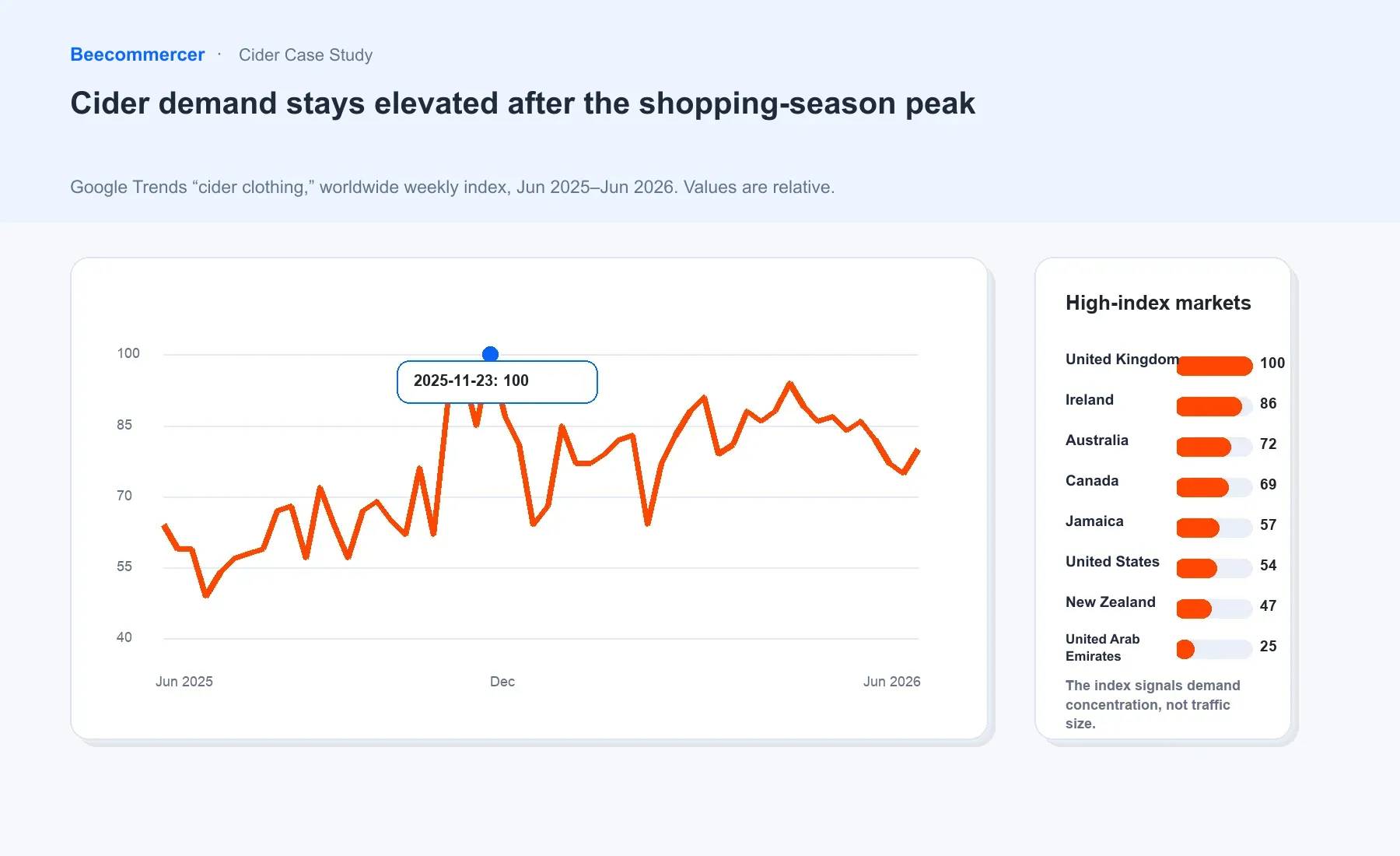
Source / scope: Google Trends, “cider clothing,” worldwide weekly index, June 2025–June 2026. Values are normalized relative interest, not traffic or sales.
High-index markets should receive localized fit, delivery, returns, and occasion content before more media is added; demand without trustworthy answers simply exports friction.
The related-query map mixes “cider dress,” reviews, UK shopping, legitimacy, location, India, Shein comparison, and irrelevant apple-cider noise. That is a reminder to filter ambiguous brand terms before planning content. Cider’s dress shop, wedding-guest collection, and party-dress category demonstrate how occasion and style pages can absorb product demand; trust questions still need dedicated answers.
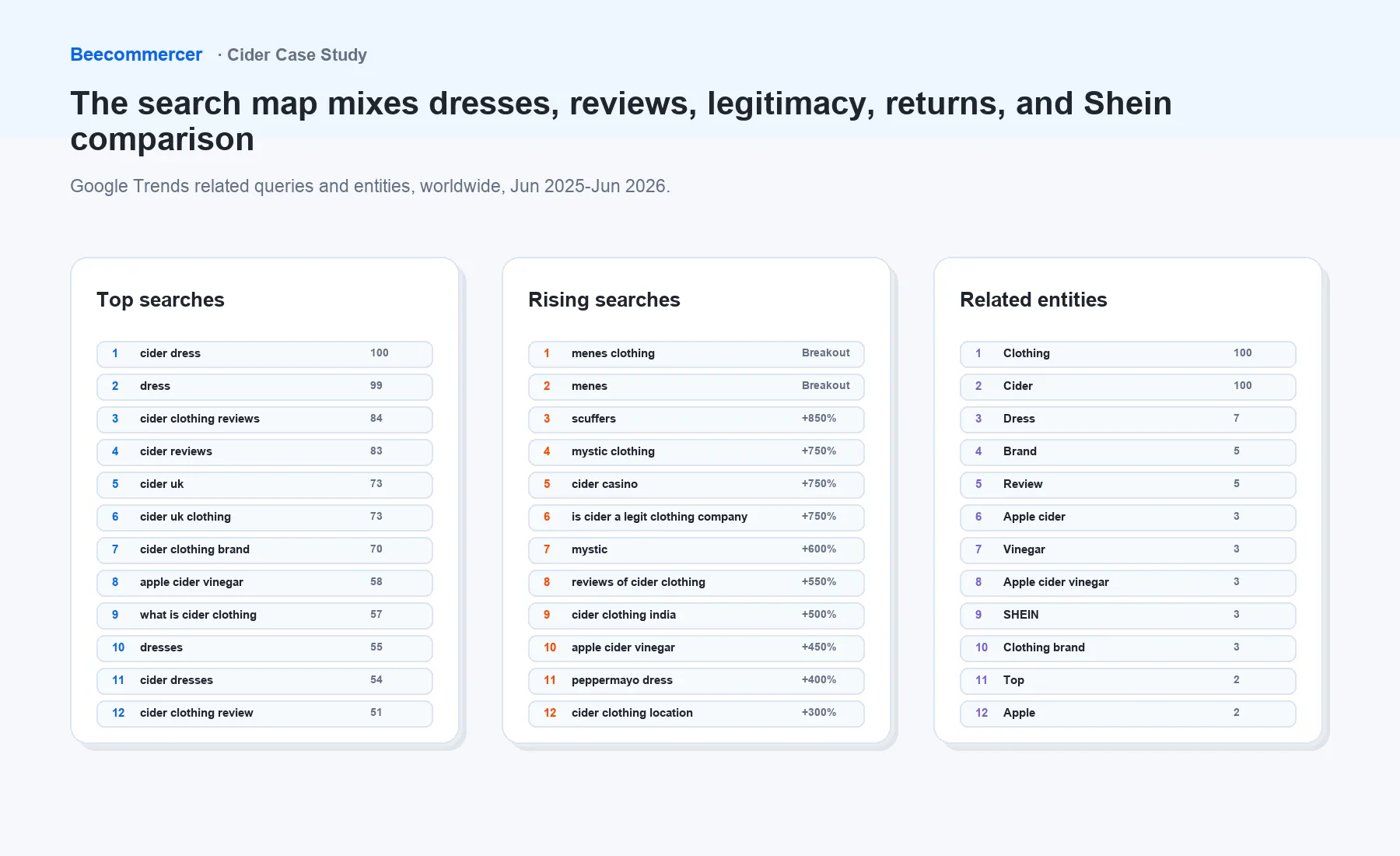
Source / scope: Google Trends related searches and entities for “cider clothing,” worldwide, June 2025–June 2026. Rising-query percentages are relative and can include ambiguous terms.
The action is to separate style and occasion clusters from trust clusters, then connect them with internal links so a shopper can move from inspiration to validation without restarting the journey.
5. The content moat is trust, not only trend coverage
Semrush’s June 2026 desktop snapshot groups Cider’s organic keyword set as 33.3% informational, 12.0% navigational, 33.2% commercial, and 21.5% transactional. Semrush describes the four intent classes in Keyword Overview and explains its machine-learning classification in keyword-intent methodology.
The top U.S. organic keywords shown in the export are overwhelmingly branded. Category growth therefore requires pages that connect style language to buying evidence: exact garment measurements, model context, fabric composition, care instructions, delivery expectations, and return consequences. Independent product testing from Reviewed, a hands-on Cosmopolitan review, and the live Trustpilot review stream illustrate why shoppers cross-check fit, quality, delivery, and service before buying.
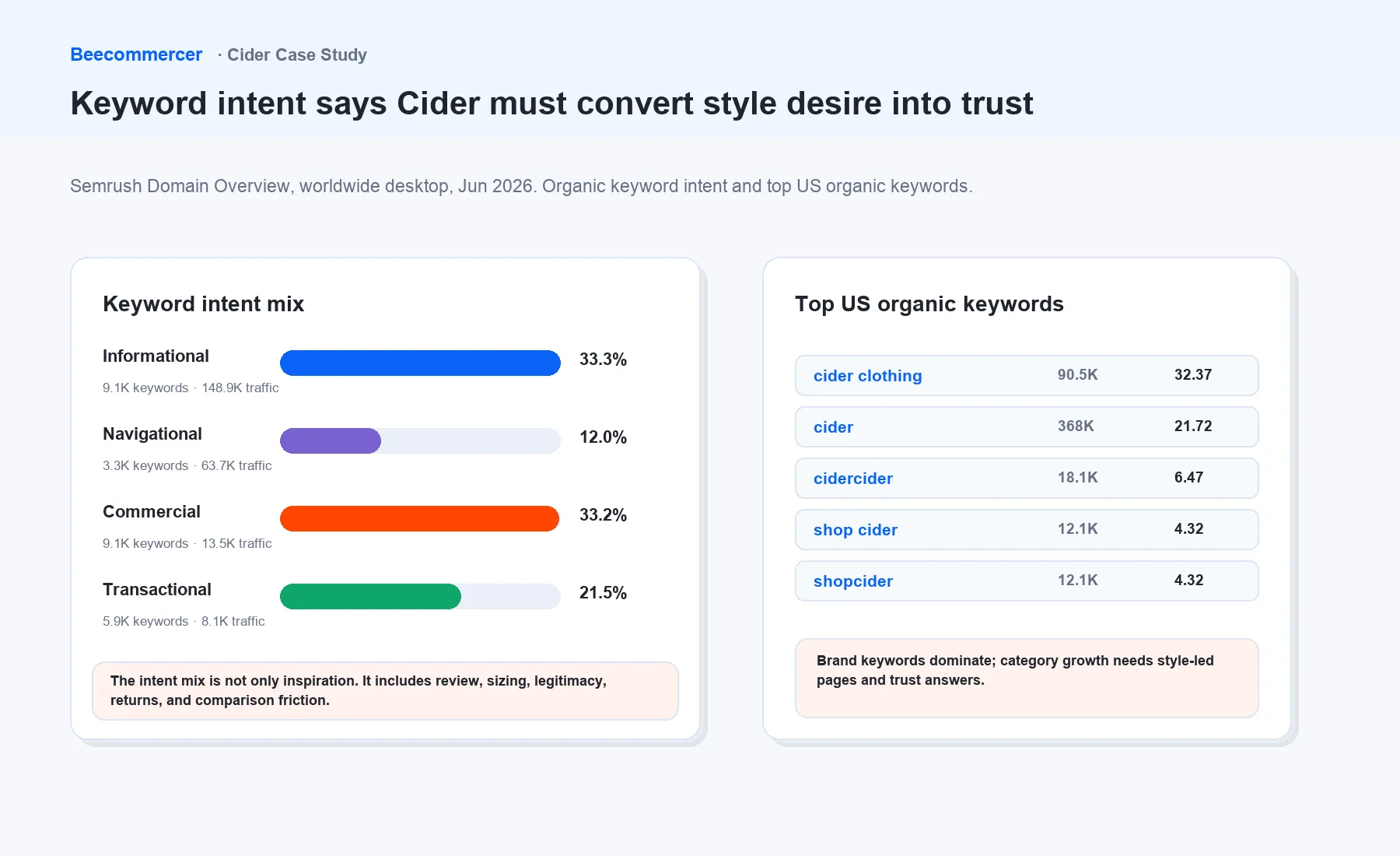
Source / scope: Semrush Domain Overview, worldwide desktop, June 2026. Keyword counts, traffic estimates, intent labels, volume, and positions are modeled third-party metrics.
That makes non-brand growth a content-design problem: useful category pages need editorial context, while trust pages need clear paths back to relevant products and occasions.
6. Reviews and community proof reveal the conversion risk
Community discussion is most useful as an objection map, not a representative sentiment score. A women’s-fashion thread mixes positive style experiences with complaints about quality, returns, and service; an Australian fashion discussion compares quality, sizing, and sustainability; a female-fashion-advice thread debates value and return ease; and a brand-legitimacy discussion asks whether expectations match delivery.
The operational response is not to argue with every comment. It is to make item-level proof easier to find: fabric and construction detail, garment and body measurements, review filters by size, photo evidence, delivery ranges, return fees, and market-specific policy summaries. Those assets improve SEO, conversion, support efficiency, and answer-engine retrieval at the same time.
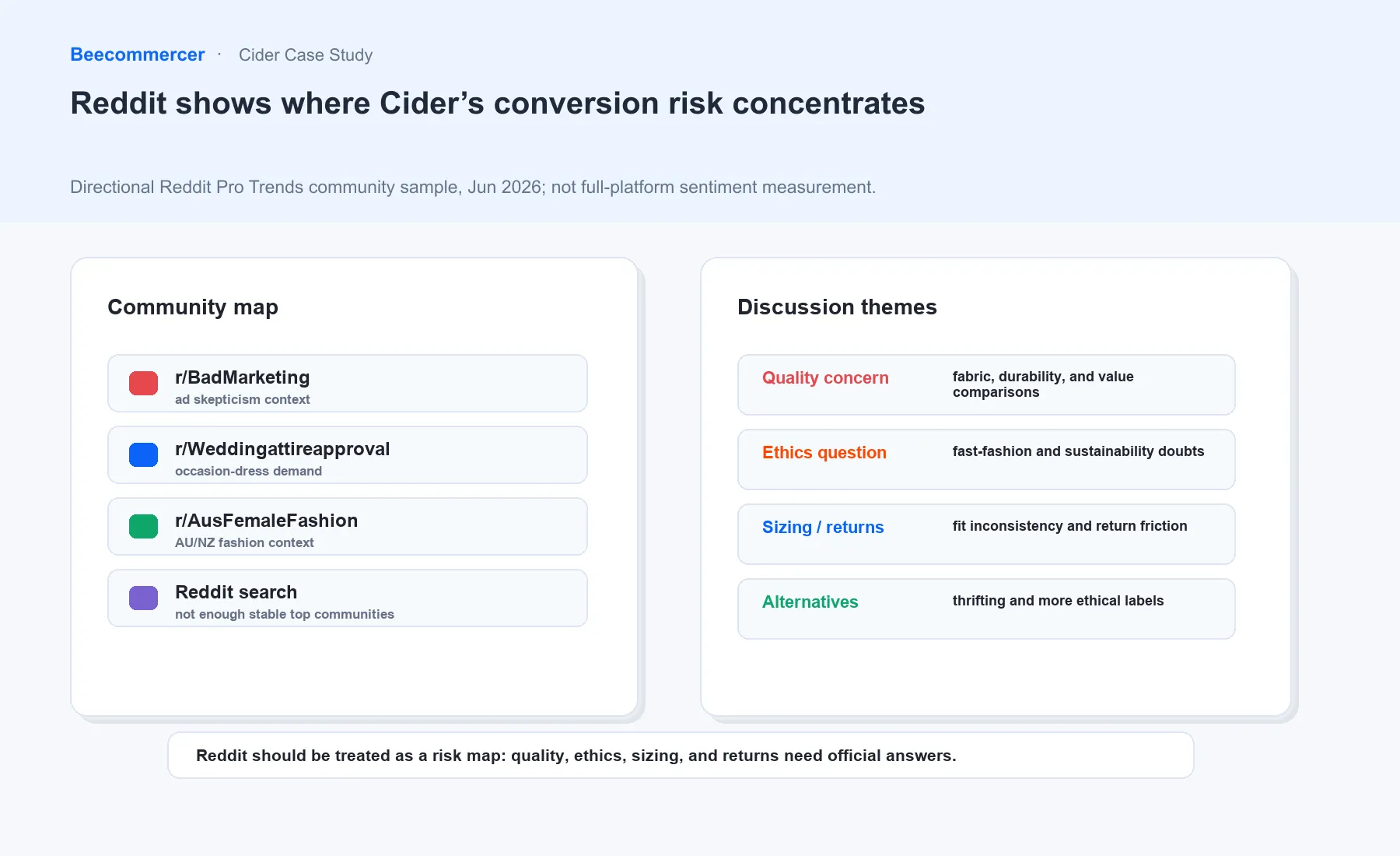
Source / scope: Directional Reddit Pro Trends community sample, June 2026, plus selected public discussions. Use as proof-and-risk mapping, not full-platform sentiment measurement.
Community monitoring should therefore feed a recurring content backlog: each repeated objection becomes a candidate FAQ, product-data field, comparison, policy clarification, or support update.
7. AI answers reuse distributed proof
Semrush’s June 2026 snapshot assigns Cider an AI Visibility score of 28/100, with 9,239 mentions, 1,247 citations, and 860 cited pages across the six-month view. The distribution shown is ChatGPT 37.8%, Gemini 33.2%, AI Mode 21.7%, and AI Overview 7.3%; the United States supplied 53.6% of observed mentions. Semrush’s AI Visibility Toolkit guide explains how these reports are used for benchmarking rather than attribution.
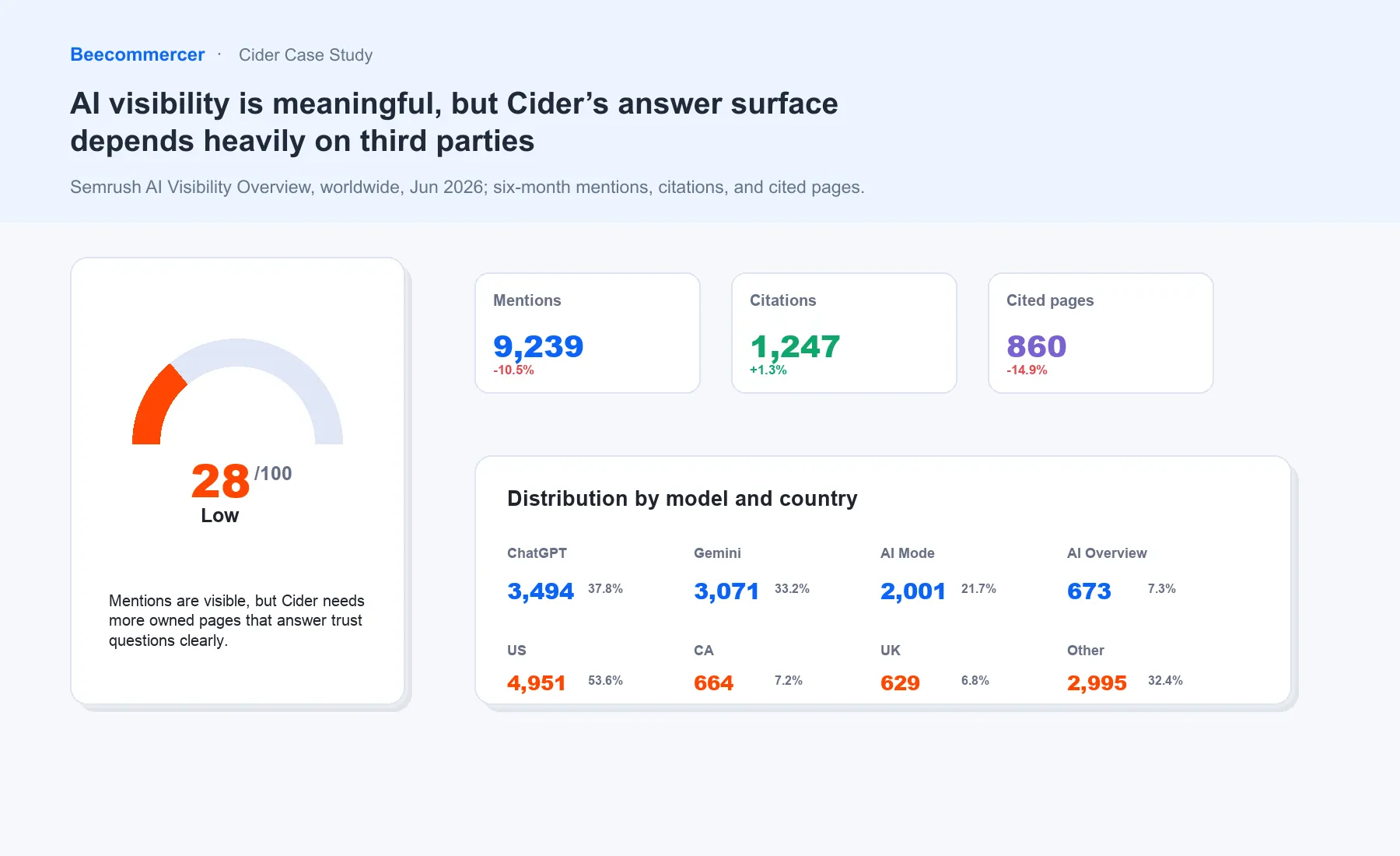
Source / scope: Semrush AI Visibility Overview, worldwide, June 2026; six-month mentions, citations, cited pages, model distribution, and country distribution.
The metric should be used as a benchmark, not a revenue proxy. The operational question is whether the answers describe products, fit, policies, and proof accurately enough to support the next click.
The cited-source graph is more actionable than the headline score. Reddit led the export with 1,887 cited prompts, followed by TikTok at 632, shopcider.com at 567, Who What Wear at 532, Etsy at 492, ASOS at 443, YouTube at 391, and Walmart at 391. Semrush’s Visibility Overview documentation defines cited sources and cited pages, while its AI data methodology explains the underlying prompt databases and update cadence.
Cider’s cited owned pages were concentrated in homepages, with smaller counts for About, return insurance, and sizing. That pattern suggests a content gap: answer engines can identify the brand, but model-specific fit, quality, delivery, return, and care evidence is not yet as prominent as the homepage.
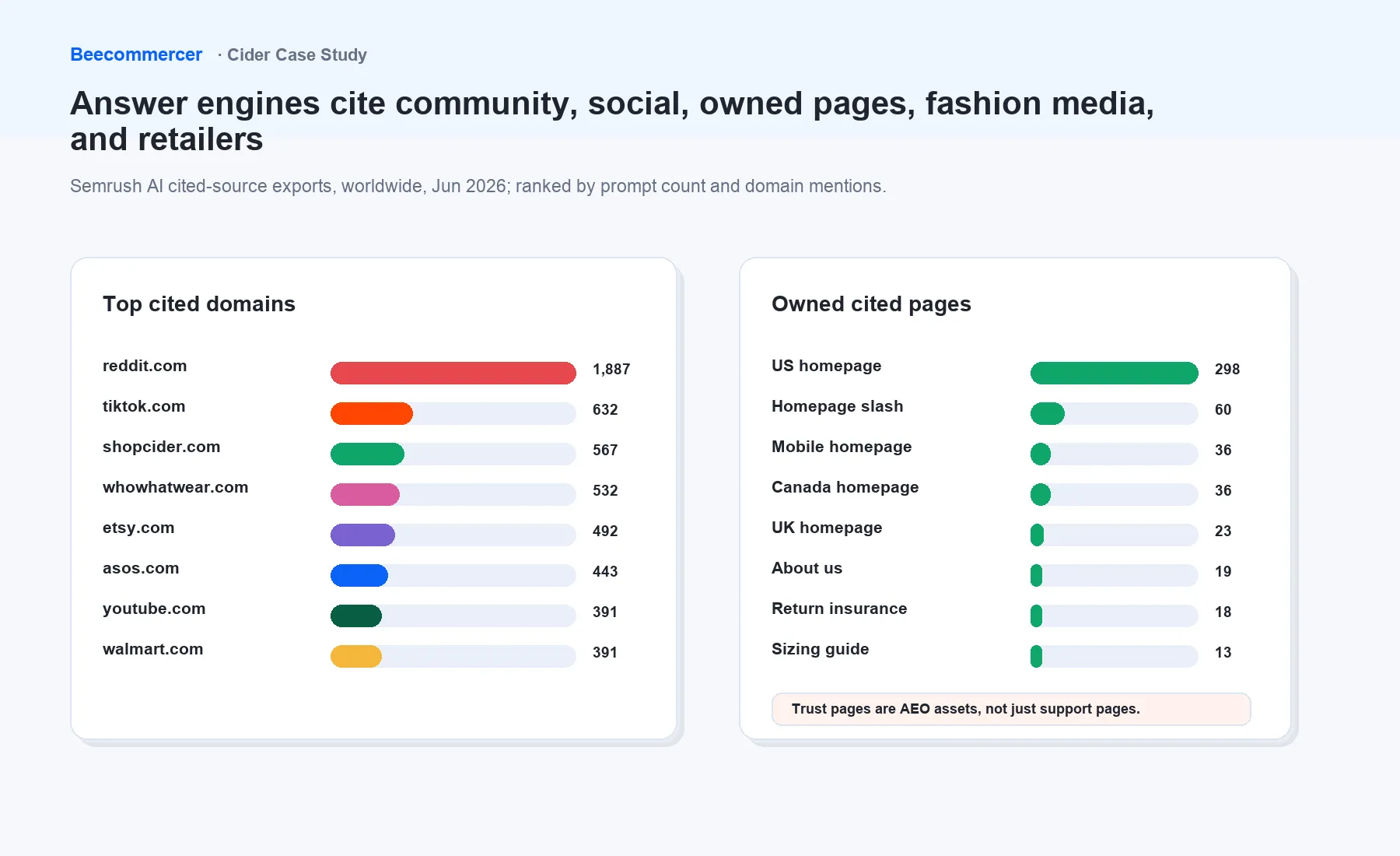
Source / scope: Semrush AI cited-source and cited-page exports, worldwide, June 2026. Counts reflect the observed prompt set and are not causal ranking weights.
Cider can increase answer quality by publishing specific, stable pages that independent reviewers and communities can corroborate—not by trying to replace third-party evidence with brand claims.
8. Market priority should connect inspiration, validation, and trust
The United States is the scale and AI anchor, with 46.98% of estimated traffic and 53.6% of AI mentions. The United Kingdom and Ireland show high relative search concentration. Australia and Canada combine high search interest with visible community questions, while Germany and France already contribute traffic and need localized sizing, delivery, and return clarity.
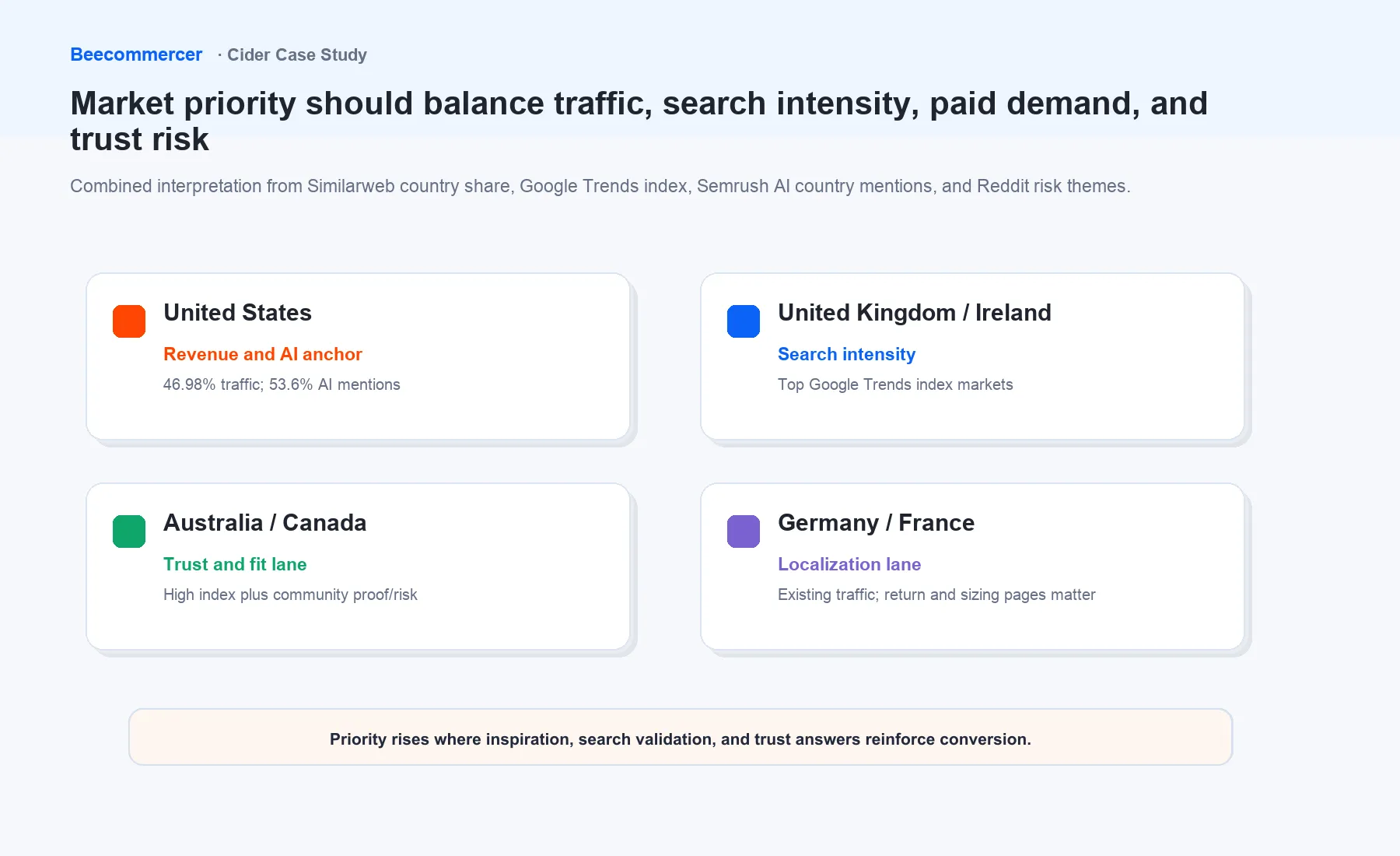
Source / scope: Beecommercer synthesis of Similarweb country shares, Google Trends relative indices, Semrush AI country mentions, and directional Reddit risk themes.
The priority is not one universal rollout. Each market needs the proof most likely to unblock its shoppers, translated into local policy, sizing, delivery, and occasion language.
The reusable operating model is a social-to-search trust flywheel: trend discovery creates desire; product and occasion pages capture style demand; reviews and policy pages reduce risk; community feedback exposes gaps; owned answers and third-party proof enter AI responses; better answers then support the next purchase. Cider’s published sustainability commitments belong inside that system too, because ethics claims need the same discoverable evidence boundaries as sizing or returns.

Source / scope: Beecommercer operating-model synthesis based on the cited traffic, search, keyword, community, official-site, and AI visibility evidence.
The flywheel works only when ownership is clear: merchandising supplies product truth, growth teams create demand, content answers questions, support closes gaps, and analytics shows which objections still interrupt conversion.
9. Frequently asked questions
What is the main SEO lesson from the Cider case study?
Cider shows that social discovery should be paired with searchable trust. Category and occasion pages capture product demand, while sizing, materials, reviews, delivery, returns, and comparison content resolve the questions that delay conversion.
Why does Cider matter for GEO and AI visibility?
AI answers already reuse Reddit, TikTok, media, retail, and shopcider.com evidence. Cider matters for GEO because the brand narrative is distributed across those sources, so owned pages must provide clear, specific facts that third parties and answer engines can verify.
What should other fashion ecommerce brands copy from Cider?
Copy the connection between fast merchandising and demand capture, then strengthen it with item-level measurements, review evidence, policy clarity, market localization, and a repeatable process for turning community objections into useful content.
Is this case study based on private Cider data?
No. It uses third-party estimates, normalized search interest, public community samples, public brand pages, and editorial synthesis. It does not use Cider’s private analytics, orders, revenue, conversion rate, or internal customer research.
10. Full methodology and editorial note
Traffic and channel figures come from Similarweb estimates for December 2025 through May 2026. Search-interest figures come from Google Trends for June 2025 through June 2026 and are normalized indices. Keyword intent and AI visibility figures come from Semrush exports dated June 2026. Community evidence is directional and not representative sentiment measurement.
Beecommercer separated observation from inference: the figures report what the selected tools displayed; the text interprets how those public signals may affect ecommerce content, conversion, support, market prioritization, and GEO. Competitor traffic is context rather than a sales ranking, and cited-source counts are evidence-distribution signals rather than causal AI ranking factors.