

Last updated on July 19, 2026 at 5:06 PM
Before a buyer reaches DJI’s checkout, they may have watched a flight test, compared Mini and Air models, checked controller compatibility, searched local flying rules, and read a troubleshooting thread. That research path is not peripheral to the sale; it is the ecommerce system.
DJI’s visible ecosystem can turn each product launch into a network of demand and proof. Product-family names organize search, creators demonstrate what specifications mean in practice, support content resolves setup friction, and third-party evidence becomes reusable in both search results and AI answers. The visible advantage is not one product page. It is a connected evidence trail that follows the buyer from curiosity to confident selection.
1. Ecommerce SEO and GEO key takeaways
- Search is a conversion surface. In the historical December 2025–May 2026 Similarweb export supplied for this case, organic search was the largest estimated traffic channel to dji.com.
- Product families make launch demand reusable. Mini, Mavic, Air, Avata, Neo, Osmo Pocket, and Osmo Action give buyers a stable vocabulary for discovery, comparison, setup, accessories, and upgrades.
- Creator proof translates hardware into outcomes. Flight tests, sample footage, tutorials, and workflow demonstrations answer questions that specifications alone cannot settle.
- Community friction is an editorial map. Model choice, compatibility, flight safety, regulation, availability, and accessory questions can become stronger product, comparison, support, and FAQ content.
- AI visibility is distributed. The June 2026 Semrush snapshot reviewed here showed citations spread across DJI-owned pages, YouTube, Reddit, retailers, publishers, and other evidence surfaces.
2. Data snapshot and source scope
This analysis combines a historical Similarweb Website Analysis export for dji.com, non-public Semrush Domain Overview and AI Visibility exports, a saved worldwide Google Trends view for “dji”, official DJI product and support information, hands-on reviews, and a directional sample of public Reddit discussions. The current public Similarweb profile is a moving view and does not reproduce the saved period.
| Metric | Observed signal | Evidence boundary |
|---|---|---|
| Website visits | 82.45 million, December 2025–May 2026 | Historical third-party estimate from the supplied Similarweb export, not DJI analytics or a current live total. |
| Monthly average | About 13.74 million visits | Beecommercer calculation: the six-month estimate divided by six, not a separate first-party metric. |
| Organic-search share | 56.96% of estimated traffic | Directional channel estimate for the historical measurement window. |
| Branded organic share | 85% of estimated organic search | Historical search-split estimate; it is not 85% of all search or all site traffic. |
| AI Visibility | 75/100, with 104K mentions, 30K citations, and 40.8K cited pages | June 2026 Semrush snapshot. “Cited pages” are pages on dji.com cited in sampled AI responses—not external pages citing DJI—and the prompt database changes over time. |
| Search-interest peak | Relative index 100 in April 2026 | Saved worldwide Google Trends export; the index is normalized and does not identify the cause of the peak. |
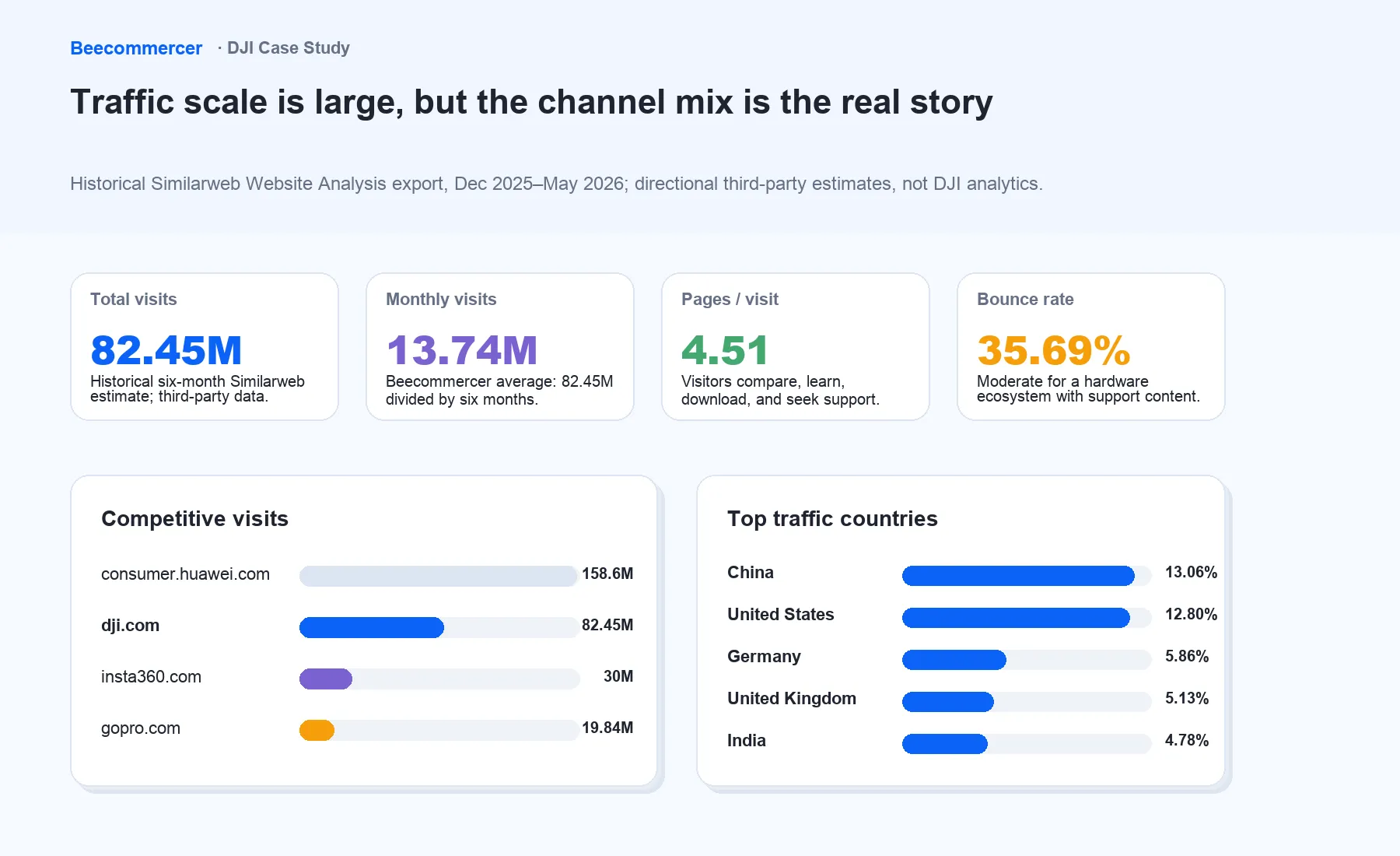
These are snapshots, not permanent brand facts. Similarweb estimates market traffic; Google Trends reports a normalized index rather than search volume; and Semrush measures visibility within a sampled, changing set of AI prompts. The public Semrush AI metric definitions explain the terms, but the DJI-specific snapshot analyzed here is not a public report.
3. Why DJI is a strong ecommerce case study
DJI gives creators tools for aerial and stabilized imaging, but the commerce opportunity extends far beyond a camera body. Its demand surface spans camera drones, handheld imaging, controllers, goggles, microphones, stabilizers, batteries, accessories, apps, firmware, manuals, and after-sales support.
That breadth creates a repeatable content moment around every release. A launch produces reviews, flight or shooting tests, comparison videos, sample footage, setup tutorials, compatibility questions, accessory decisions, regulatory questions, and repair or firmware searches. The DJI Download Center and product-specific support hubs keep part of that research inside the official ecosystem, while creators and communities provide independent context.
The mechanism compounds because new models inherit an existing vocabulary. A buyer already understands what Mini, Avata, or Osmo means before evaluating the latest version. Search demand does not reset to zero at every launch; it branches into model, use-case, comparison, and support queries that can reconnect shoppers to the right official page.
4. Search is the conversion surface
A historical Similarweb export used for this case estimated 82.45 million visits to dji.com from December 2025 through May 2026. Dividing that six-month estimate by six gives a Beecommercer-calculated average of about 13.74 million visits per month; it is not a separate Similarweb metric. In the same export, organic search represented an estimated 56.96% of traffic, compared with 23.17% direct and smaller shares from paid search, referrals, social, email, display, and other channels.
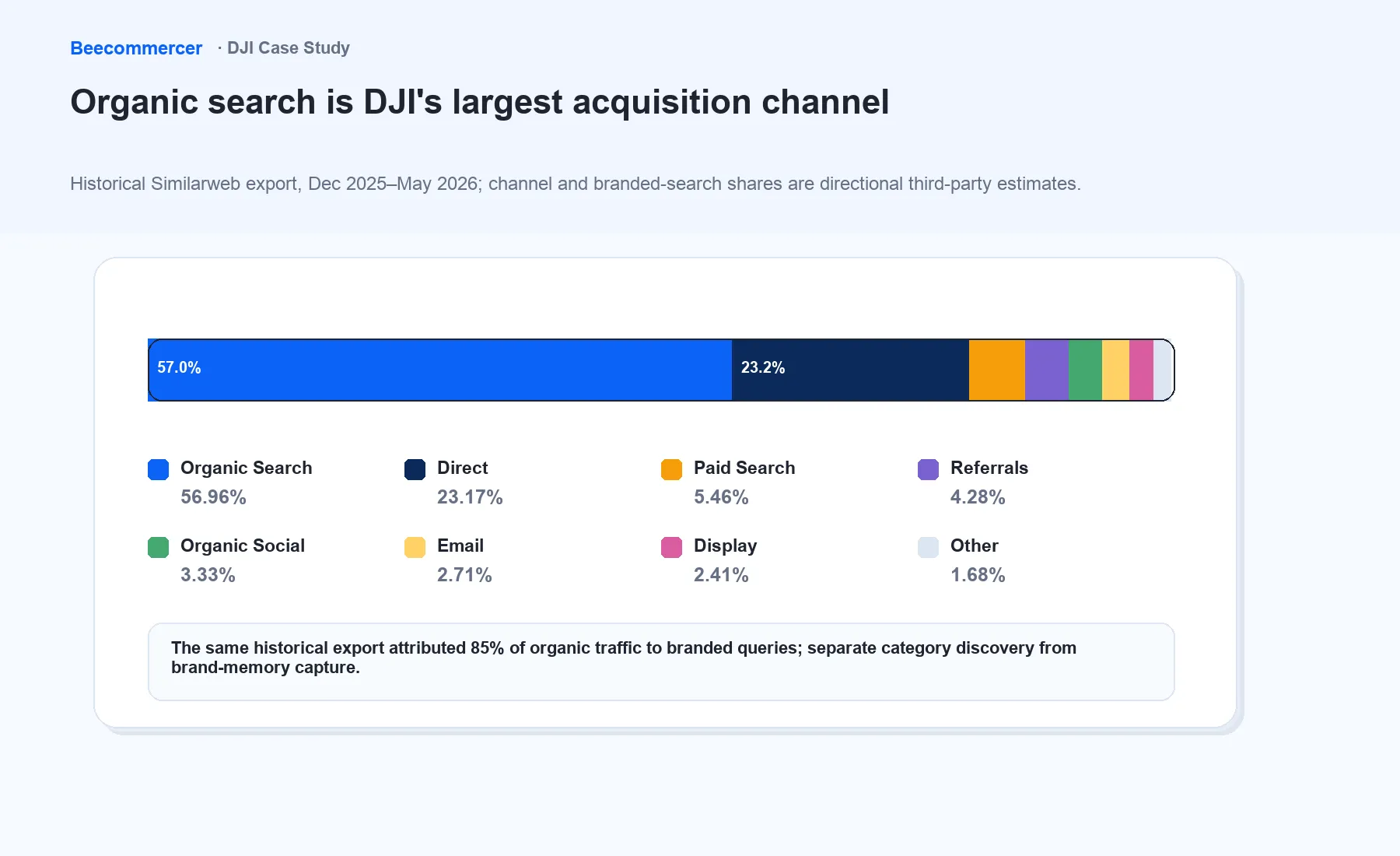
The export’s search split attributed 85% of organic traffic to branded queries. That does not make non-brand SEO unimportant. It is consistent with a pattern in which demand created by product launches, retailers, creators, events, reviews, and word of mouth becomes measurable when a buyer returns with a product-family or model query.
The non-public Semrush brand-topic export used for this analysis adds another layer. Informational intent led the weighted topic mix, but commercial and transactional topics remained meaningful. A shopper may learn about drone categories in one query, compare Mini and Air in the next, and look for a specific bundle or accessory later.

For operators, the practical unit is not a keyword list but a query-to-page system. Educational searches need explainers and legal caveats; comparison searches need stable criteria; transactional searches need clear model, bundle, market, and stock information; and navigational searches need a clean route to the right regional product or support page.
5. Product-family demand compounds across launches
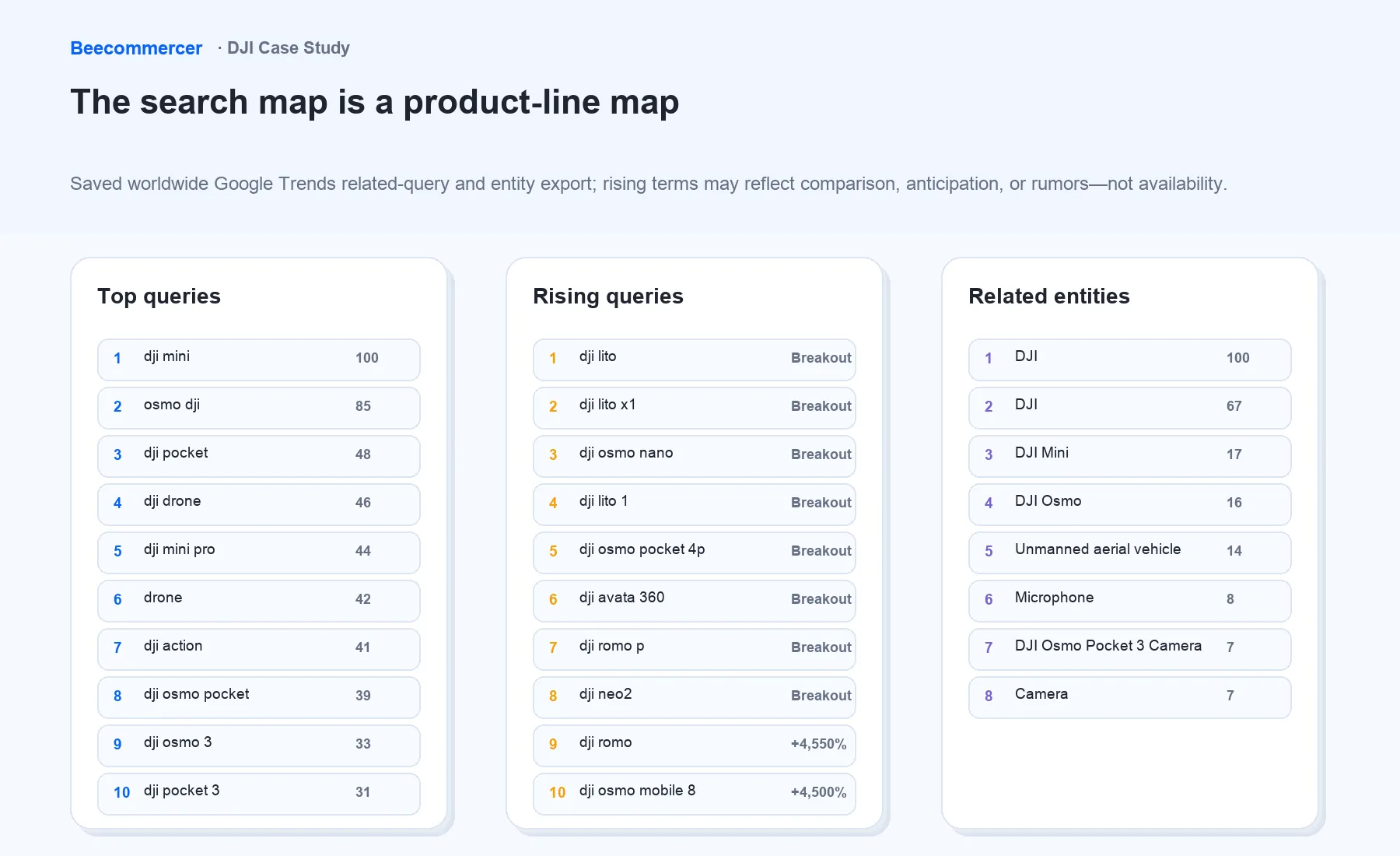
In the saved worldwide Google Trends export for “dji,” the highest relative-interest point in the selected June 2025–June 2026 period occurred in April 2026. The peak is consistent with a launch- or news-driven demand wave, but Google Trends alone does not identify the cause.

The related-query export reveals a catalog inside the search behavior. Top queries grouped around DJI Mini, Osmo, Pocket, drones, Action, and Pocket 3. Rising searches included product, comparison, rumor, and anticipation language. Under Google’s definition of top and rising queries, a breakout term signals growth in the selected window; it does not prove that a rumored product was available in every market.
DJI’s official architecture gives that demand a destination. Mini 4 Pro represents the lightweight camera-drone branch; DJI Neo frames a compact personal-videographer use case; and Avata 2 connects FPV flight with goggles and motion control. Handheld demand branches into Osmo Pocket 3 and Osmo Action 5 Pro.
The strongest family page does more than list models. It explains who the family is for, how versions differ, which controller, battery, app, or accessory is compatible, and what changes after purchase. Product-specific hubs such as Mini 4 Pro support and Osmo Pocket 3 support extend the search surface into tutorials, firmware, FAQs, and troubleshooting.
6. Creator and community proof reduce buyer risk
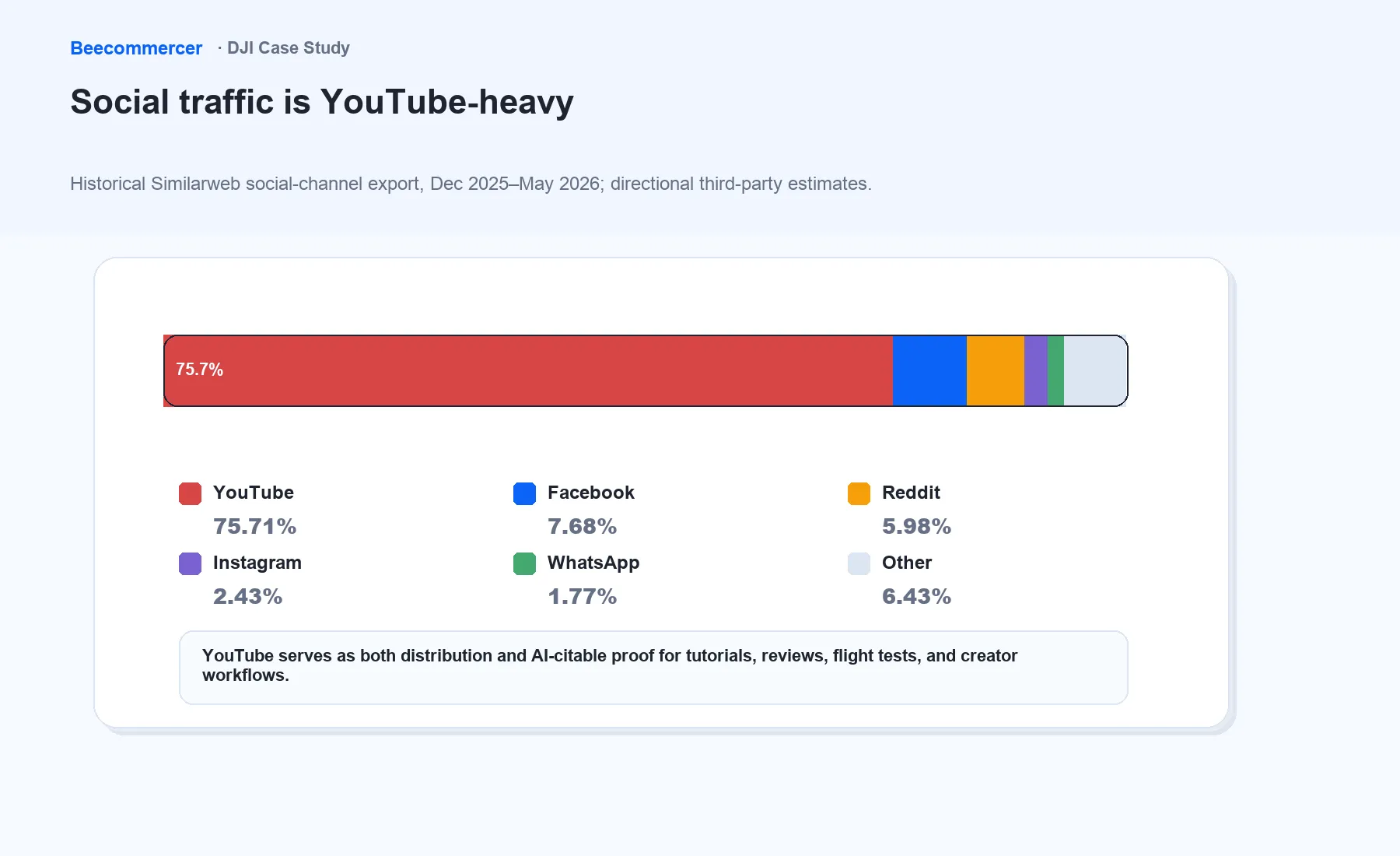
Creator hardware is demonstrated before it is trusted. In the historical December 2025–May 2026 Similarweb social-traffic estimate supplied for this case, YouTube represented 75.71% of modeled social referrals to dji.com, ahead of Facebook, Reddit, Instagram, WhatsApp, and other sources. That pattern fits a category in which buyers want to inspect footage, stabilization, tracking, controller behavior, wind performance, setup, and editing workflow.
Owned tutorials establish the intended workflow, while independent reviews supply a different kind of proof. TechRadar’s hands-on Mini 4 Pro review, its Osmo Pocket 3 review, and DC Rainmaker’s beginner guide help buyers evaluate trade-offs and workflows that official specifications cannot communicate alone.
Community threads surface earlier-stage friction. The sampled discussions included questions about first-drone setup and safety, Air 3S versus Mini 4 Pro, whether Neo fits a first-time buyer, and Osmo Pocket 3 accessories. These are directional examples of buyer language, not a representative measurement of Reddit sentiment.
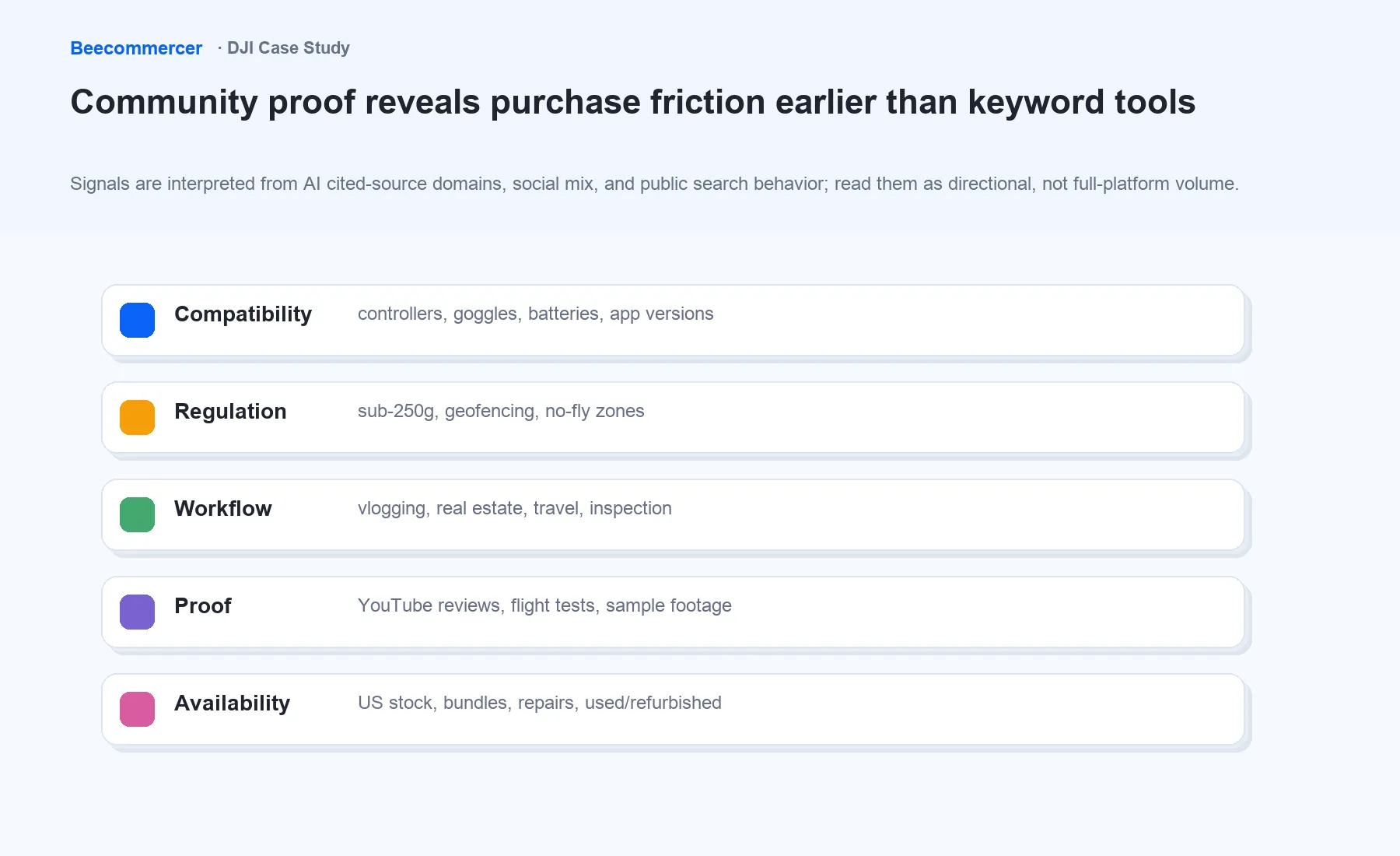
Regulation requires an additional boundary. DJI FlySafe can support product geofencing and flight planning, but legal requirements come from the relevant aviation authority. US content should link to FAA recreational-flyer rules; EU content should use EASA Open Category guidance. Weight, registration, Remote ID, and operating rules should never be generalized across markets.
The useful workflow is closed-loop: collect recurring questions, verify the answer with product and legal specialists, publish a durable owned explanation, and give creators and retailers the same approved facts. Community friction then becomes both conversion support and better evidence for search and AI systems.
7. AI answers reuse distributed proof
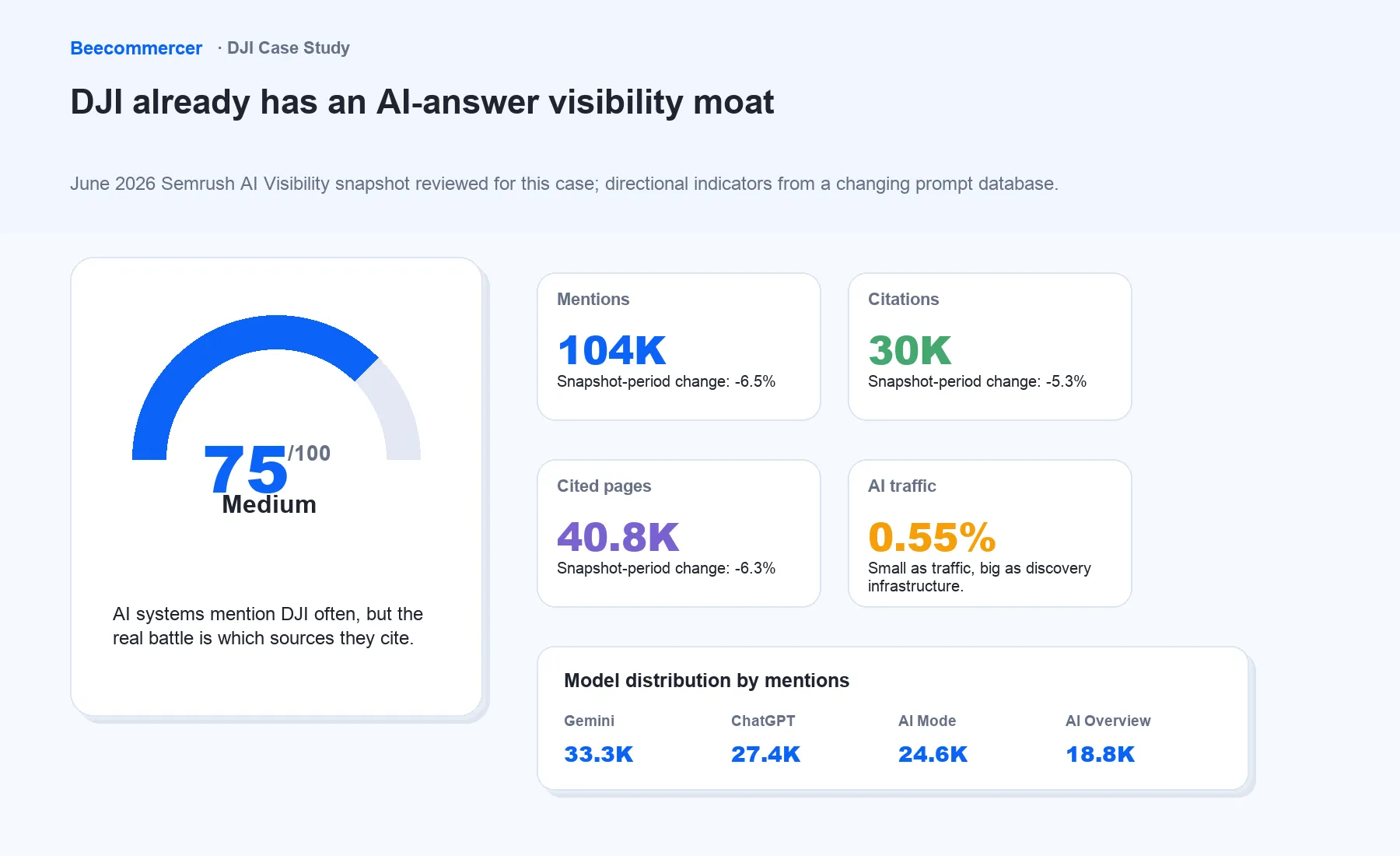
In a June 2026 Semrush AI Visibility snapshot reviewed for this case, DJI recorded a 75/100 visibility score, 104K mentions, 30K citations, and 40.8K cited pages. Under Semrush’s metric definitions, Mentions are tracked prompts whose responses include the brand, Citations are AI responses that cite the analyzed domain, and Cited Pages are pages on dji.com cited in those AI responses—not external pages that cite DJI. These figures should be read as a dated, directional evidence map rather than a universal count of every AI answer or buyer.
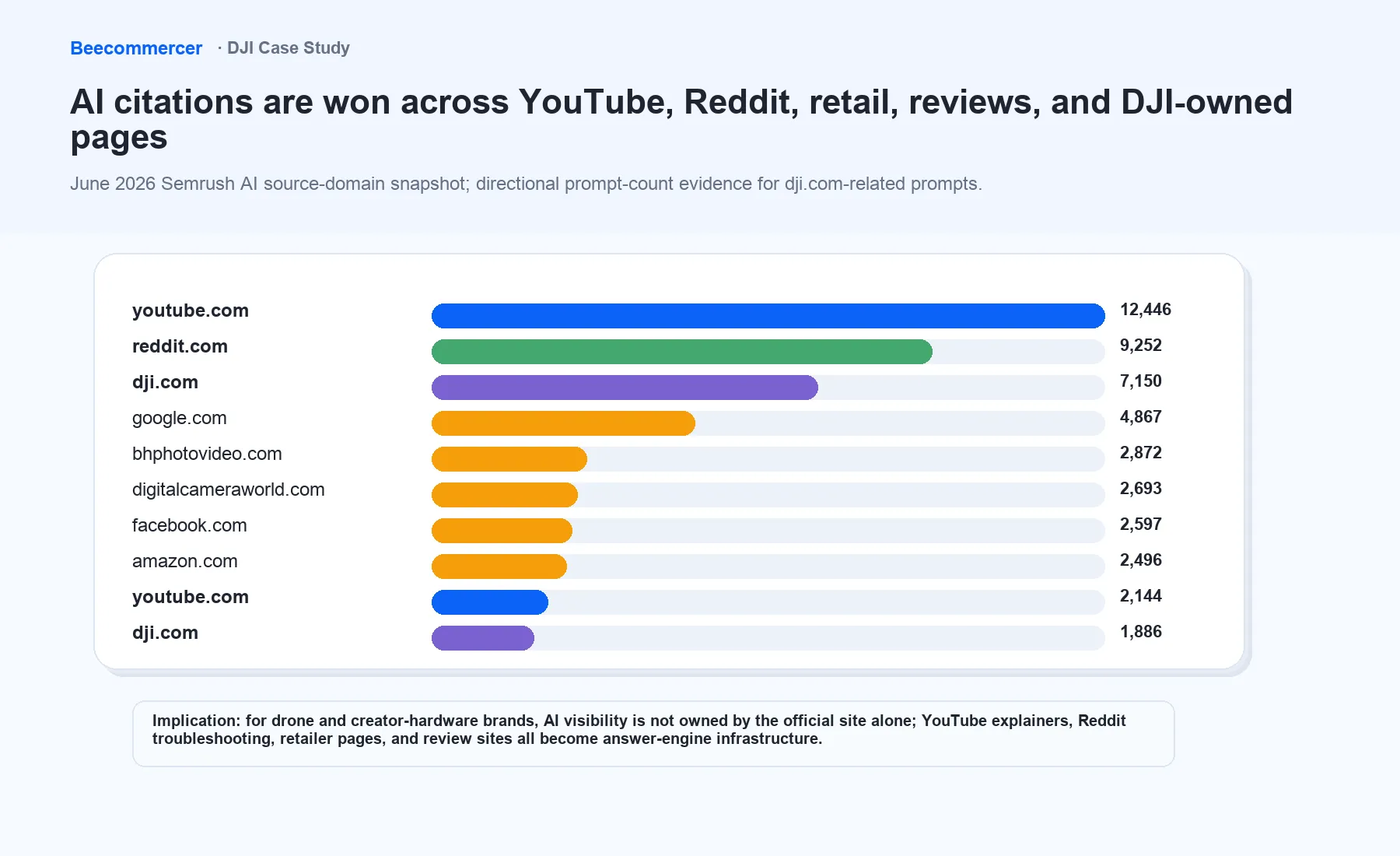
The source mix matters more than the headline score. The same export surfaced YouTube, Reddit, dji.com, Google, B&H Photo Video, Digital Camera World, Amazon, Facebook, and other sources around dji.com-related prompts. Official specifications and support pages remain important, but answer engines also reuse creator demonstrations, community troubleshooting, retailer availability, and independent review logic.
GEO therefore starts with evidence design, not a separate layer of generic AI copy. Product entities should be explicit. Specifications and compatibility statements should agree across regions. Comparison criteria should be stable. FAQs should answer one question at a time. Important claims should point to durable proof, and support pages should show clear ownership and update signals.
8. What cross-border brands can copy
DJI’s visible system can be reduced to a practical loop: product families create repeatable demand; creators turn features into outcomes; search captures questions; official pages convert and support; communities expose friction; and the resulting evidence becomes available to future shoppers and AI answers.

Teams do not need DJI’s market position or launch cadence to apply the model. They need a consistent route from product naming and evidence creation to decision support and conversion.
- Give every product family a durable buyer promise. Make the hierarchy understandable without requiring shoppers to decode model numbers first.
- Build a query map before a content calendar. Connect each family to category, comparison, compatibility, setup, safety, regulation, workflow, accessory, repair, and upgrade questions.
- Design launches as evidence programs. Prepare specifications, comparison tables, sample outputs, tutorials, FAQs, creator briefs, and support pages before attention peaks.
- Separate demand creation from search capture. Treat branded queries as a recall signal while measuring creators, retailers, events, paid media, reviews, and communities as upstream influences.
- Turn demonstrations into page-level proof. With permission and attribution, connect creator tests and review findings to the exact claims and use cases they help buyers evaluate.
- Convert recurring friction into structured answers. Community questions should become comparison criteria, compatibility tables, regional guidance, tutorials, support articles, or merchandising changes.
- Maintain one evidence vocabulary across channels. Product names, specifications, compatibility, use cases, and legal caveats should agree across the DTC site, support pages, retailers, marketplaces, and creator materials.
- Measure AI citations by source and topic. A visibility score cannot show whether the official domain explains the right questions or whether third parties carry most of the proof.
9. FAQ
What is the main SEO lesson from the DJI case study?
DJI makes complex hardware demand easier to capture by connecting stable product families to comparison, setup, accessory, safety, and troubleshooting questions. Cross-border brands can apply the same principle with clear product architecture and query-specific pages.
Why does DJI matter for GEO?
DJI shows how AI answers can reuse distributed proof from official pages, YouTube, reviews, retailers, forums, and communities. GEO improves when those sources agree on product entities, specifications, use cases, compatibility, and comparison logic.
What should ecommerce brands copy from DJI?
Brands should copy the mechanism rather than DJI’s market position: coherent product families, content for real buying questions, independent demonstrations, community-informed support, and sourceable facts that stay consistent across markets and channels.
Is this case study based on private DJI data?
No. It uses official public information, public web sources, a historical Similarweb estimate, a June 2026 Semrush snapshot, and a saved Google Trends view. It should not be read as DJI first-party analytics, revenue, conversion, or attribution reporting.
10. Full methodology and editorial note
The primary measurement window is December 2025 through May 2026 for the historical Similarweb website-analysis export, June 2026 for non-public Semrush Domain Overview and AI Visibility exports, and June 2025 through June 2026 for the saved worldwide Google Trends data for “dji”. The public Similarweb profile is linked only as current context and may not reproduce the historical snapshot. Product and entity context comes from DJI’s company overview, its official camera-drone and handheld portfolios, product pages, the Download Center, and support hubs.
The Similarweb visit and channel figures are modeled third-party estimates, and the 13.74M monthly figure is Beecommercer’s average of the six-month total. Semrush’s AI Visibility, mention, citation, and cited-page metrics describe a sampled, changing prompt environment and do not establish a direct ranking factor or sales effect. Google Trends values are normalized indices, not search volumes, and the April peak does not prove a specific cause. Reddit observations are directional examples of buyer language and objections, not full-platform volume or sentiment.
Beecommercer prepared this analysis independently from public and supplied research signals. It is not sponsored by DJI and does not claim access to DJI’s private analytics or commercial performance data.