

Last updated on July 25, 2026 at 10:25 PM
EcoFlow’s AI citation footprint contains a revealing clue: several highly cited owned pages are not product pages. They explain US versus European voltage, AC versus DC current, watts-to-amps conversion, and electrical sizing questions. For portable power, education is not a side channel. It is part of how a buyer decides what a battery can run, whether it fits a local electrical system, and what could go wrong.
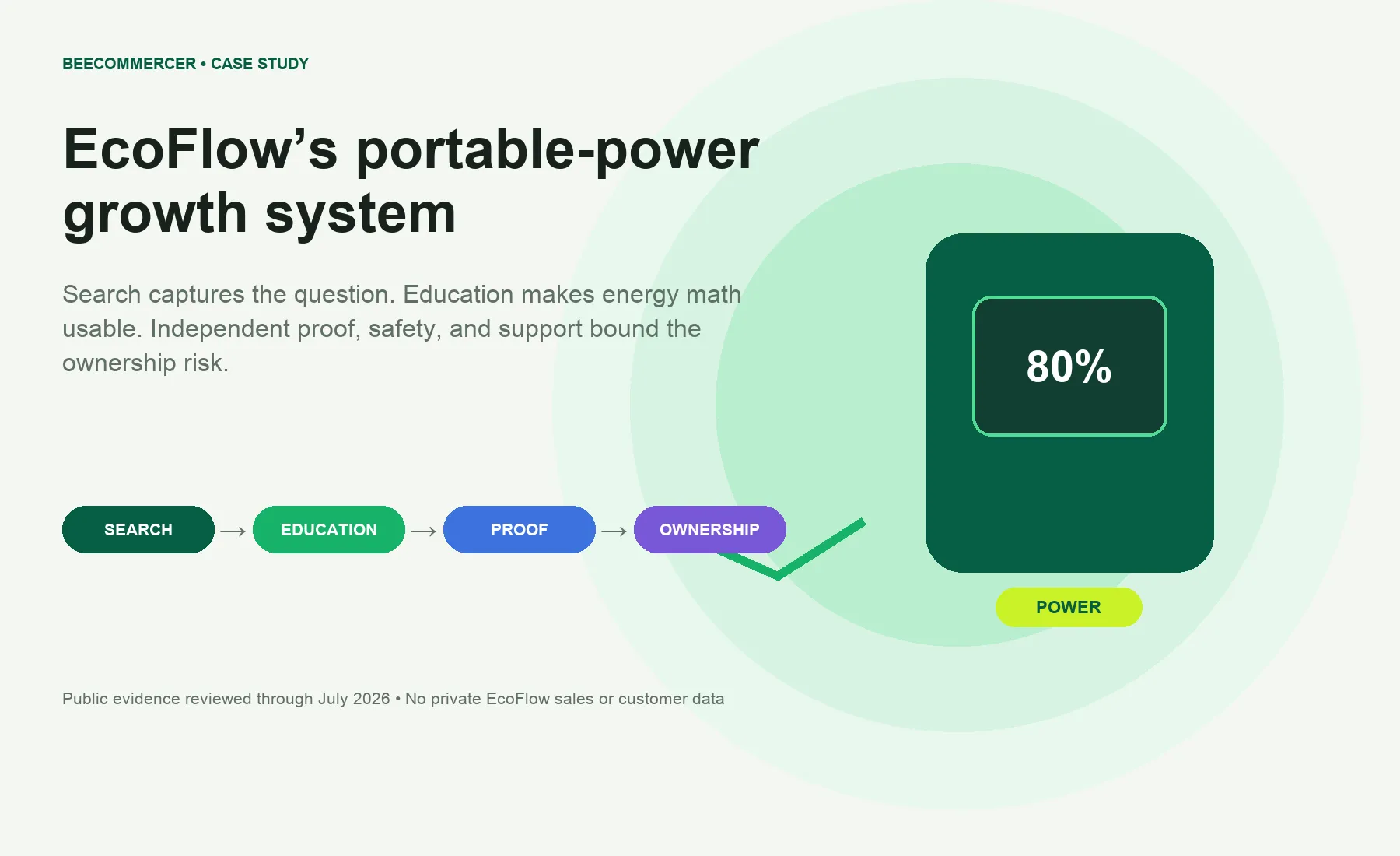
That makes EcoFlow a useful operating case for cross-border ecommerce. The company describes a portfolio spanning portable power, solar, and smart home energy on its official company page, while its portable power station range stretches from compact RIVER products to DELTA home-backup systems. The growth mechanism is a connected evidence system: search captures the question, education makes specifications usable, independent proof tests the promise, and safety, policy, and support information bound the ownership risk.
1. EcoFlow case study: key takeaways
Four findings matter most. First, Similarweb estimated 29.84 million visits to ecoflow.com from December 2025 through May 2026, a large public demand surface but not a measure of orders or revenue. Second, organic and paid search supplied an estimated 47.43% of visits together, so product discovery and technical education meet on the same results pages. Third, the saved Semrush snapshot gave EcoFlow an AI Visibility score of 53/100 and showed that answer engines reused both EcoFlow pages and independent sources. Fourth, community and safety evidence can change the purchase decision: public discussion includes successful outage and off-grid use, but also shipping, reliability, warranty, and service questions.
The operator lesson is not “publish more content.” It is to connect selection, use, risk, and ownership. EcoFlow already offers a DELTA comparison guide, a RIVER comparison experience, a support center, and a community hub. The growth task is to keep the claims, conditions, compatible products, regional policies, and next actions consistent across those surfaces.
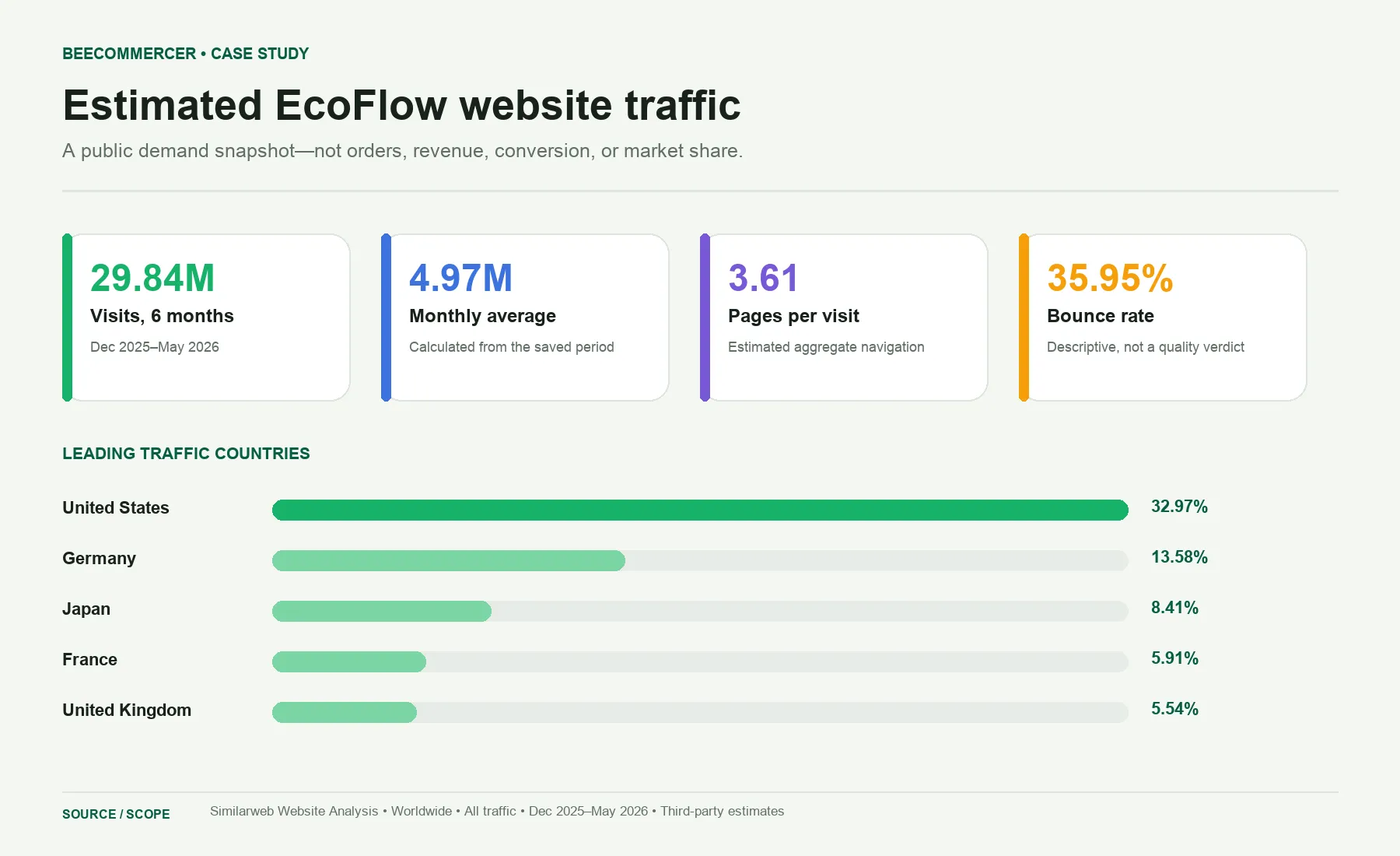
Source note: Beecommercer analysis of Similarweb Website Analysis for ecoflow.com, Worldwide, All Traffic, Dec 2025–May 2026. Similarweb defines the fields in its website performance documentation. Values are third-party estimates, not EcoFlow first-party analytics.
The scale makes small improvements potentially meaningful, yet it does not identify the pages, users, or markets that create commercial value. An estimated 3.61 pages per visit and 35.95% bounce rate describe navigation in aggregate. They do not prove purchase intent or page quality. The United States, Germany, Japan, France, and the United Kingdom led the observed country mix, but budget decisions still require EcoFlow’s own margin, inventory, conversion, returns, and support data.
2. Search concentration is more actionable than the traffic total
In the saved channel view, organic search accounted for 33.00% of estimated visits and paid search for 14.43%. Together they represented 47.43%. Direct traffic contributed 19.68%, display 12.82%, organic and paid social 9.52% combined, and the remaining displayed channels completed the mix. Similarweb explains these categories in its Marketing Channels documentation; they should be read as modeled acquisition shares, not incrementality or sales attribution.
For a considered battery product, search is a decision environment rather than a single channel. The results page can contain EcoFlow product pages, comparison guides, retailer listings, independent testing, videos, Reddit threads, safety notices, and support pages at once. Organic and paid teams therefore need the same evidence: capacity and continuous output, surge conditions, recharge assumptions, solar compatibility, dimensions, weight, regional voltage, warranty scope, and recall status where applicable.

Source note: Similarweb Website Analysis for ecoflow.com, Worldwide, All Traffic, Dec 2025–May 2026. The ten displayed shares sum to 100.00%. They estimate website visits by acquisition channel and do not show conversion, revenue, profit, or causal attribution.
The useful measurement plan starts below the channel total. Segment queries by brand, family, capacity, comparison, appliance, outage, solar, RV, setup, support, and safety intent. Then connect those segments to first-party impressions, qualified visits, assisted product views, orders, cancellations, returns, and service outcomes. A paid keyword can expose an unanswered question quickly; an organic answer can preserve the learning after the campaign ends.
3. Search demand moves from brand interest to energy math
Google Trends shows timing, not commercial volume. In the saved worldwide view for “EcoFlow,” the weekly index reached 100 in the week beginning March 29, 2026. Google explains that Trends data is sampled and normalized; 100 marks the relative peak for the selected query, geography, category, and time window. It does not equal searches, visitors, orders, or market size, and the data does not identify what caused the peak.
The geography panel is especially easy to overread. Cuba indexed at 100 while Ukraine indexed at 14 and Germany at 4 in this saved view. That can indicate concentrated relative interest in a smaller search base; it cannot justify market entry on its own. EcoFlow should treat unusual indices as investigation prompts, then validate distribution, electrical standards, service coverage, shipping restrictions, first-party demand, and customer economics.
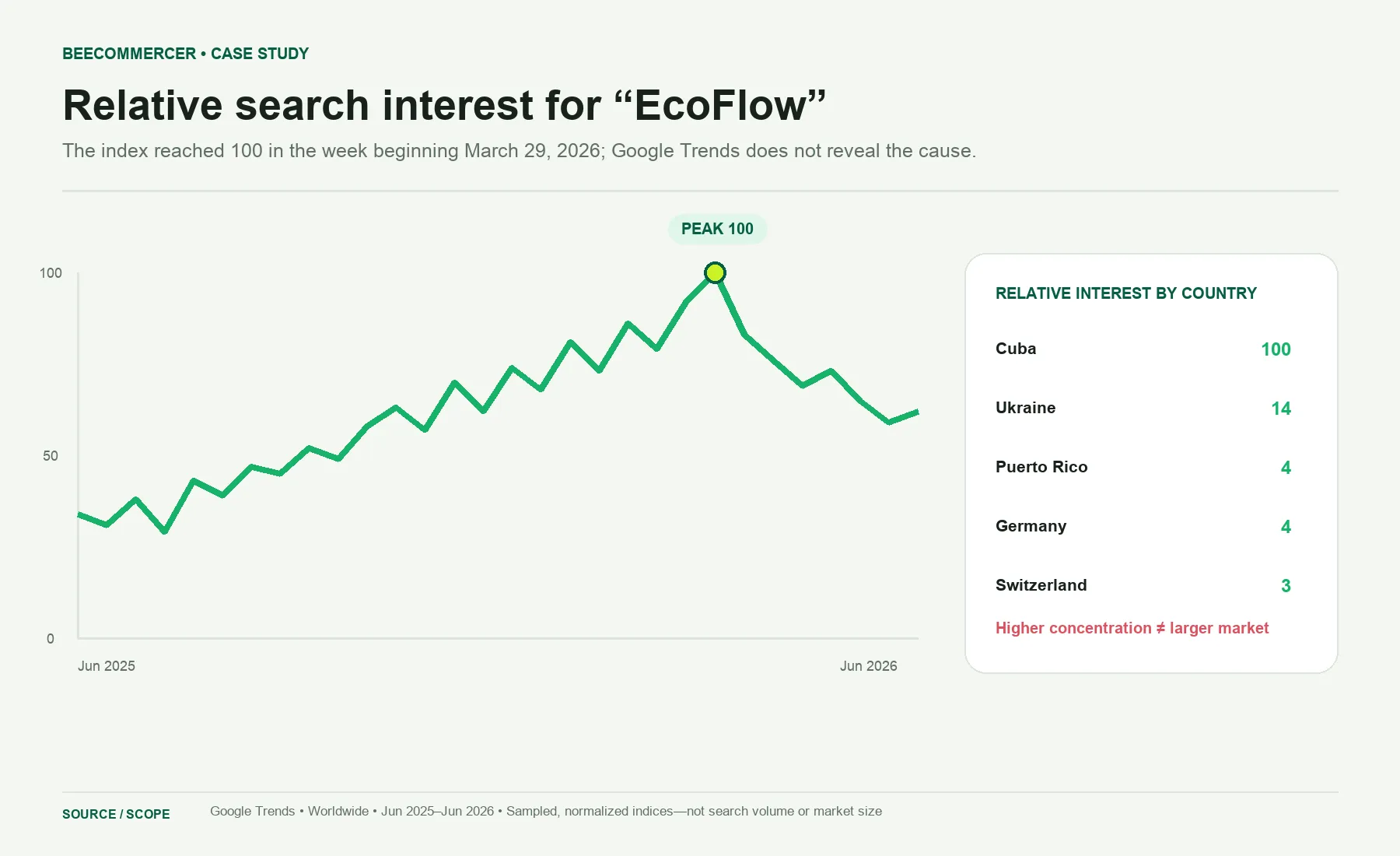
Source note: Google Trends export for “EcoFlow,” Worldwide, All categories, Jun 2025–Jun 2026. Values are sampled, normalized relative indices. No event is assigned as the cause of the peak, and country indices are not traffic or sales estimates.
Search becomes operational when the brand connects timing to query language. A spike should trigger a review of the landing pages, product families, comparison questions, and support topics that gained first-party impressions. Without that linkage, a trend chart is only an alert.
4. DELTA, RIVER, solar, and home backup create job-based demand
EcoFlow demand does not stop at the brand name. The saved related-query view was led by “delta ecoflow,” followed by EcoFlow Pro, DELTA 3, DELTA 2, RIVER, and other family or model terms. Relevant rising queries included DELTA 3 Classic, TRAIL 300, RAPID Pro X, DELTA Pro Ultra X, and DELTA 3 1000 Air. The export also contained unrelated “AI news” noise; those rows are excluded from the product-demand interpretation rather than treated as EcoFlow interest.
The official portfolio makes the jobs behind those names clearer. EcoFlow positions the DELTA 3 series for higher-output portable and backup use, the RIVER 3 series as a smaller starter battery, the DELTA Pro around expandable home-backup use, and its power-preparedness range across hours-long, multi-day, and whole-home outage scenarios. Buyers are choosing an energy workflow: what must stay on, for how long, at which voltage, with what recharge source, and under which mobility constraints.
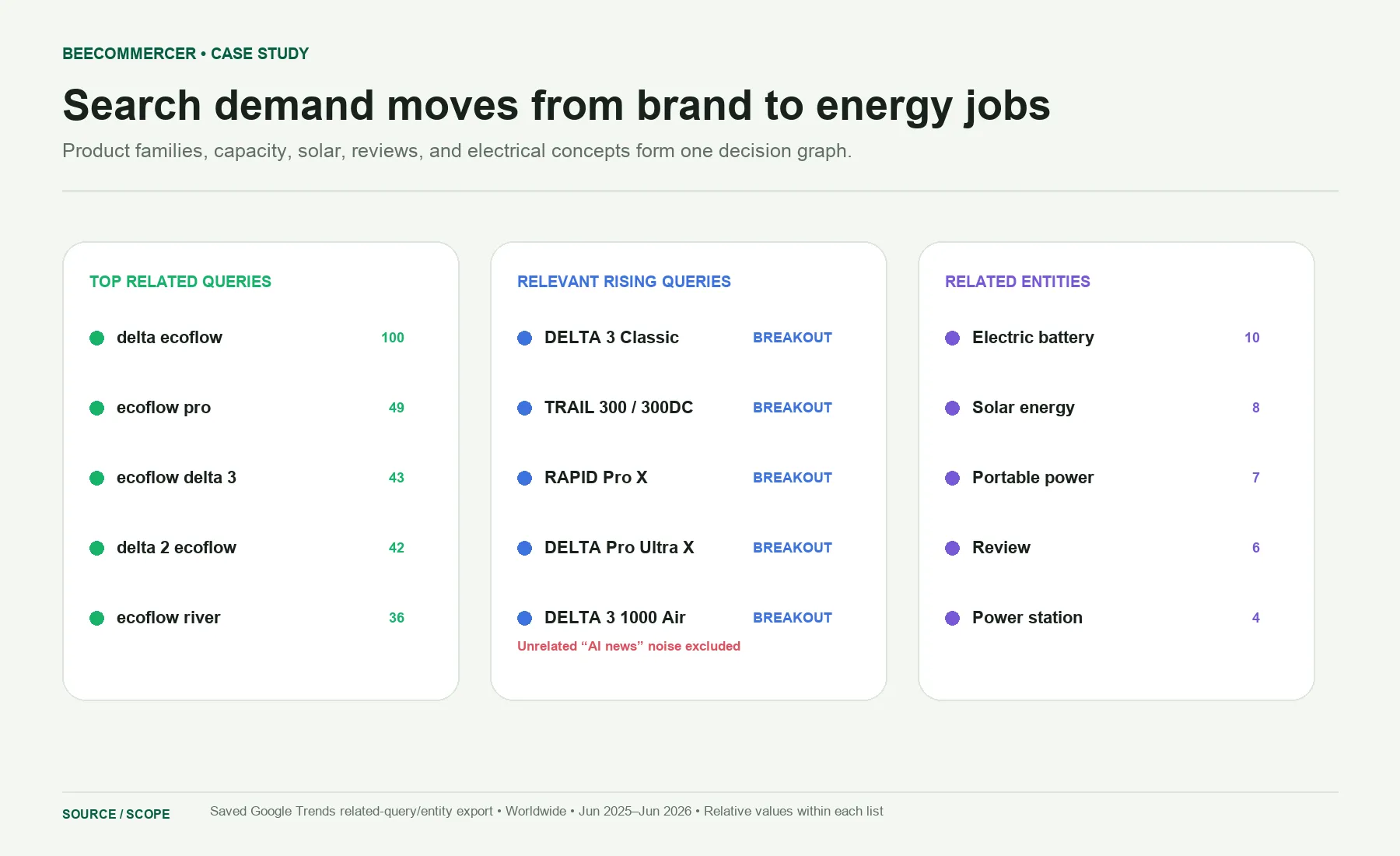
Source note: Saved Google Trends related-query and related-entity export for “EcoFlow,” Worldwide, Jun 2025–Jun 2026. Values are relative within each list. Beecommercer excluded unrelated “AI news” rows from the product interpretation and did not convert “breakout” into absolute volume.
A useful site architecture follows those jobs. Category pages define the portfolio; family pages bound the intended use; product pages state capabilities and limits; comparison pages explain tradeoffs; education pages calculate loads and runtime; manuals and support pages prepare the buyer for ownership. Internal links should let a visitor move between those layers without rebuilding the decision from search results.
5. Education content carries the conversion load
The saved Semrush Domain Overview classified 65.9% of EcoFlow’s ranking-keyword set as informational, 20.3% as commercial, 9.4% as transactional, and 4.5% as navigational. Those categories total 100.1% because of rounding. The displayed estimates also associated large keyword pools with informational and commercial intent. This does not show which terms convert, but it supports a practical point: the addressable search surface is dominated by questions and evaluation, not checkout language alone.
EcoFlow already publishes the raw material for that journey. Its guide to choosing a portable power station explains capacity, output, ports, battery type, and recharge options. Its portable power specification guide defines expandable capacity and continuous output, while its volts, amps, watts, and charging guide turns electrical units into operating decisions. These assets become more valuable when each one names applicable models, markets, versions, assumptions, and limits.
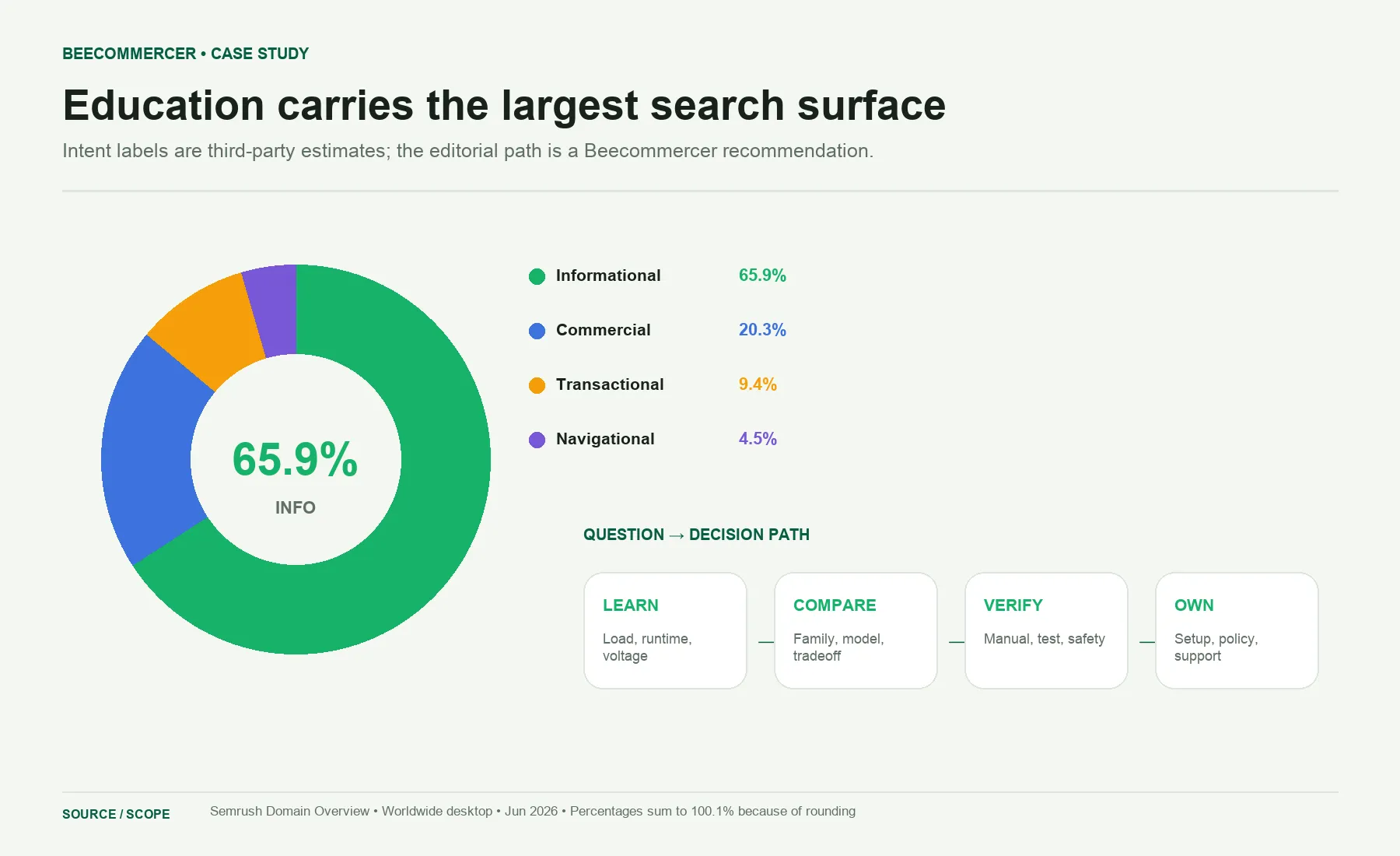
Source note: Semrush Domain Overview for ecoflow.com, Worldwide desktop, Jun 2026, plus Beecommercer’s editorial mapping of observed portable-power questions. Keyword counts, intent labels, and traffic are third-party estimates; the action path is a recommendation, not EcoFlow attribution data.
The format matters. A statement such as “powers your essentials” is hard to verify without the appliance load, runtime formula, inverter limit, surge behavior, battery reserve, temperature, and recharge assumptions. A bounded answer is easier for a buyer, support agent, reviewer, and answer engine to reuse. Education content should therefore link to the exact product, current manual, compatibility table, safety instructions, and support route—not just a storefront category.
6. Safety, support, and community evidence are part of the product
Ownership risk is visible before checkout. EcoFlow’s download center exposes manuals and app resources; its product FAQ organizes model questions; and its US warranty policy explains geographic scope, proof-of-purchase requirements, and logistics conditions. The return policy separately states timing, fees, channels, and regional limits. These pages should be treated as conversion evidence because they tell a prospective buyer what happens after a problem.
Safety information needs the same visibility. In October 2025, the US Consumer Product Safety Commission published a recall notice for about 25,030 DELTA Max 2000 model EFD310 units, directing affected owners to stop use and install a repair delivered by firmware update. This is model-specific and does not apply to every EcoFlow product. The ecommerce lesson is to make recall eligibility, model identification, remediation, and support escalation easy to find from product, manual, account, and support surfaces.
Community evidence shows both successful use and operational friction. EcoFlow’s official community hub collects backup, off-grid, and product stories, while public Reddit threads ask about setup, reliability, shipping, returns, and support. A saved directional sample included r/Ecoflow_community, r/UKPreppers, r/cuba, and EcoFlow user groups. Individual posts such as a reported RMA delay or a shipping-time discussion are not representative service measurements. They are specific objections that the brand can answer with clearer policy, status, and escalation information.
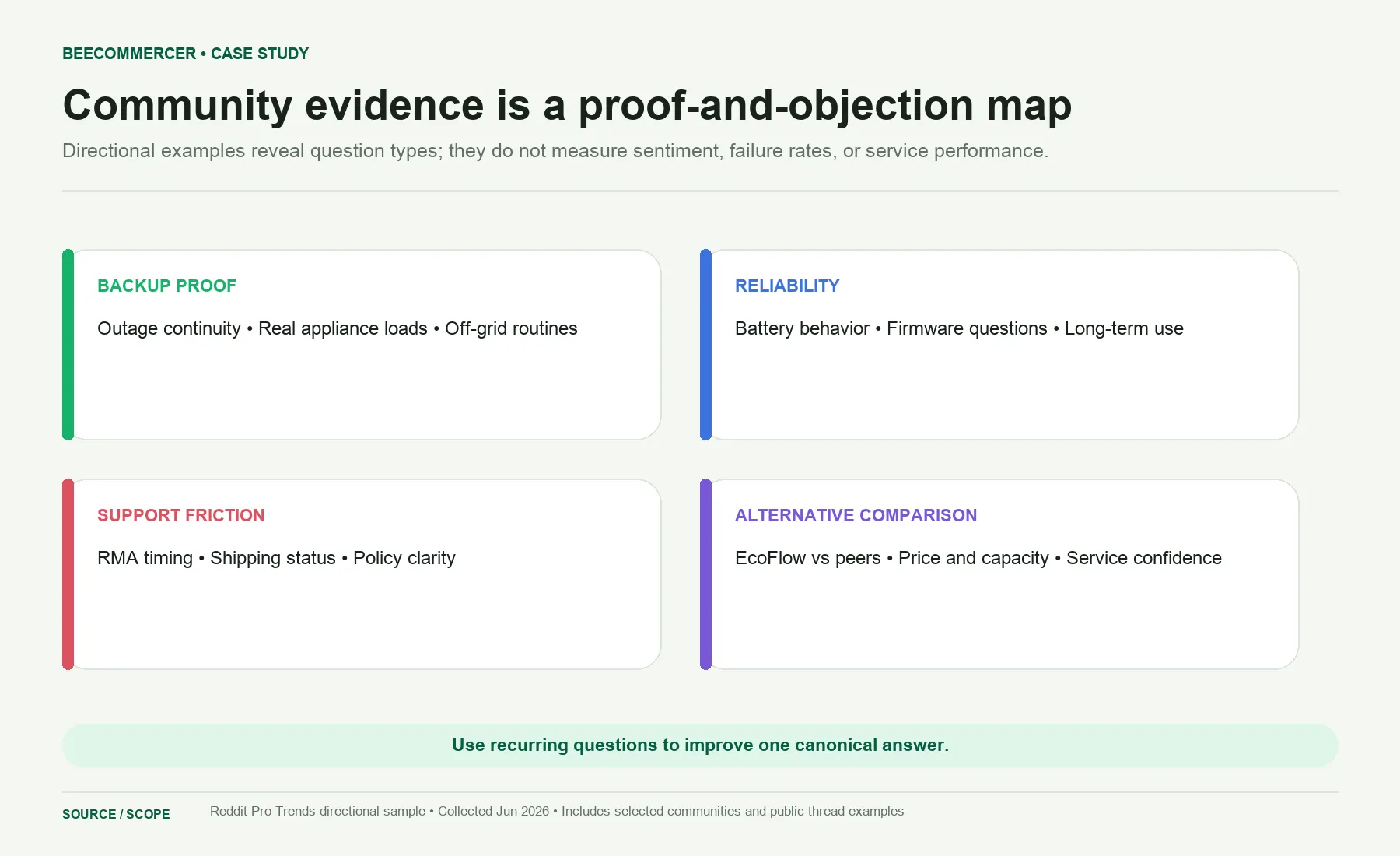
Source note: Reddit Pro Trends community sample collected Jun 2026, supplemented with cited public threads. It is a directional selection of communities and themes—not full-platform coverage, sentiment measurement, failure-rate evidence, or an audit of EcoFlow service performance.
The operating response is a governed issue loop. Tag recurring questions by model, market, order stage, risk, and needed evidence; assign an owner; publish or update one canonical answer; link it from the relevant product and support pages; and monitor whether the question recurs. Community participation should clarify and route, not suppress criticism or manufacture endorsements.
7. AI answers reuse a distributed proof network
Semrush’s June 2026 saved snapshot gave EcoFlow an AI Visibility score of 53/100, with approximately 29.5K mentions, 113.8K citations, and 41.7K cited pages across the displayed six-month indicators. Semrush describes mentions, citations, and cited pages in its AI Visibility Overview documentation and separately defines its broader AI SEO metrics. The score is a vendor benchmark based on a changing prompt database and tracked platforms; it is not market share, answer share for every possible question, or a Google ranking factor.
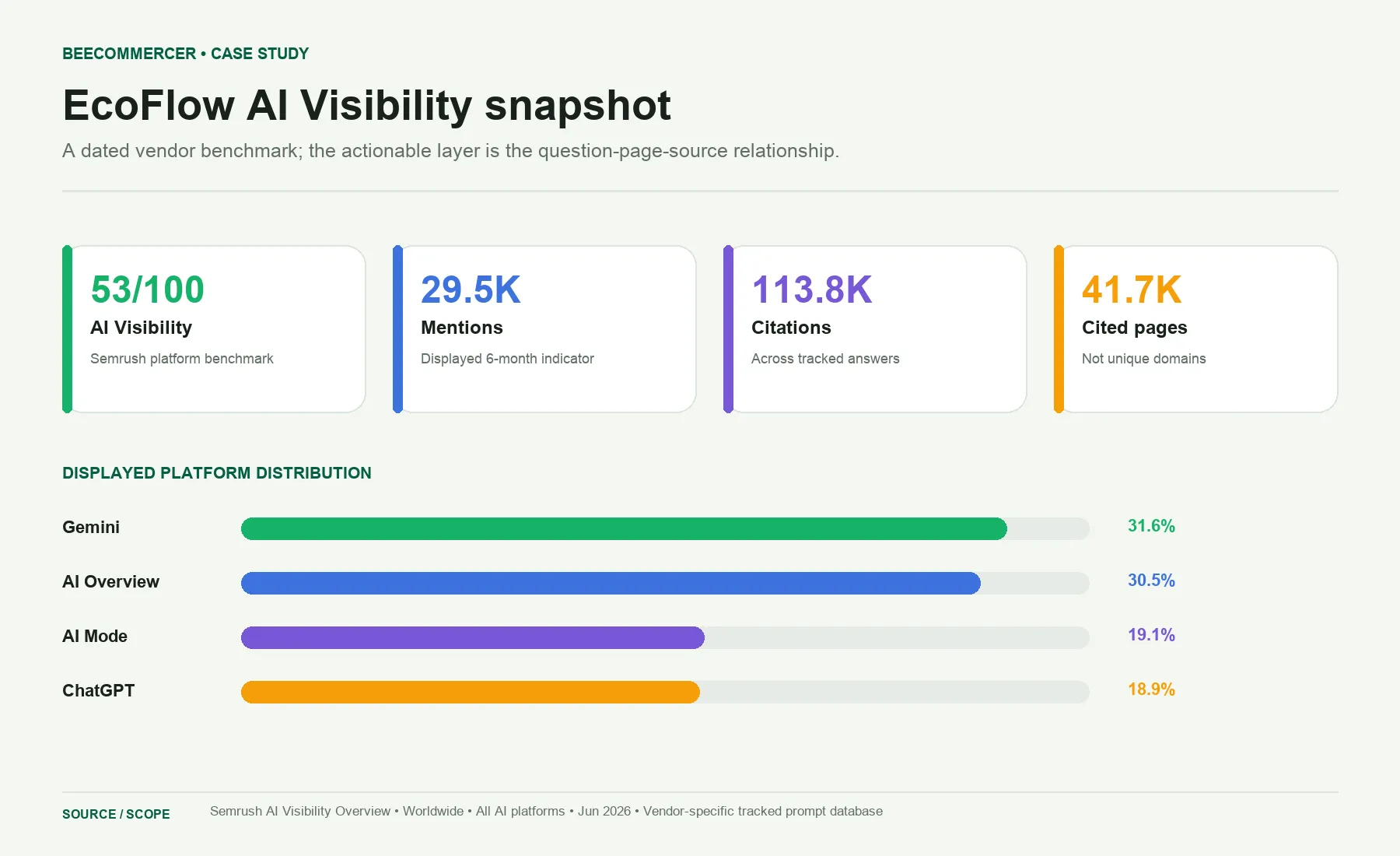
Source note: Semrush AI Visibility Overview for EcoFlow, Worldwide, All AI Platforms, Jun 2026. Metrics depend on Semrush’s prompt database, platform coverage, geography, and collection method and can change as prompts and generated answers change.
The source map explains why owned content alone cannot control the answer. The saved export included rows for ecoflow.com, YouTube, Reddit, Google, Facebook, and Amazon. EcoFlow.com appeared in multiple rows, so the visual preserves them as export rows rather than pretending they are unique-domain totals. Independent testing adds another layer: TechRadar’s DELTA 3 Plus review and RIVER 3 review show how model claims are translated into use conditions and tradeoffs outside the brand domain.
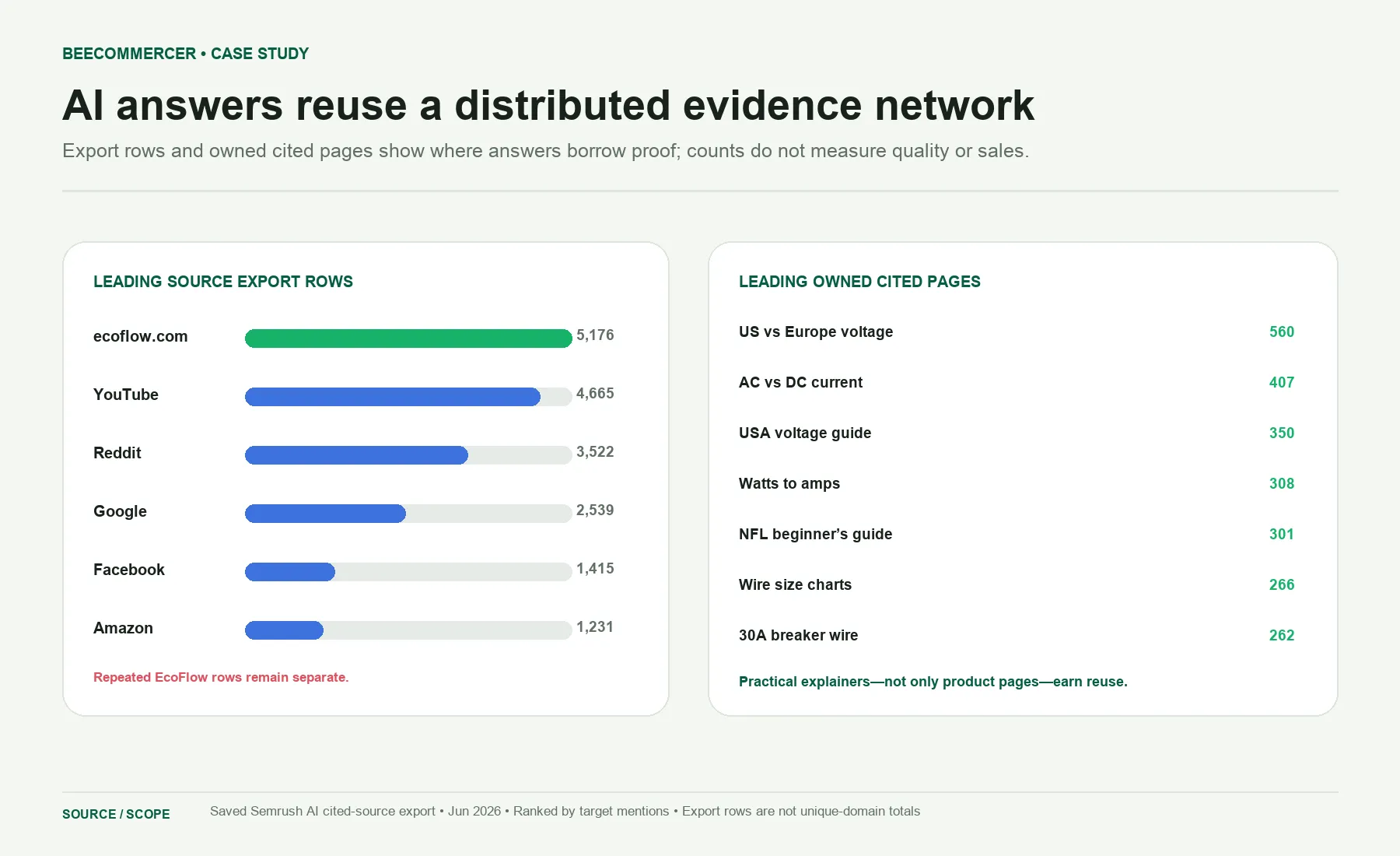
Source note: Saved Semrush AI cited-source export for EcoFlow-related prompts, Jun 2026, ranked by target mentions. Repeated ecoflow.com entries are separate export rows, not unique domains. Counts describe the saved Semrush scope and do not measure authority, quality, traffic, or sales.
The best GEO task is evidence maintenance. For each high-value question, define one current owned answer, the product and market it applies to, the supporting manual or policy, the last-reviewed date, the safety boundary, and credible independent tests. Then track whether answer engines cite the right page and whether the answer stays accurate—not merely whether the visibility score rises.
8. What cross-border brands can copy
The first reusable practice is to separate public demand signals from market decisions. Similarweb’s leading traffic countries, Semrush’s leading AI-mention markets, and Google Trends’ high-index geographies answer different questions. The United States, Germany, and Japan are meaningful traffic signals; the United States, Germany, and Australia are visible in the saved AI distribution; Cuba is a Trends concentration anomaly. None of these alone proves where EcoFlow earns the best margin or delivers the best service.
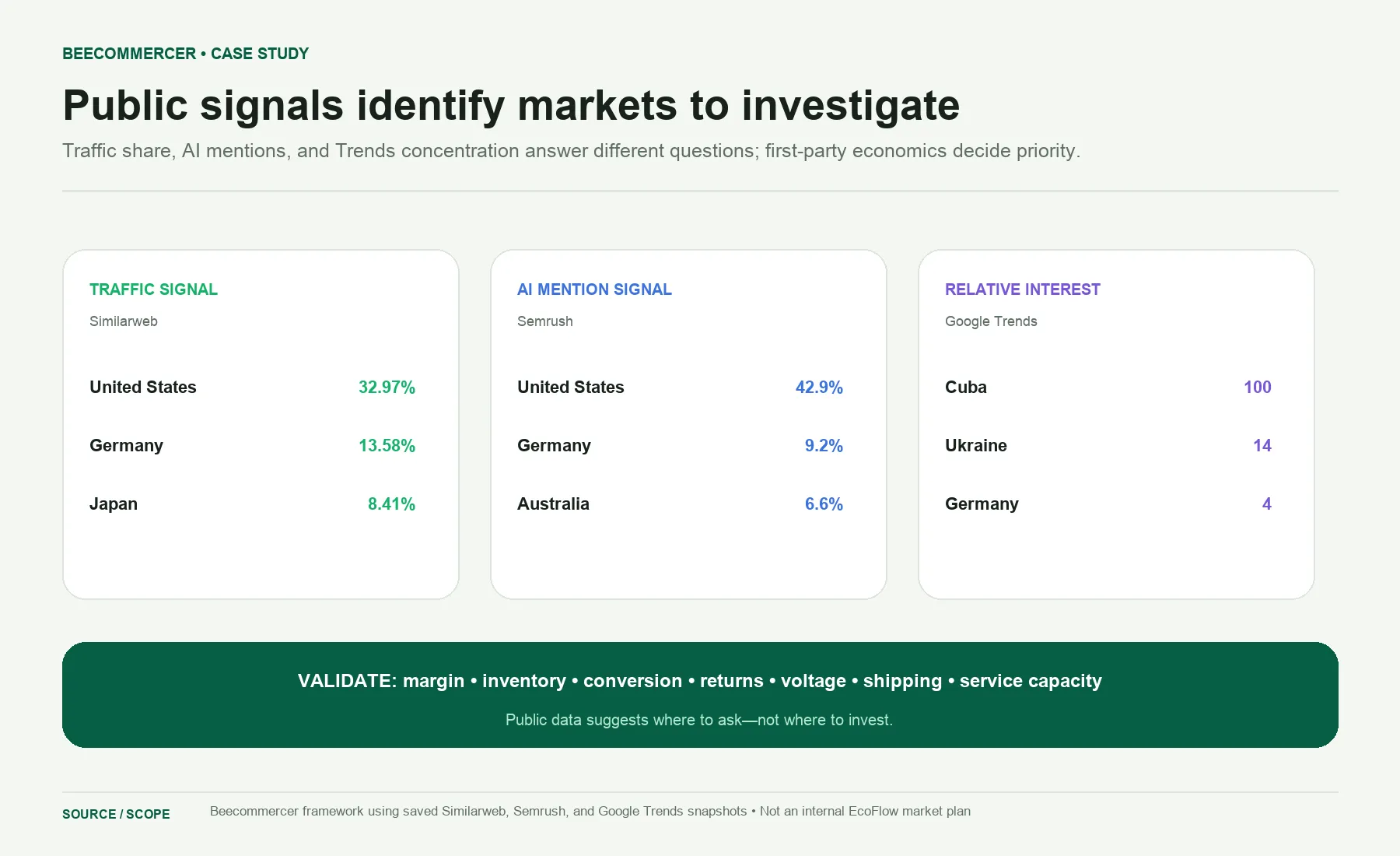
Source note: Beecommercer framework using saved Similarweb country shares, Semrush AI mention distribution, and Google Trends indices. It is an editorial investigation map—not EcoFlow’s internal market plan, a revenue ranking, or a recommendation to enter any market without first-party validation.
The second practice is to run product launches as answer-system releases. Every model should ship with a selection page, specification table, comparison view, runtime and compatibility guidance, setup and app instructions, manual, safety notice, warranty scope, return path, troubleshooting content, and a route to independent testing. Query, community, and support feedback should update the same evidence layer.
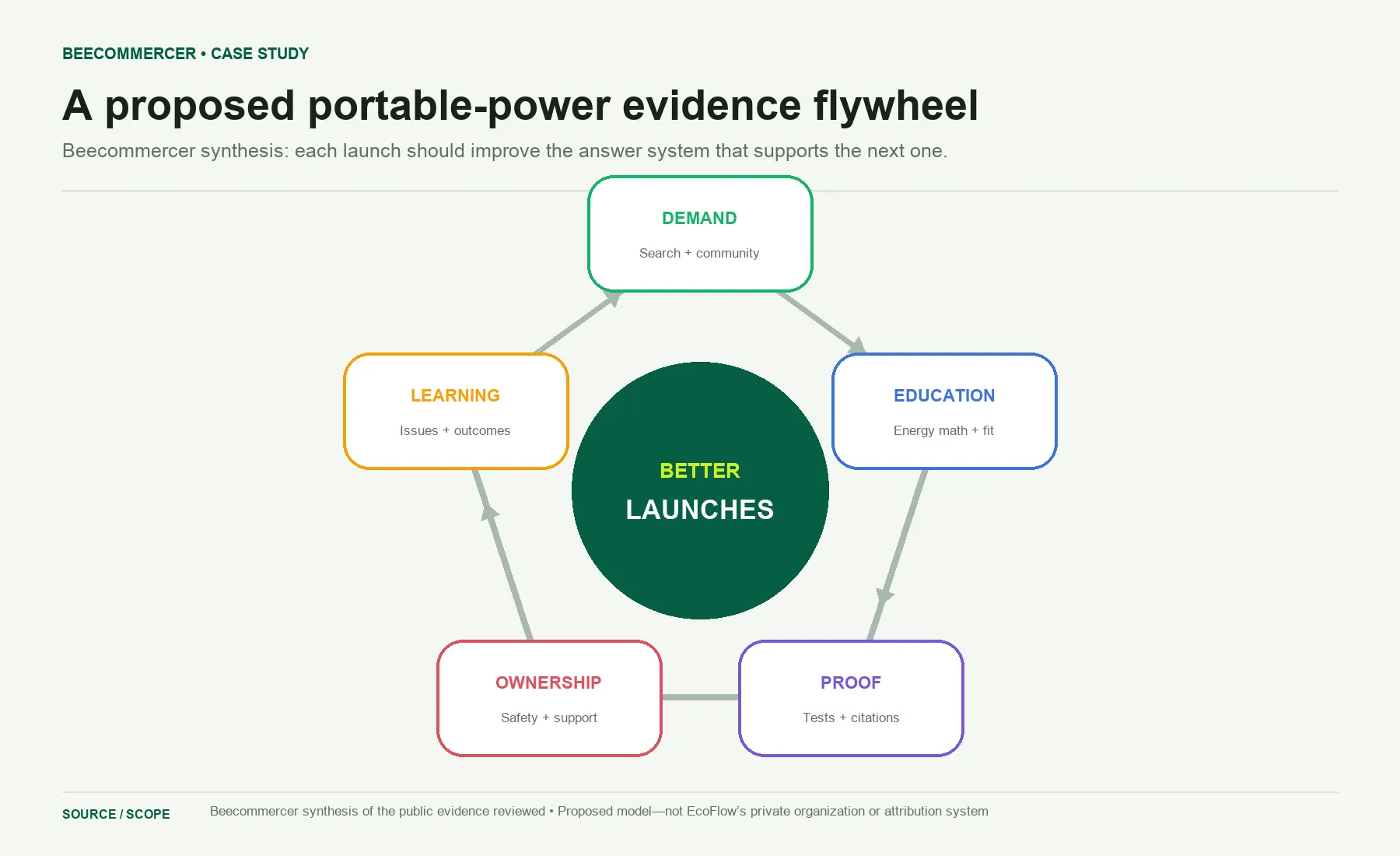
Source note: Beecommercer synthesis of the public evidence reviewed in this case. The flywheel is a proposed operating model, not a description of EcoFlow’s private organization, attribution system, customer data, or financial performance.
A practical 90-day sequence is simple. In days 1–30, audit high-value questions across search, community, support, and AI answers. In days 31–60, improve the pages where commercial demand and ownership risk overlap, starting with comparisons, runtime assumptions, compatibility, safety, and regional policy. In days 61–90, measure first-party query progression, assisted product visits, content freshness, issue recurrence, service outcomes, independent citation coverage, and a fixed set of AI prompts. Visibility is useful only when the evidence becomes more accurate and the customer path becomes easier to verify.
9. FAQ
What is the main growth lesson from the EcoFlow case study?
Portable-power growth depends on more than product specifications. Search pages, comparison tools, electrical education, independent testing, safety notices, policy explanations, and support content must work as one evidence system that helps buyers choose and use the right product.
Why is search so important to EcoFlow?
Similarweb estimated that organic search supplied 33.00% of ecoflow.com visits and paid search another 14.43% from December 2025 through May 2026. The figures are third-party traffic estimates, not EcoFlow sales, conversions, or attribution data.
What does EcoFlow’s AI Visibility score of 53 mean?
In Semrush’s June 2026 snapshot, 53 out of 100 was a platform benchmark of EcoFlow’s presence across tracked prompts and AI platforms. It is not market share, a Google ranking factor, or a permanent score; the prompt database and generated answers can change.
Is this case study based on private EcoFlow data?
No. It uses dated public and third-party sources, including Similarweb, Google Trends, Semrush, official EcoFlow pages, a CPSC recall notice, independent reviews, and a directional Reddit community sample. It does not use EcoFlow analytics, orders, customers, support tickets, revenue, profit, or internal strategy.
10. Full methodology and editorial note
This independent Beecommercer case study uses public information only. The quantitative layer consists of Similarweb Website Analysis for ecoflow.com, Worldwide, All Traffic, Dec 2025–May 2026; a Google Trends export for “EcoFlow,” Worldwide, Jun 2025–Jun 2026; Semrush Domain Overview and AI Visibility snapshots from Jun 2026; and a directional Reddit Pro Trends community sample collected in Jun 2026. Similarweb describes the limits and construction of its estimates in its data methodology FAQ. The qualitative layer reviews public EcoFlow product, comparison, education, community, policy, recall, manual, and support pages, together with selected independent review and community examples. Official pages and policies were checked in Jul 2026 and can change after publication.
Similarweb values are modeled third-party traffic estimates, not EcoFlow analytics, orders, customers, conversion, revenue, profit, or market share. Google Trends is sampled and normalized relative interest, not absolute search volume. Semrush AI Visibility is a vendor-specific, dated view of tracked prompts and platforms, not universal answer share or a search ranking factor. The Reddit examples are individual public accounts selected to illustrate question and risk types; they are not a representative sentiment sample, failure-rate study, or service-performance audit.
Product names, specifications, prices, inventory, electrical compatibility, software, manuals, warranty, returns, recall instructions, and support procedures can vary by model, serial number, market, channel, and date. Readers should verify current information on the applicable official page before making a purchase, installation, safety, or operational decision. All frameworks, interpretations, market-investigation priorities, and the 90-day plan are Beecommercer editorial analysis. No access to EcoFlow’s private strategy, advertising accounts, customer records, service tickets, contracts, attribution, unit economics, or financial results is claimed, and no causal relationship between public visibility metrics and sales is asserted.