
Brand recognition is already doing substantial work for Govee: Similarweb classifies 89% of its September 2026 organic-search traffic as branded. The next operating question is what visitors can accomplish after they arrive—choose lighting for a room, find the right version, install it and keep it working.
Govee links room-based shopping with product recommendations, user-created setups and rewards. Its traffic and reviews also reveal distinct needs within that journey: some visitors are shopping, others are downloading the app or seeking help. Those tasks need relevant destinations and clear service promises.
Start with the room, then make product selection specific
The US storefront offers shopping routes for living rooms, bedrooms, home theaters, gaming desks and outdoor spaces. This helps a visitor begin with the setting they want to change. The product finder then asks about indoor or outdoor use, lighting type and, for TV backlights, screen size. A 55–65-inch selection leads to named products and related bundles.
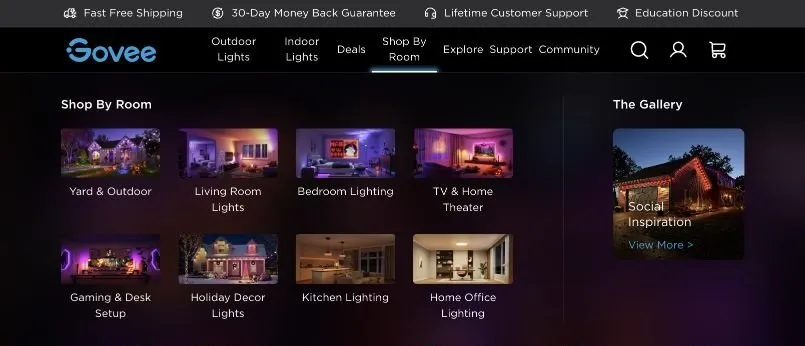
The useful practice is to carry the room idea into a concrete setup. Product pages should state the supported size, included parts, installation requirements and smart-home compatibility for the exact version. An attractive lighting scene creates interest; these details help the shopper decide whether they can reproduce it at home.
Separate shopping visits from app and device-use journeys
Similarweb estimates 16.75 million visits to govee.com during April–September 2026. Its monthly summary is 2.792 million visits, with 73.89% on mobile web, 3.08 pages per visit, 1 minute 54 seconds per visit and a 39.69% bounce rate. The monthly summary is not September traffic.
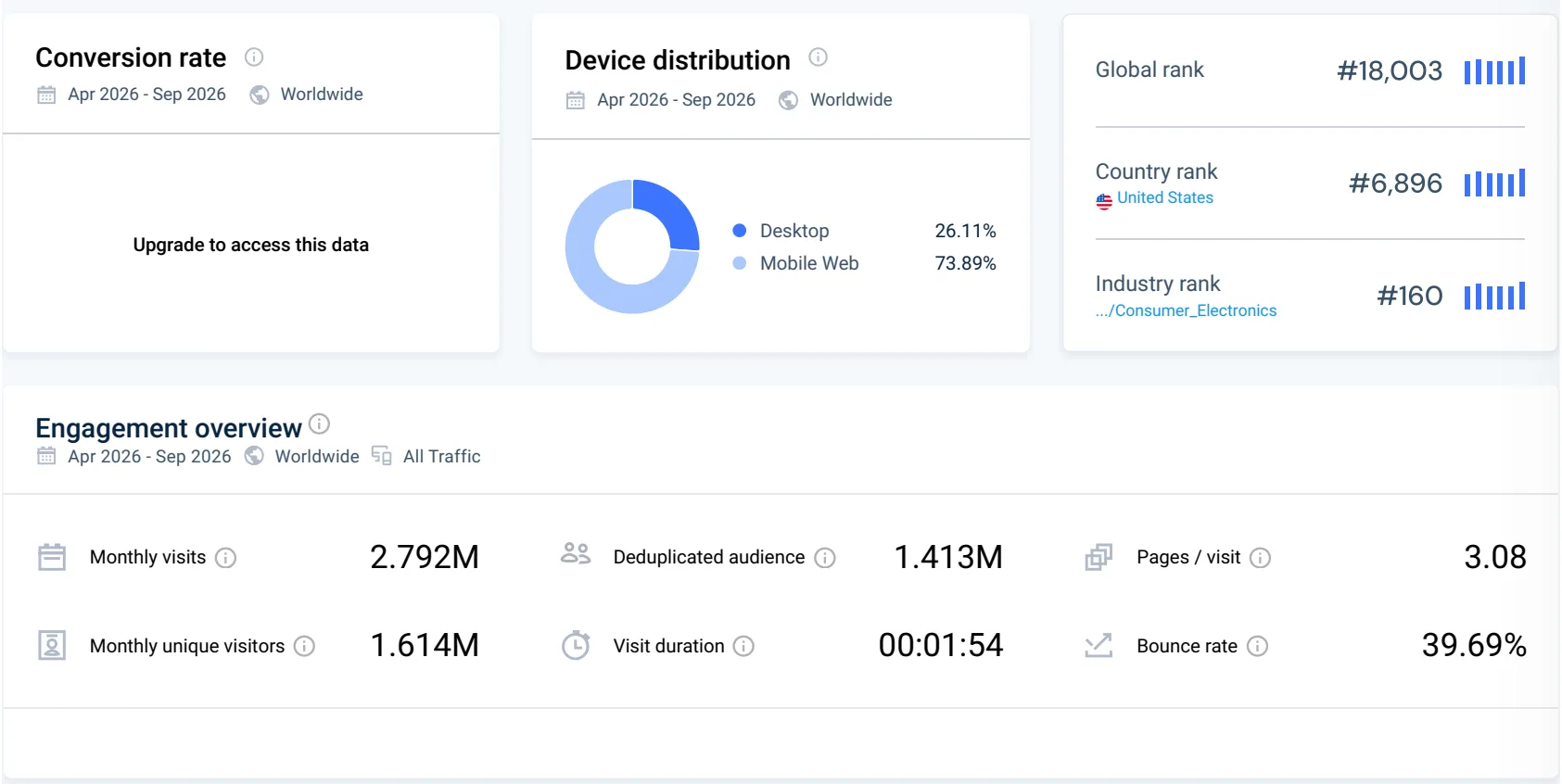
Mobile navigation deserves attention, especially the transition from inspiration to product choice and installation guidance. The report is labelled govee.com without a visible subdomain-coverage setting; its figures should not be silently relabelled as traffic to the US store alone.
Semrush’s separate September worldwide, all-device view estimates 3.5 million visits, 1.9 million unique visitors, a 72.86% mobile share, 2.8 pages per visit, 5 minutes 41 seconds per visit and a 55.51% bounce rate.

The two tools agree on a mobile majority but use different models and reporting windows. Semrush’s 0.11% purchase-conversion field is an estimate; Similarweb’s conversion field is unavailable. Neither supplies verified merchant orders.
Semrush’s Top Pages panel includes us.govee.com at 13.59%, app-h5.govee.com/common/app-download at 4.35% and govee.com/apps/qrcode at 2.99%.

Those app-related paths make the distinction practical. Assess product discovery, checkout, app download and support separately in first-party analytics. Page shares cannot be added into a count of distinct app users or treated as a retention rate.
Match each acquisition route to the question it brings
In Similarweb’s April–September mix, organic search contributes 31.43% of visits and paid search 17.81%, totaling 49.24%. Direct contributes 22.89%, display advertising 9.71%, referrals 5.46%, organic social 2.44%, paid social 4.42%, generative AI 1.09%, email 1.97% and affiliates 2.78%.
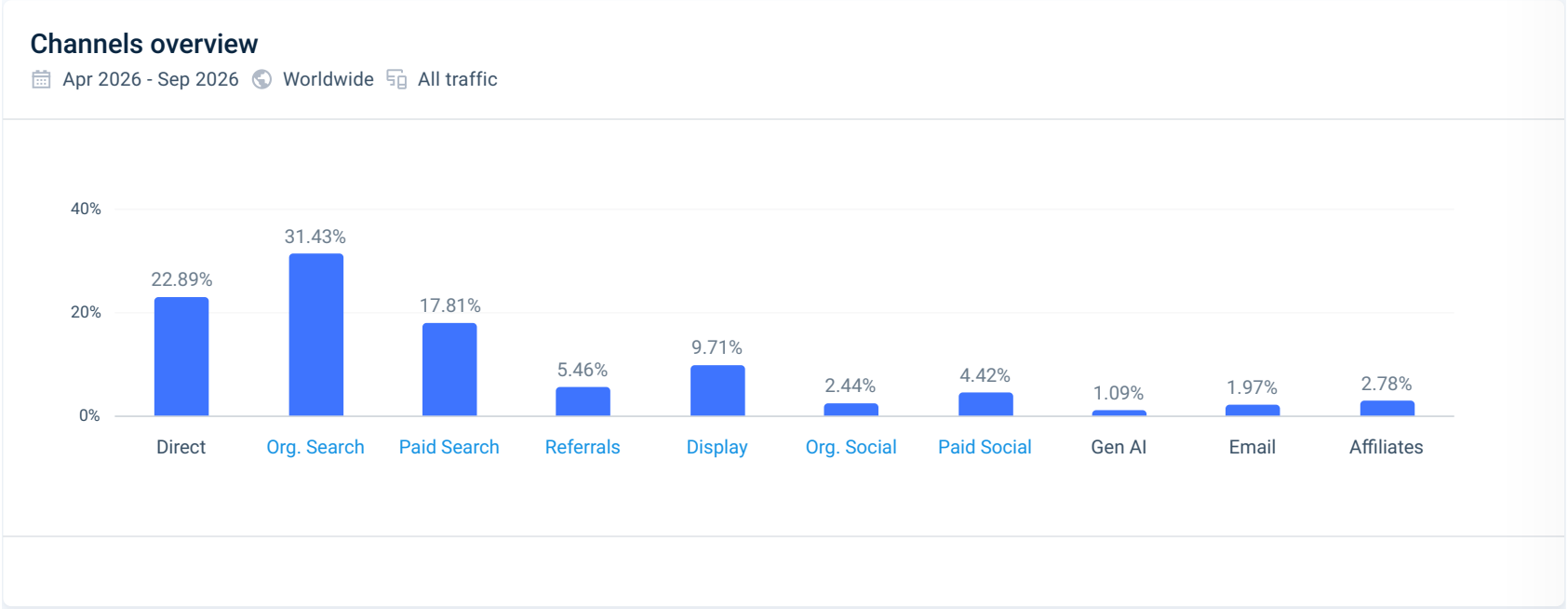
A brand search should lead quickly to the requested product or help page. A video showing a room transformation should link to the same lighting setup, with parts and installation needs explained. A comparison query needs differences between models, rather than a generic promotion.
Referral and display-publisher panels include deal sites and home-assistant.io. These suggest questions about price and integration worth checking; they do not establish direct partnerships. Channel shares also cannot establish advertising spend, customer acquisition cost or return on advertising spend.
Use brand demand to support broader lighting questions
Similarweb’s September organic-search split is 89% branded and 11% non-branded. Its non-branded panel includes “tv lights”, “galaxy projector” and “tv backlight”, alongside the ambiguous “product” and the event query “prime day 2026”.
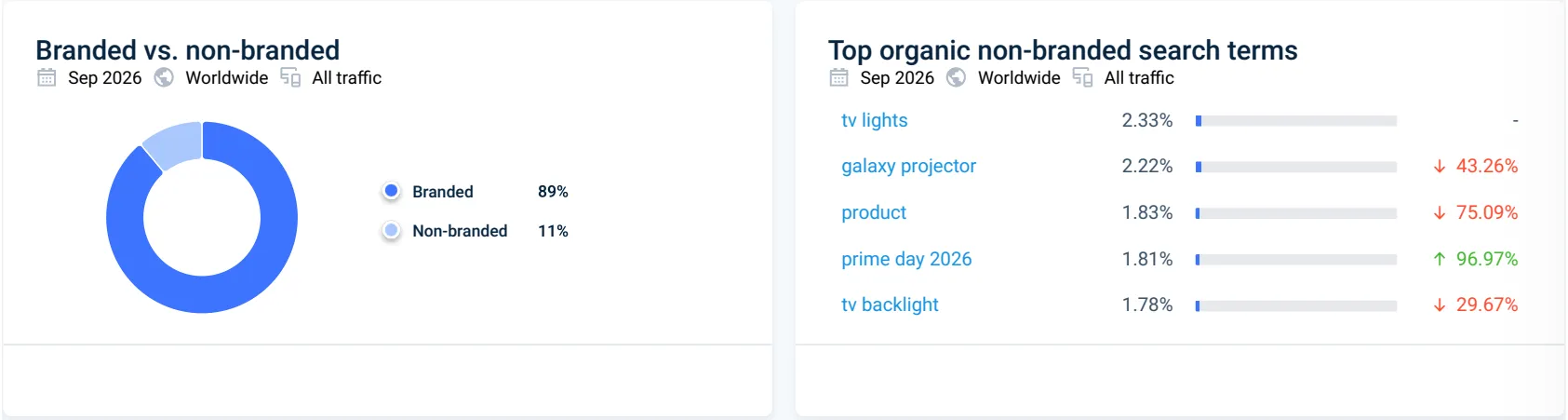
Organize these intents separately. TV-backlight content can explain screen fit and setup; projector content can compare the room effect and placement. Event searches need clear offer eligibility and dates. The 11% is a provider classification, not a verified share of new customers.
Semrush’s October 29 worldwide desktop overview estimates 1 million organic-search visits and 100,800 organic keywords. In its separate US keyword panel, “govee” contributes 31.87% and “govee lights” 14.25% of estimated organic traffic, totaling 46.12%.

The adjacent intent panel classifies 56% of keywords as informational; that is a keyword mix, not a traffic or conversion share. Prioritize useful answers about choosing, installing and connecting specific lights. Measure whether those answers lead to an appropriate product or successfully resolve an owner’s question.
Connect lighting videos with real setups and usable product context
Organic and paid social together contribute 6.86% of April–September visits in Similarweb. Within social traffic, YouTube accounts for 41.85%, Facebook 40.91% and Reddit 12.62%. YouTube and Facebook together account for 82.76% of social traffic, rather than all website visits.
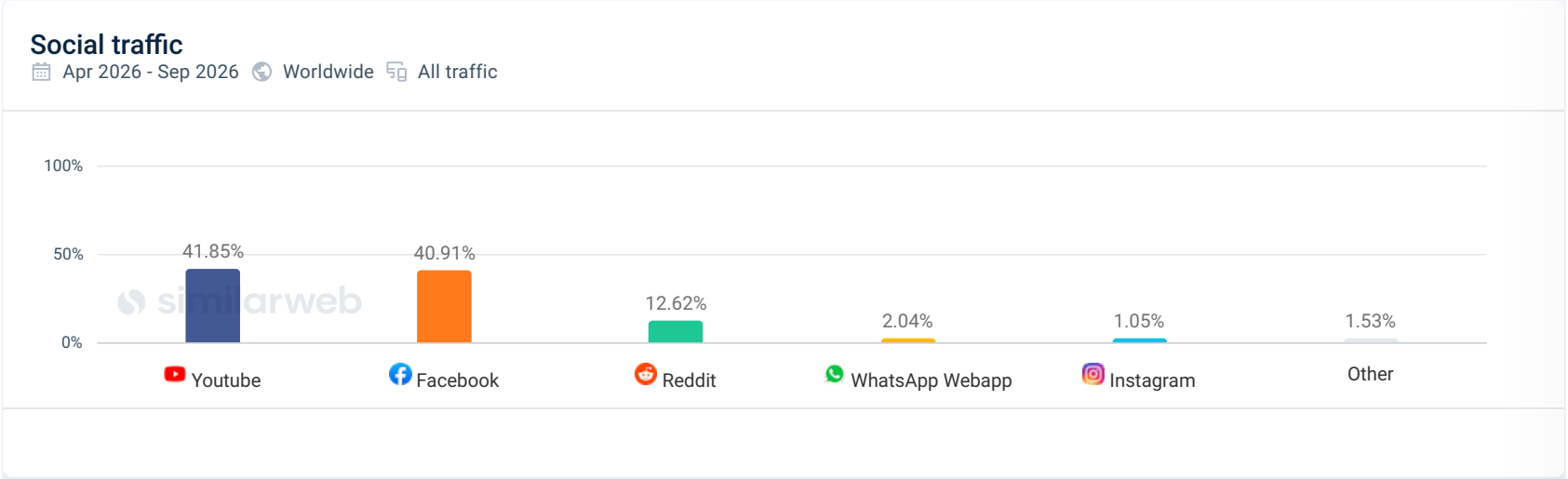
Lighting is well suited to before-and-after and room-use videos. Keep the product version, room dimensions and control method visible so the viewer understands what produced the effect. The traffic mix does not identify how much came from owned accounts, creators or paid placements.
The official home-decor gallery groups user setups by room and invites participation through #LitByGovee. It gives visitors examples from homes and gaming spaces, extending the room-based shopping idea beyond studio product images.
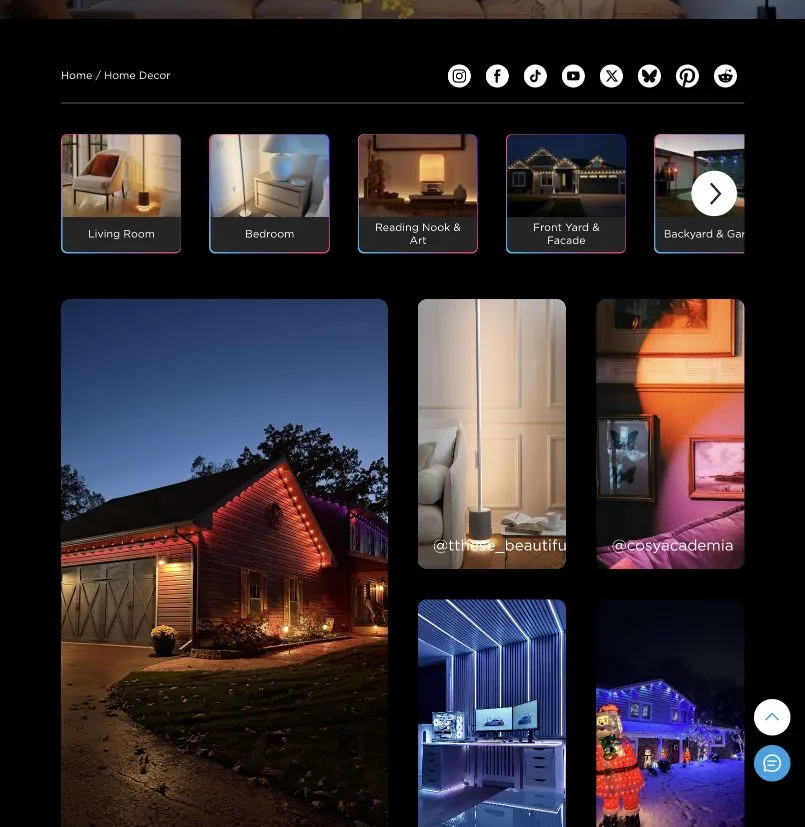
Reusable contributions should retain attribution and the product/setup details, with permission for reuse. The affiliate program offers tracked links or codes, promotional assets and up to 10% commission on valid sales, subject to program terms. Evaluate the resulting product visits and completed orders; content volume and referral shares alone do not establish sales contribution.
Make rewards understandable across the store and app
The US rewards program connects joining, earning and redemption. It advertises 5 Govee Store Points per US$1 spent and rewards for selected account activities. Its FAQ ties earning and redemption to the same shopping account, describes purchase rewards credited after 7 days and says one discount code can be used per order.

This can give owners reasons to return for another room or compatible light. The operational work is to explain which points balance applies, when it becomes usable, what can be redeemed and which promotions can be combined. Store points, app participation and repeat purchases should be measured separately.
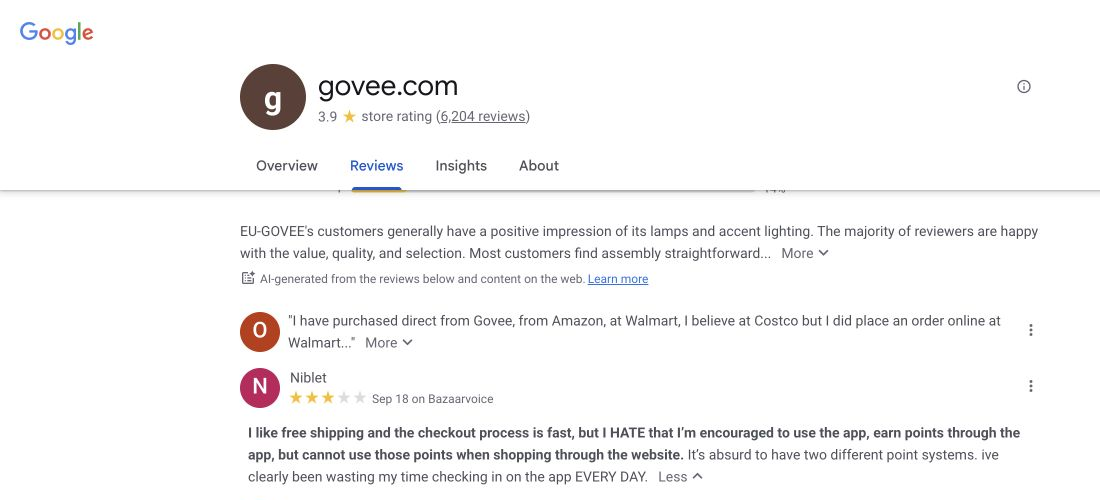
The Google feedback below shows why these explanations matter. A historical comment about app points is a customer’s reported experience, not proof that the current store program has a defect—or that a later program update resolved that customer’s issue.
Localize installation and service alongside the offer
Similarweb attributes 50.12% of April–September visits to the United States, 9.25% to Germany, 6.98% to Canada, 6.82% to the United Kingdom and 3.20% to France. These are visit shares, not order destinations or regional profit.
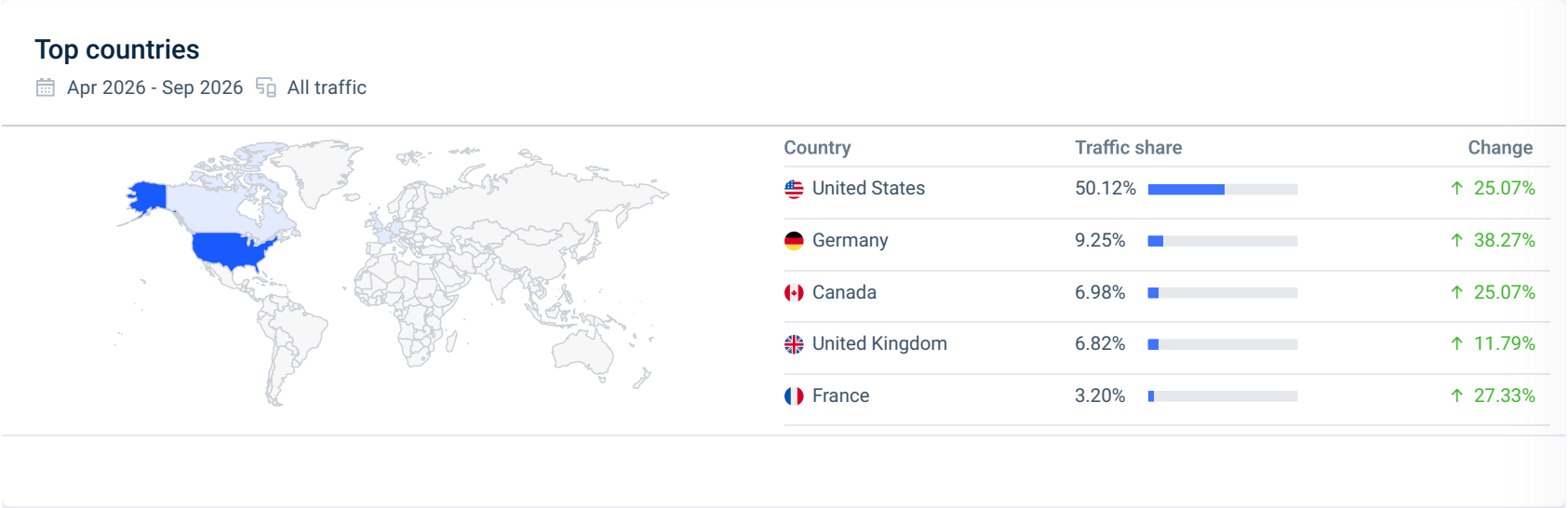
Use the concentration to prioritize checks of local product availability, power specifications, delivery timing, return costs and the team responsible for support. Confirm commercial priorities with actual orders, returns and contribution margin. An English-language product page or country selector cannot by itself establish that the installation and service journey is localized.
Check category fit before using a market-share figure
Semrush’s September worldwide Market Overview uses a selected set of 94 domains with about 42 million visits. Govee accounts for 8.34% of that set’s traffic, Vivint 56.16% and Philips Hue 6.72%.
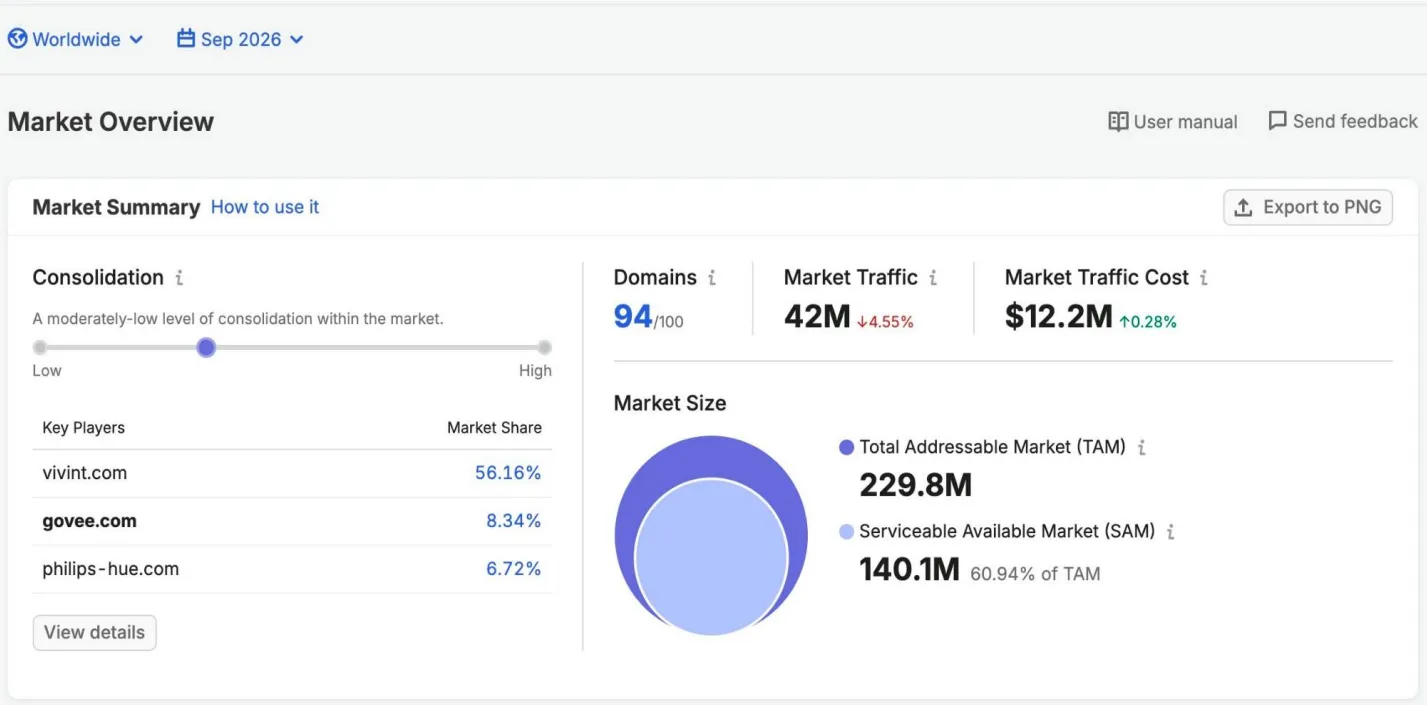
The set mixes smart-home security, lighting and other properties. It is a website comparison set, not the whole smart-lighting industry. Build a narrower comparison by category, product range and regional coverage before drawing competitive conclusions. The displayed audience-opportunity fields also cannot be treated as a revenue market size.
Give AI answers precise installation and compatibility evidence
Semrush’s October 28 worldwide AI Visibility score is 35/100, with about 22,400 mentions, 11,200 citations and 4,900 cited pages. Those metrics describe observed AI coverage, not site visits or orders.

Topic scores are more specific: the US music-sync topic scores 98 and the US outdoor-installation topic 86. These country-and-topic results use a different scope from the overall 35. The SEO report’s separately labelled US cited-source panel also includes YouTube, Google and Govee’s own domain.
A useful content plan would answer model-specific questions about screen size, connection methods, controller and power-supply matching, installation limits and troubleshooting. Test the answers and their cited pages for accuracy. Mentions, citations, referral visits and resolved support tasks should remain separate measures.
Google reviews surface promotion and points confusion
The Google US store page displays 3.9/5 from 6,204 reviews when checked on October 30. The selected comments below are labelled Bazaarvoice by Google; they are store-review entries, rather than Google Maps reviews.
| Reviewer | Reported experience | Operational question |
|---|---|---|
| Niblet · 3 stars | Praises shipping and checkout, but says app points could not be used on the website. | Are store and app points, redemption routes and eligible purchases explained before checkout? |
| matsellah · 2 stars | Describes confusion over an email offer and a separate military discount on an already discounted item. | Can shoppers see promotion exclusions before trying a code, and get a clear explanation from support? |
The visible dates are September 18 and March 10, respectively, without a displayed year. These accounts identify friction to investigate. They do not establish the current policy or its effect on every customer. Google and Trustpilot counts should not be combined into one customer total.
Trustpilot: distinguish a reply from a working replacement
The govee.com Trustpilot profile displays 3.7/5 from 1,113 reviews on October 30. Individual accounts help distinguish product enjoyment, promotion concerns and service completion.

| Reviewer and experience date | Reported experience | Visible outcome |
|---|---|---|
| Thomas Murphy · October 16, 2026 · 5 stars | Enjoys a TV backlight and plans to expand his setup. | Future purchase intention; no repeat order confirmed. |
| Tara · October 3, 2026 · 4 stars | Reports failed parts and replacements. | October 16 update confirms everything works again. |
| Matt L · October 14, 2026 · 2 stars | Initial replacement parts did not resolve the problem; a full kit followed. | October 30 update confirms operation for one week; longer-term reliability remains unknown. |
| Michael Hsu · October 3, 2026 · 2 stars | Reports misdelivery and a charge dispute. | No customer-confirmed resolution. |
| Everton Fagundes Dias · October 21, 2026 · 1 star | Wanted a replacement; reports a retailer refund. | Refund confirmed; requested replacement not received. |
| Nadir · October 7, 2026 · 3 stars | Repetitive promotions discourage him. | Has not used support; this is a promotion concern. |
Track the steps separately: request received, diagnosis, correct replacement dispatched, delivery and restored operation confirmed by the customer. These selected accounts do not measure company-wide failure or satisfaction rates.
Current official service pages also deserve alignment. The after-sales policy routes direct website/App Mall purchases and other retail purchases differently. A parallel returns page describes retailer handling and country-of-purchase limits, while the homepage advertises a longer term for Permanent Outdoor Lights. Make the exact model, purchase channel, region and applicable terms clear; current wording cannot settle historical disputes.
Carry the lighting promise through setup and after-sales support
Two Reddit follow-ups show why the outcome matters. In a March service thread, the author later says the app’s Express Replacement route worked after email difficulties; receipt and restored operation are not explicitly confirmed. In an October service thread, an October 28 author update says an entire Elite kit was shipped, without confirming the system worked again. These are individual accounts, not a platform-wide sentiment measure.
What other ecommerce teams can apply
- Connect inspiration to selection: retain the room, exact model, dimensions and included components from the creative content through the product page.
- Separate journey metrics: measure shopping, app setup and support tasks before interpreting domain-wide conversion.
- Explain incentives early: show points eligibility, redemption and promotion exclusions before checkout.
- Measure the final service outcome: distinguish replies and shipments from a correctly installed, working product.
The operating model to test is room inspiration → suitable product → successful installation → continued use and relevant expansion. The website makes parts of that journey visible; repeat orders, incrementality and service improvements still require first-party evidence.
Sources
Traffic and search: Similarweb, April–September 2026, with September search details; Semrush Traffic Analytics and Market Overview, September 2026; Semrush SEO, October 29; Semrush AI Visibility, October 28. These are third-party estimates with separately identified scopes. Official US pages and public reviews were checked October 30, 2026. Review samples are self-selected accounts; regional profiles and source populations are kept separate.