

Last updated on July 19, 2026 at 3:21 PM
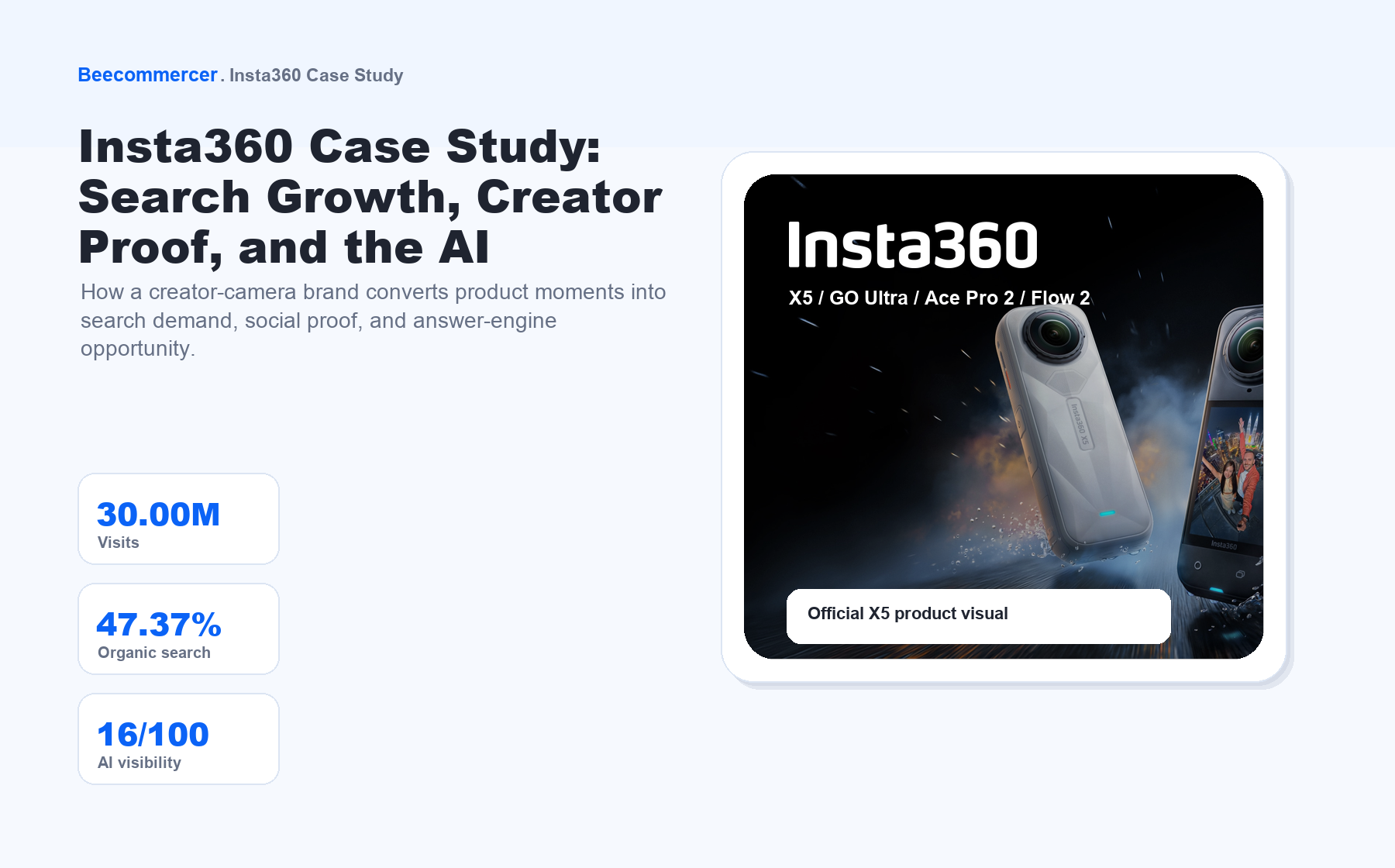
Insta360’s growth engine starts whenever a buyer asks a product question: Is the X5 worth the upgrade? Is GO better for everyday filming? How does Ace Pro compare with DJI? The brand turns those questions into search demand, creator demonstrations, community proof, and official-site conversion.
The visible gap is not awareness. It is evidence portability. Insta360 already performs strongly across search and YouTube, but its proof is distributed across videos, reviews, community threads, product pages, and support content. Making that evidence easier for AI answer engines to understand and cite is the next growth opportunity.
1. Ecommerce SEO and GEO key takeaways
- Demand is product-led. The strongest searches cluster around X5, GO, Pro, Ace Pro, X4, price, and DJI comparison terms.
- Organic search is the main acquisition surface. Similarweb’s insta360.com profile estimates that it contributes 47.37% of traffic; 86% of organic search is branded.
- YouTube is both a discovery and proof engine. The platform accounts for an estimated 82.48% of social traffic and is also a leading AI-cited source domain.
- AI visibility has room to catch up. The Semrush AI Visibility export used for this analysis reported a score of 16/100, 513 mentions, and roughly 16,000 citations during the measured six-month window.
2. Data snapshot and source scope
This analysis combines Similarweb Website Analysis, non-public Semrush Domain Overview and AI Visibility exports, worldwide Google Trends data, and official Insta360 product information. These are public and third-party signals, not Insta360’s private analytics, revenue, conversion, or attribution data.
Similarweb and Semrush figures should be read as directional estimates. Google Trends reports relative interest rather than search volume. AI citation data maps the sources answer engines reuse; it does not by itself prove ranking causation or sales impact. The Semrush CSV exports are not publicly accessible, so no public report URL is implied.
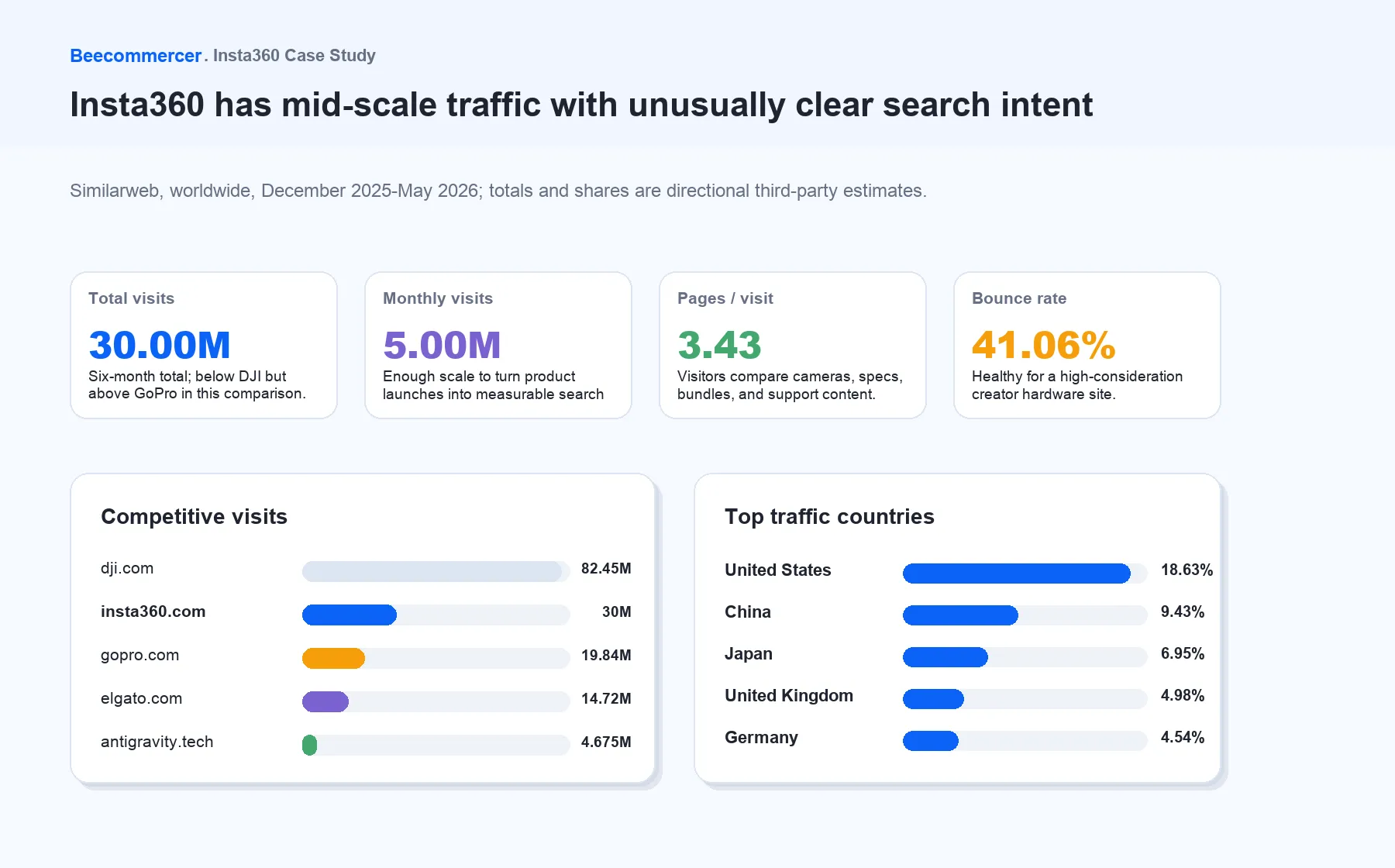
The useful signal is not the exact visit count. It is that Insta360 has reached meaningful global demand while remaining smaller than DJI, making channel efficiency and evidence reuse especially important.
3. Why Insta360 is a strong ecommerce case study
Insta360 does not behave like a single-product camera company. Its portfolio spans the X5 flagship 360 camera, GO Ultra pocket camera, Ace Pro action-camera line, X4, and Flow smartphone gimbal. Each family creates a new set of buyer questions: upgrade timing, form factor, stabilization, low-light performance, accessories, editing workflow, price, and competitor comparisons.
Those questions keep the category active between launches. A product moment becomes a review, tutorial, sample clip, comparison, support query, community discussion, and search result. The same evidence can then support a product page or appear in an AI-generated answer.
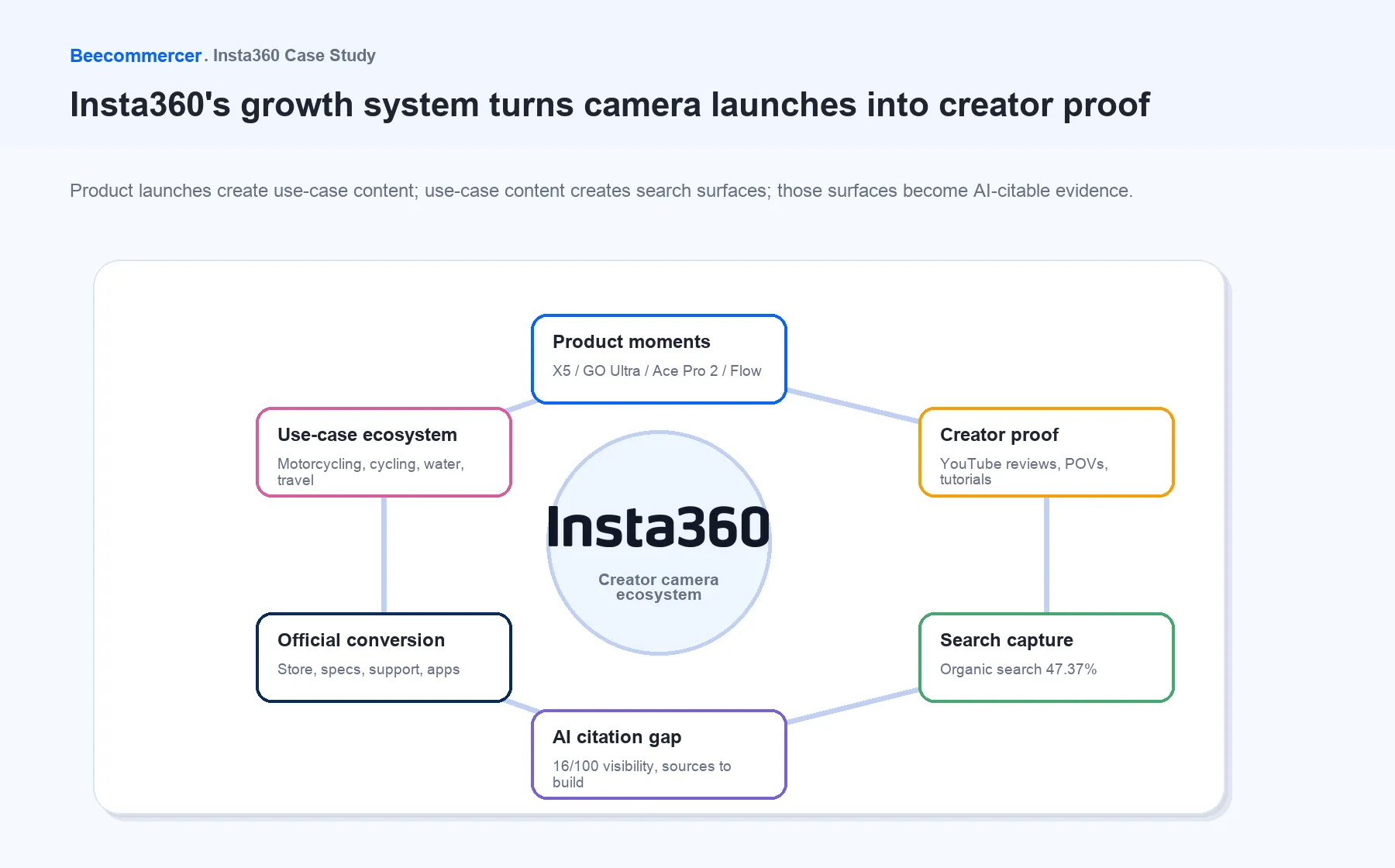
The mechanism is cumulative: every well-documented launch expands both the product portfolio and the brand’s searchable evidence base.
4. Search is the conversion surface
Similarweb estimates 30.00 million visits from December 2025 through May 2026, or about 5.00 million per month. Organic search is the largest channel, while direct, paid search, affiliate, and creator-led social traffic play supporting roles.
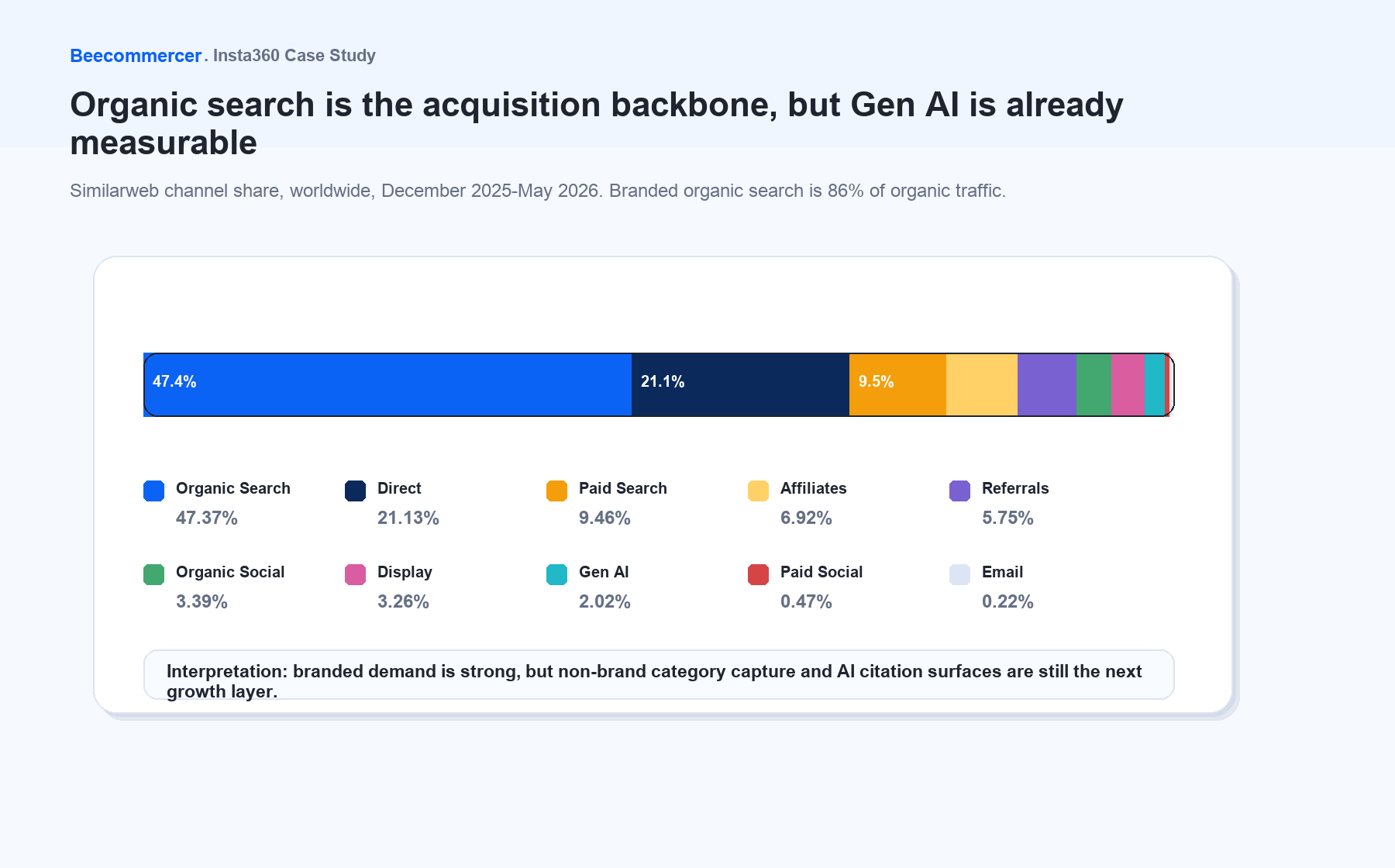
The 86% branded share is both an advantage and a constraint. It shows strong brand recall, but also suggests that non-brand discovery—queries about use cases, camera formats, filming problems, and comparisons—can become a larger acquisition layer.
5. Demand splits by product line and buyer question
Google Trends shows that search demand follows the portfolio rather than a generic term such as “camera.” High-interest queries include insta360 x5, insta360 go, insta360 pro, insta360 ace, insta360 price, and dji insta360. Rising searches point to new products and competitor comparisons.
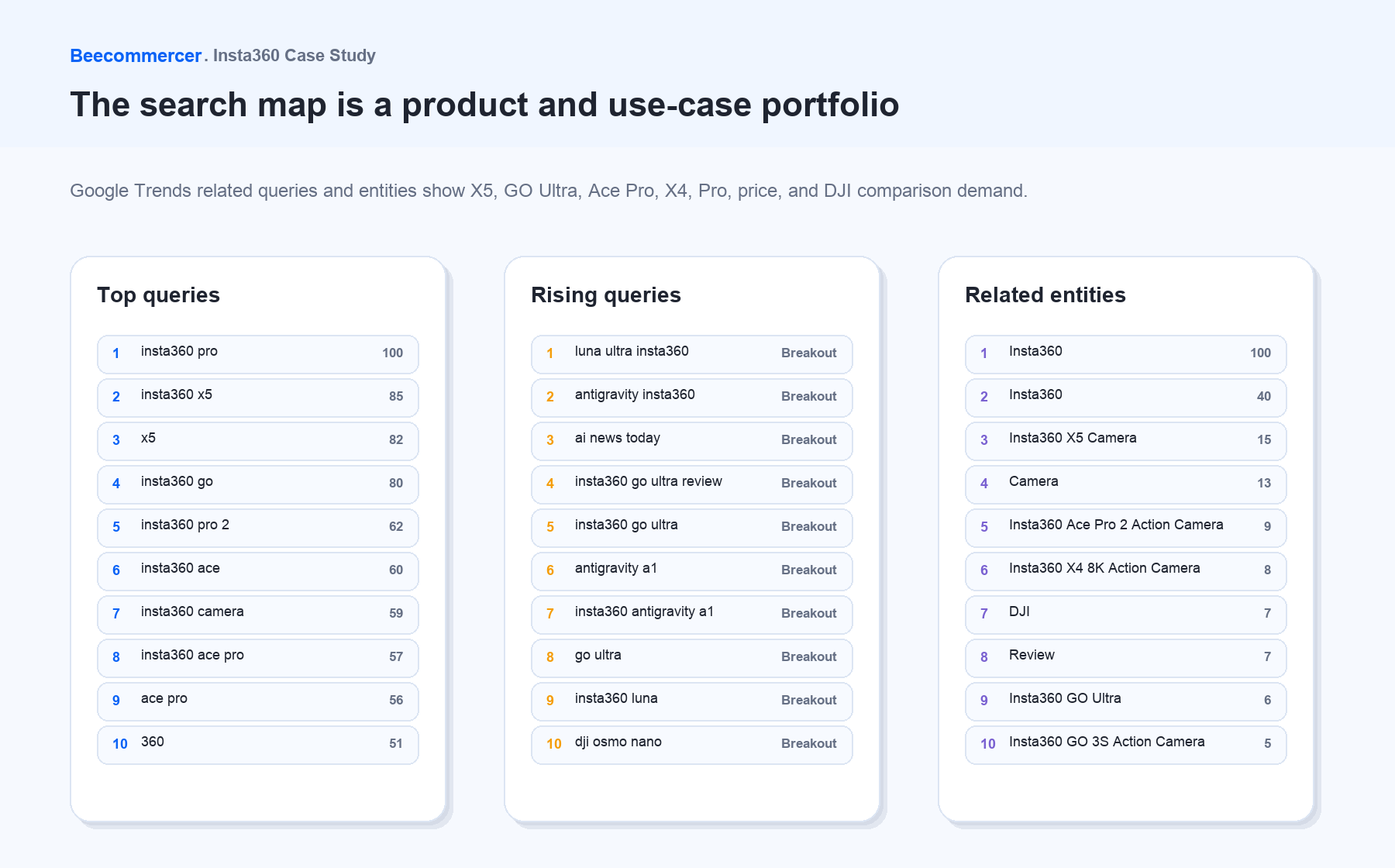
This is why durable product-family pages matter. A launch page can peak with an announcement; a family page can keep answering upgrade, comparison, accessory, and use-case questions across generations.
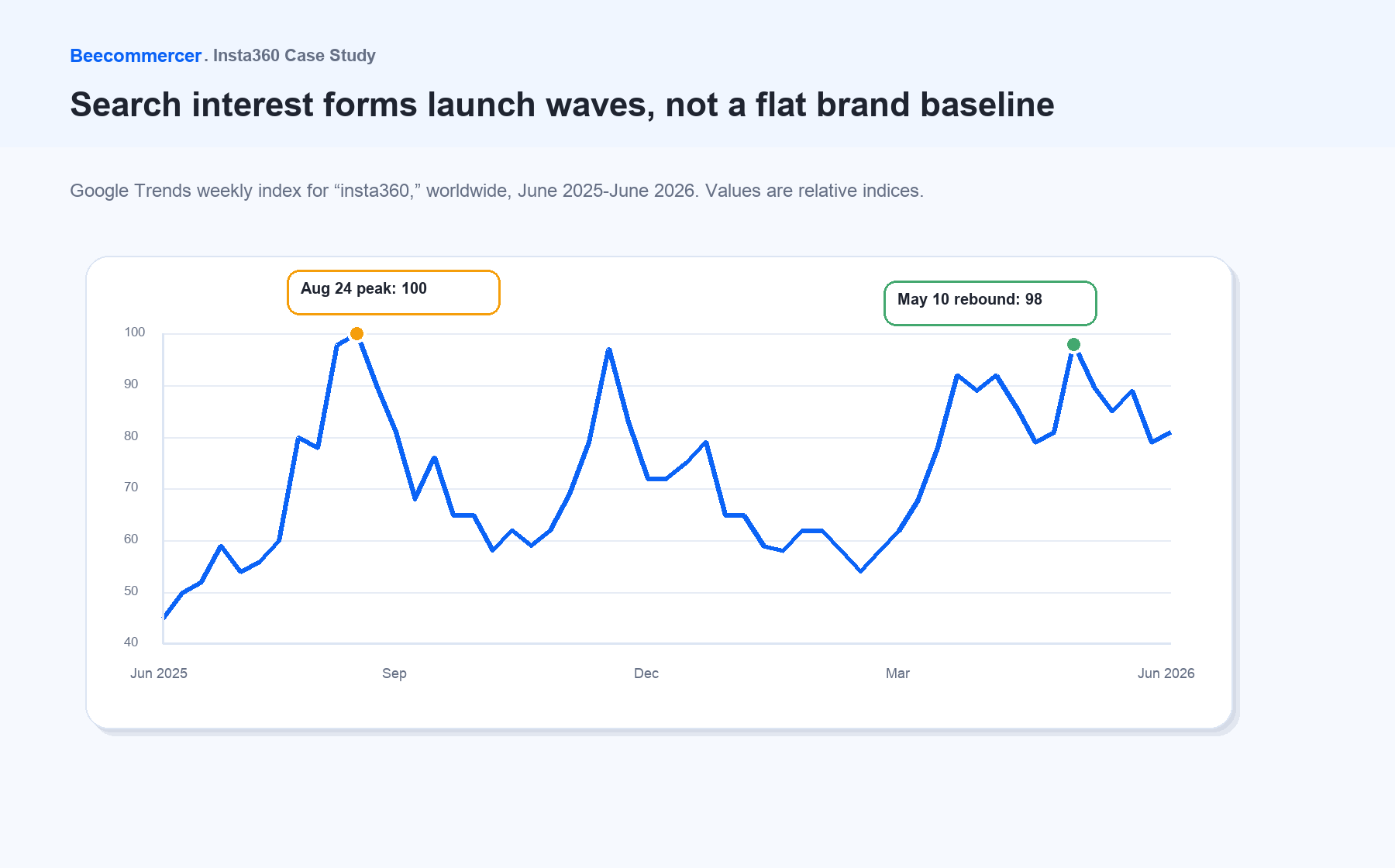
For operators, the lesson is to plan content around the whole product lifecycle: anticipation, launch, review, comparison, setup, troubleshooting, accessories, and eventual upgrade.
6. Creator and community proof reduce buyer risk
Camera buyers need to see outcomes, not only specifications. Sample footage, stabilization tests, mounting demonstrations, editing workflows, and side-by-side comparisons make product claims observable. That explains why YouTube can function as a proof layer rather than merely a social referral channel. Independent comparisons such as TechRadar’s Insta360 X4 review add a publisher perspective beyond official specifications.
Reddit’s r/Insta360 community adds a different kind of evidence: recurring questions, objections, edge cases, and the vocabulary buyers use when official claims are not enough. These discussions are directional community signals, not a representative measure of full-platform sentiment.
7. AI answers reuse distributed proof
Semrush’s snapshot places Insta360’s AI Visibility at 16/100 despite its established search demand. That mismatch suggests answer engines can identify the brand but still rely heavily on third-party sources to explain products and comparisons.

The issue is not simply “more AI content.” It is whether important facts, comparisons, use cases, compatibility details, and support answers are available in clear, stable, sourceable formats.
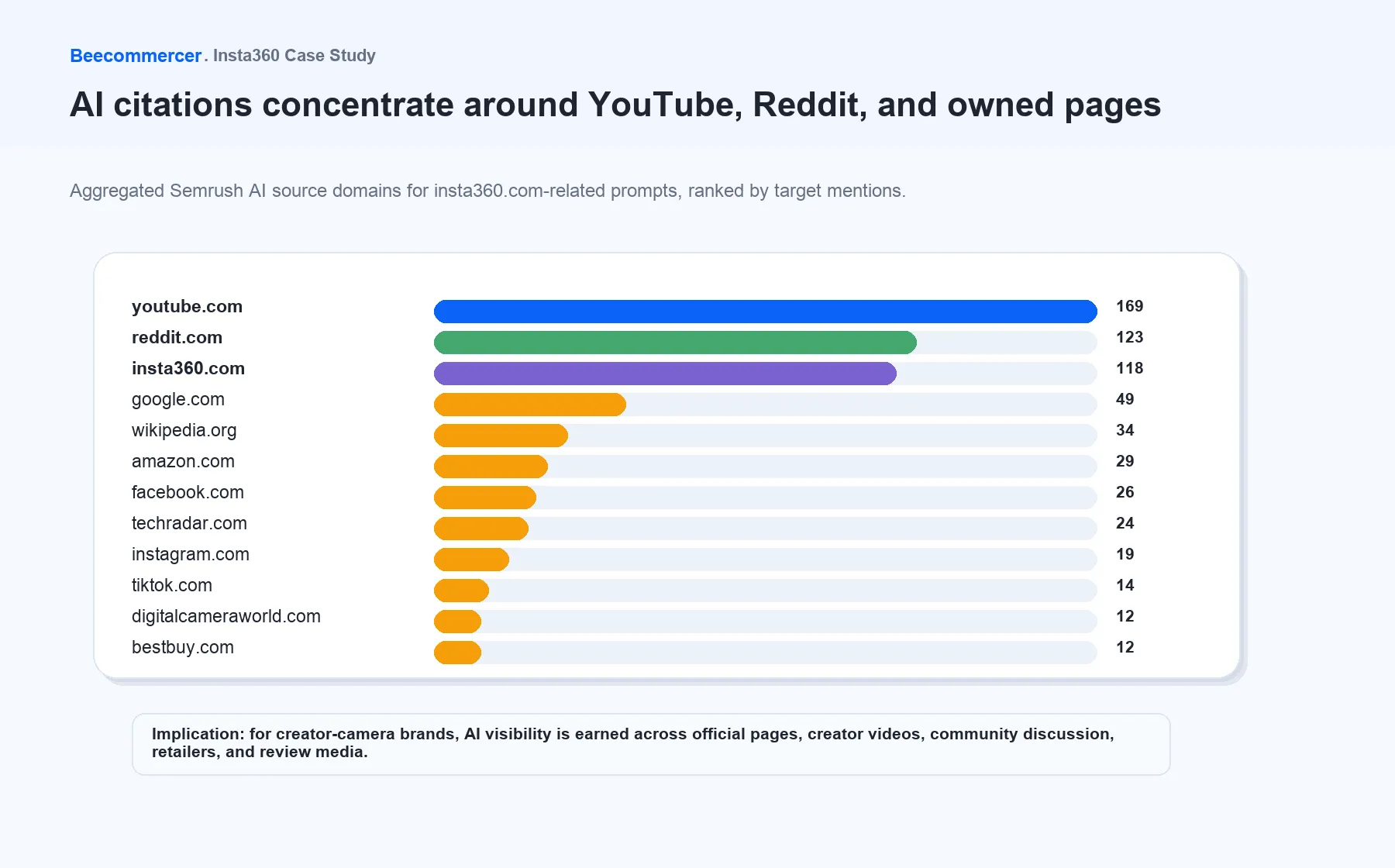
Owned pages can compete more effectively when they use explicit product entities, concise answer blocks, comparison tables, descriptive headings, author and update signals, and links to supporting proof.
8. What cross-border brands can copy
- Build product-family hubs. Preserve demand across launches instead of replacing each campaign with the next one.
- Map content to buyer questions. Cover price, comparison, setup, compatibility, accessories, use cases, and upgrade decisions.
- Turn creator output into reusable proof. Connect videos and demonstrations to relevant product and support pages with permission and clear attribution.
- Separate branded capture from non-brand discovery. Measure how much demand already knows the brand and where category education can expand reach.
- Design for citation. Make facts and answers easy to extract without stripping them of context or evidence.
9. FAQ
What is the main growth lesson from the Insta360 case study?
Insta360 turns recurring product moments into search demand and creator proof. Cross-border brands can copy the mechanism by organizing content around product families and buyer questions rather than one-off launches.
Why is YouTube important to Insta360’s ecommerce strategy?
Video demonstrates footage quality, stabilization, workflows, and comparisons that specifications alone cannot prove. Similarweb also estimates that YouTube supplies most of Insta360’s social traffic, while Semrush shows it as an important AI-cited source.
What is Insta360’s main GEO opportunity?
The opportunity is to convert distributed proof into clear, sourceable owned content: product-family hubs, comparison pages, use-case guides, FAQs, support answers, and structured facts that AI answer engines can interpret and cite.
Is this case study based on private Insta360 data?
No. It uses public product information and third-party estimates from Similarweb, Semrush, and Google Trends. It should not be read as an Insta360 first-party performance or attribution report.
10. Full methodology and editorial note
The analysis covers Similarweb Website Analysis for insta360.com from December 2025 through May 2026; non-public Semrush Domain Overview and AI Visibility Overview exports from June 2026; worldwide Google Trends data for “insta360” from June 2025 through June 2026; and Semrush AI source-domain, source-URL, and brand-topic exports. Official product context comes from Insta360’s product portfolio, the X5 product page, and X5 support documentation.
Traffic and keyword figures are third-party estimates. Google Trends values are relative indices. AI citation data is an evidence map, not proof of a direct ranking factor. Community observations are directional and are not a representative sentiment study.