

Who this is for: First-time Meta Ads Manager users who run independent online stores, Shopify or WooCommerce storefronts, or small e-commerce brands.
What you will accomplish: Set up your account and tracking, create sales ads, test creative, interpret performance data, and build your first 30-day optimization plan.
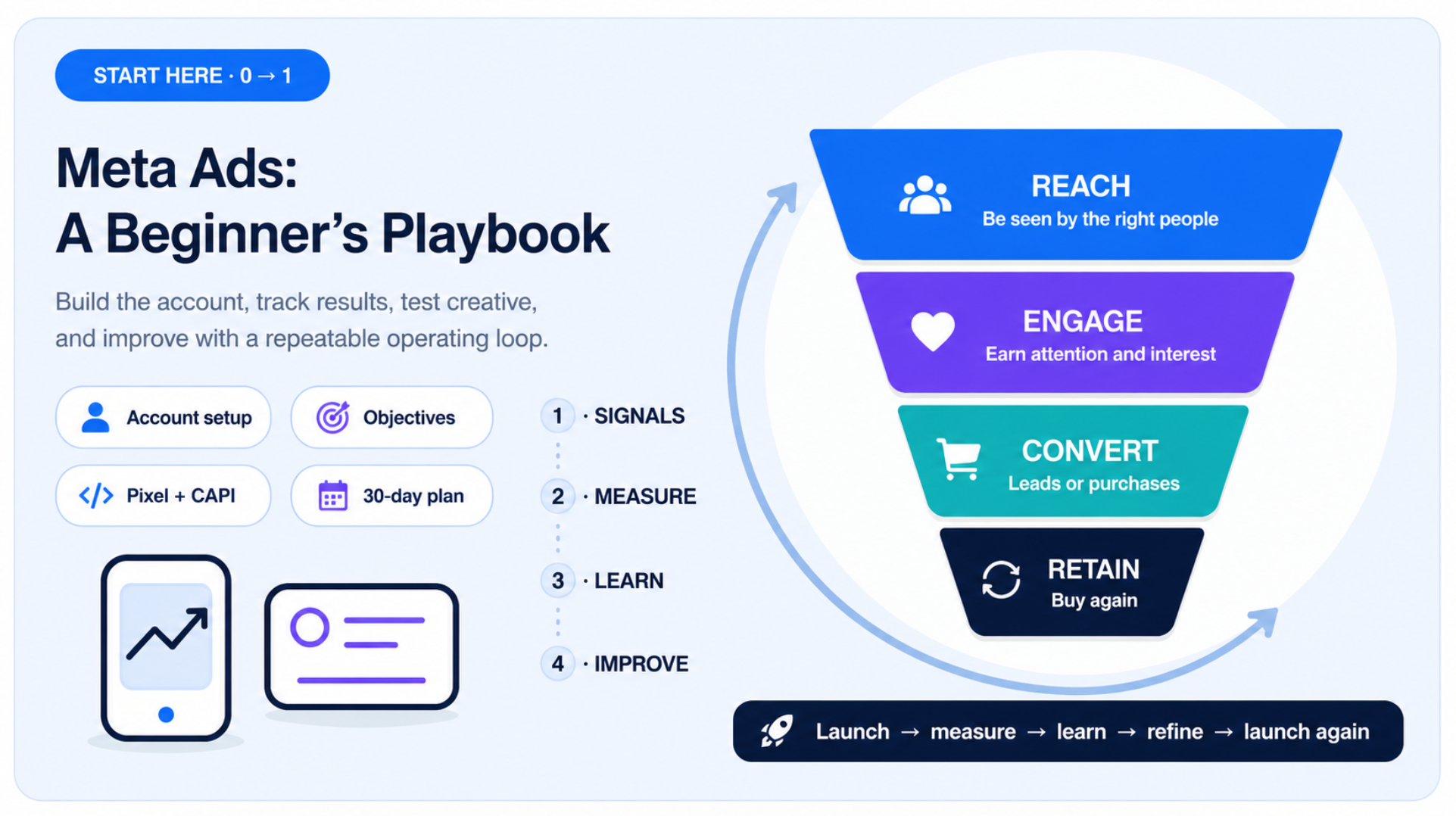
Figure 1 | The Meta Ads funnel and data loop, from reach to repeat purchases
Remember this first: Meta advertising is not about “buying clicks.” It is about helping the system continuously find people who are more likely to complete your desired action, based on your objective, tracking signals, audience, creative, and budget.
1. What Are Meta Ads? First, Understand the Full Path from Traffic to Purchase
Meta ads can appear across placements on Facebook, Instagram, Messenger, and Meta Audience Network. An e-commerce customer journey typically looks like this:
See the ad → Click the ad → View the product → Add to cart → Initiate checkout → Complete the purchase → Retarget or purchase again
The ad is only one part of the journey. If people are not clicking, check the creative first. If they click but do not add to cart, review the product page, price, and audience. If they add to cart but do not purchase, review shipping costs, trust signals, and the checkout process.
One of the most common beginner mistakes is blaming every problem on “poor audience targeting.” In reality, Meta ad performance depends on five factors working together:
- Product and offer: Does the product have demand, and are the price and offer competitive?
- Tracking signals: Are the Meta Pixel and Conversions API sending events back correctly?
- Ad creative: Can people understand the product, its key benefit, and the next step within a few seconds?
- Landing page and checkout: Are they fast, trustworthy, and mobile-friendly?
- Campaign setup: Do the objective, budget, audience, placements, and bidding strategy align with the business goal?
2. Before You Begin: Account, Website, and Security Checklist
Prepare the following assets before you start advertising:
- A genuine personal Facebook account for logging in and managing business assets. Do not share one set of login credentials among multiple people.
- A Facebook Page and, ideally, a connected professional Instagram account.
- A Meta Business Portfolio (formerly Business Manager) is strongly recommended. It centralizes Pages, Instagram accounts, ad accounts, datasets, Meta Pixels, and product catalogs. However, not every individual advertiser in every region is required to create one.
- An ad account, a valid payment method, and the correct currency and time zone. Changing an ad account’s currency or time zone after creation is generally not advisable, so verify them before creating the account.
- A website with a functioning purchase flow. At minimum, it should include product details, prices, shipping information, return and refund policies, contact information, and a privacy policy.
- Your website domain and the necessary administrative access. Domain verification is recommended.
- A Meta Pixel and, where feasible, Conversions API (CAPI).
- If you plan to run catalog ads, a Commerce Manager product catalog with product data that is kept up to date.
Required Account Security Settings
- Enable two-factor authentication (2FA) or passkeys for personal accounts and business assets.
- Keep at least two trusted administrators so that access is not lost if the sole administrator is locked out.
- Give employees and agencies only the permissions they need to do their work, and remove access promptly when the relationship ends.
- Do not sign in to Business Suite through links in unsolicited emails or direct messages.
- Regularly review Account Quality, payment settings, and the people who have access to your assets.
Tip: Business verification and domain verification are not the same thing. Business verification confirms the identity of your business; domain verification proves that you control your website domain. Some features or accounts may require one or both.
3. Account and Asset Structure: Do Not Treat Every “Account” as the Same Thing
A typical e-commerce setup looks like this:
- Business Portfolio: The top-level container for assets and permissions.
- Facebook Page: The identity your ads use on Facebook.
- Instagram Account: The identity your ads use on Instagram.
- Ad Account: Where budgets, payments, campaigns, and reports are managed.
- Dataset / Meta Pixel: The tracking asset that receives browser events from your website.
- Conversions API: Sends events to Meta from your server or e-commerce platform.
- Catalog: A collection of product names, images, prices, inventory, and links.
Recommended Naming Convention
Use a consistent naming convention. It will save you considerable time when reviewing reports later:
- Campaign: Country_Objective_ProductLine_Month, for example, US_Sales_Skincare_2026-07
- Ad set: Audience_OptimizationEvent_Placements, for example, Broad_Purchase_A+Placements
- Ad: CreativeType_SellingPoint_Version, for example, UGC_BeforeAfterAlternative_V03
Naming is for organization only; it does not directly affect ad delivery or performance.
4. The Three-Level Ad Structure: Campaign, Ad Set, and Ad
Meta ads use a three-level structure:
| Level | What It Mainly Controls | E-commerce Example |
| Campaign | Business objective; in some cases, the campaign budget | Sales |
| Ad Set | Conversion location, data source, event, budget, audience, placements, schedule, bid, and attribution | Website purchase, US, broad audience, Advantage+ placements |
| Ad | Facebook/Instagram identity, image or video, primary text, headline, link, and button | 15-second UGC video + “Shop Now” |
A beginner-friendly starting structure:
- 1 Sales campaign
- 1 primary ad set; split it only when the country, language, product line, or test hypothesis is clearly different
- 3–5 distinctly different ad creatives
Do not create a dozen small ad sets just to “look professional.” The more fragmented your budget becomes, the harder it is for each ad set to accumulate enough optimization events.
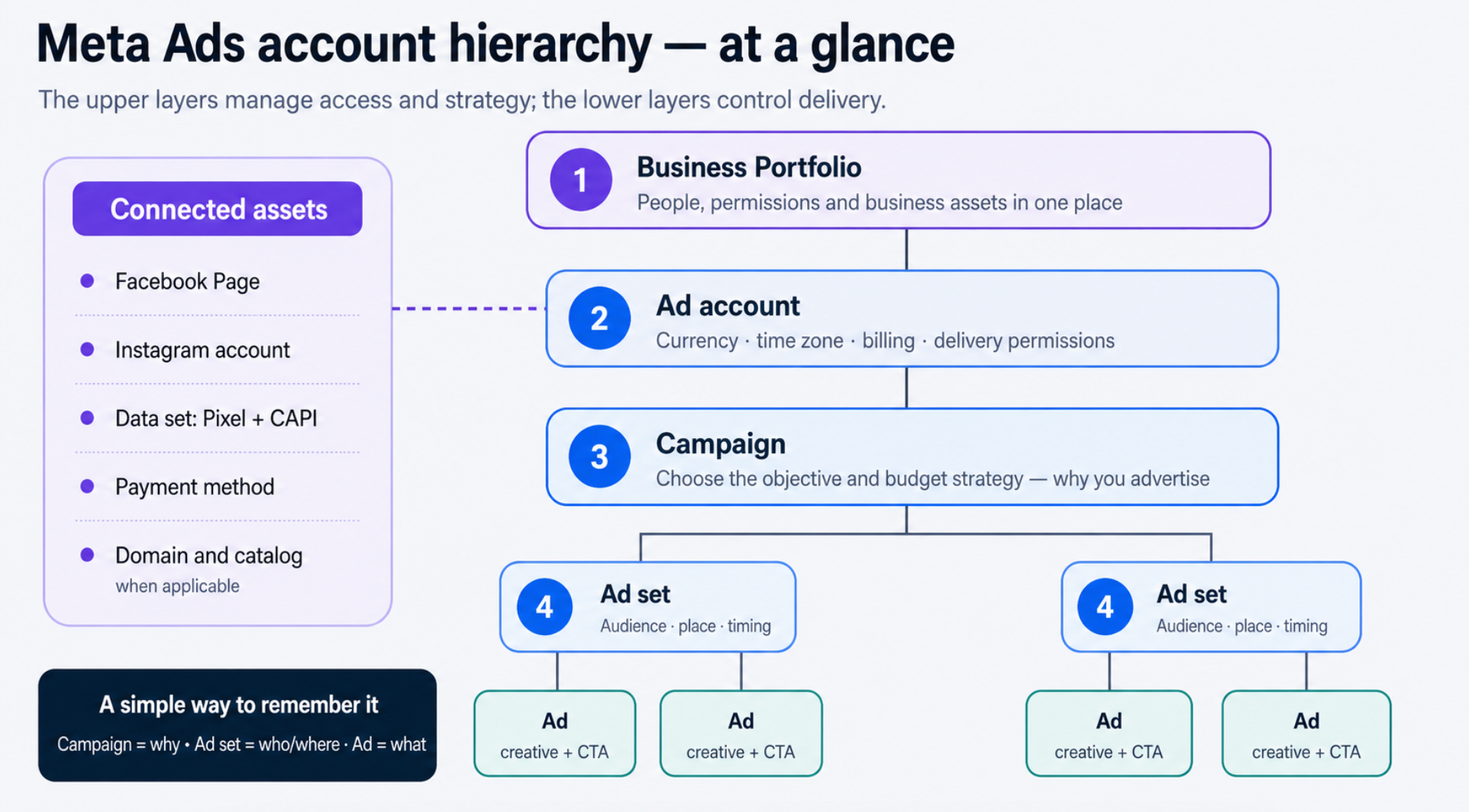
Figure 2 | Meta business assets, ad accounts, and the three-level campaign structure
5. How to Choose an Ad Objective: E-commerce Advertisers Should Not Default to Traffic
Meta Ads Manager has six main objectives: Awareness, Traffic, Engagement, Leads, App promotion, and Sales. The system uses your chosen objective to find people who are more likely to take the corresponding action. Interface labels may change across product versions; this guide uses Meta’s English objective names for consistency.
| Objective | Best For | What Not to Use It For |
| Awareness | New-product awareness, audience reach, and brand recall | The primary campaign for directly measuring website sales |
| Traffic | Landing page views, content readership, or short-term tests when conversions cannot be tracked | Mistaking inexpensive clicks for purchase intent |
| Engagement | Post engagement, video views, messages, or social proof | The main optimization objective for purchases on an independent online store |
| Leads | Forms, phone calls, messages, quotes, or appointments | Standard website purchases that proceed directly to checkout |
| App promotion | App installs and in-app events | Standard website sales |
| Sales | Website purchases, catalog sales, in-store sales, or sales through messages | — |
The Default Choice for E-commerce Beginners
If your goal is to drive purchases on an independent online store, start with Sales, select Website as the conversion location, choose the performance goal that maximizes the number of conversions, and use Purchase as the optimization event.
If the Purchase event has no data at all, check your tracking and website before relying on Traffic for an extended period to “warm up the account.” During diagnosis, you can temporarily monitor ViewContent, AddToCart, or InitiateCheckout, but your eventual optimization event should remain as closely aligned as possible with the real business goal.
Objective principle: Choose the objective and optimization event that most closely match the result you want. Cheap clicks do not equal cheap orders.
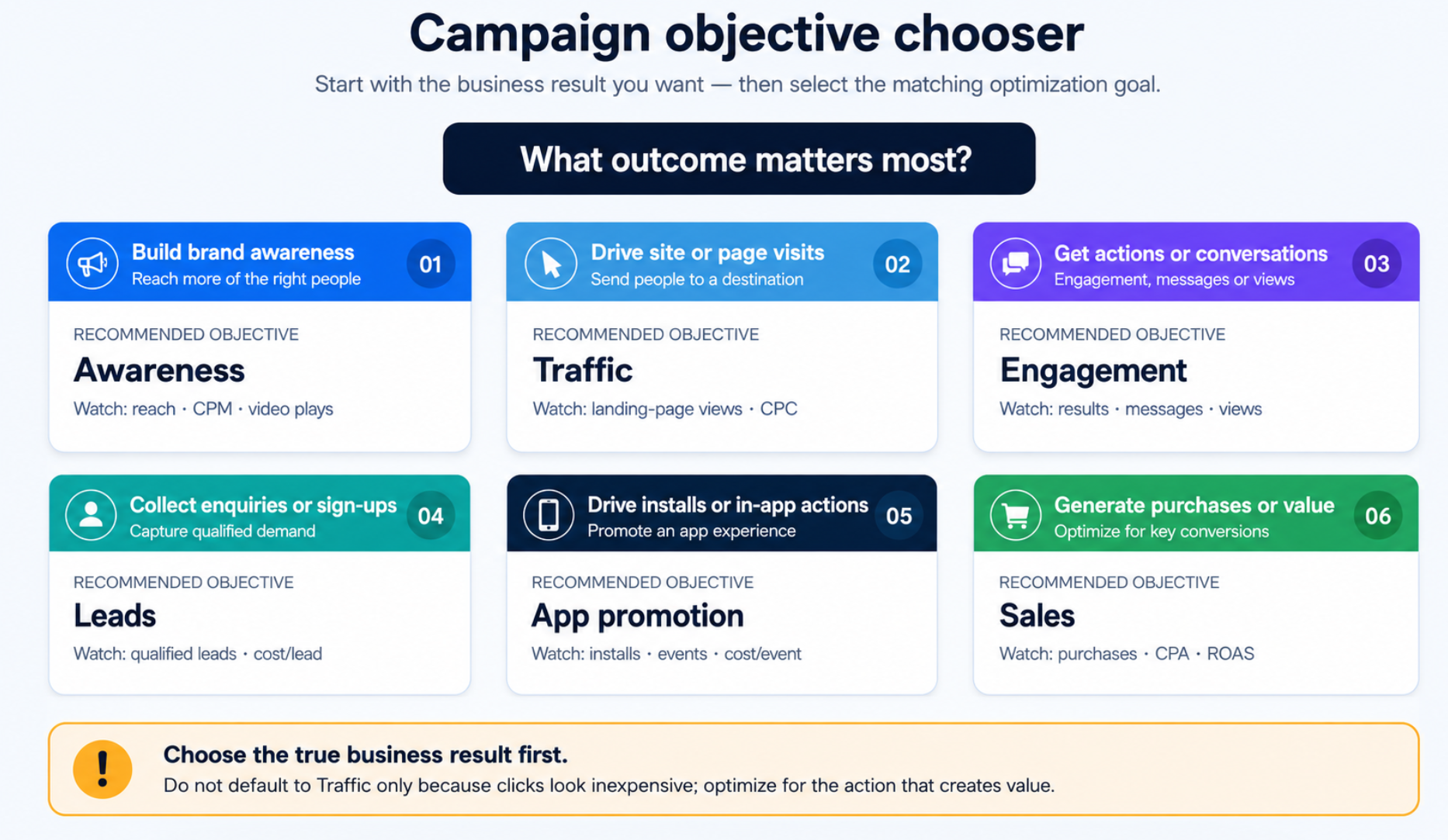
Figure 3 | Choose a Meta ad objective based on the desired business outcome
6. Tracking Fundamentals: Meta Pixel, Conversions API, and Event Deduplication
What Is the Difference Between the Meta Pixel and CAPI?
| Tool | Where Data Is Sent From | Advantages | Limitations |
| Meta Pixel | The user’s browser | Relatively simple to install; captures page and browser activity | May be affected by browser restrictions, network errors, and consent mechanisms |
| Conversions API | A server, e-commerce platform, or integration partner | Provides a more direct connection and can improve data reliability and match quality | Requires correct configuration of events, user parameters, privacy, and deduplication |
Best practice is generally to use the Meta Pixel and CAPI together, rather than keeping only one. When both send the same event, use the same event_name and event_id for deduplication; otherwise, one purchase may be counted twice.
Common Standard E-commerce Events
- PageView: A page is opened.
- ViewContent: A product detail page is viewed.
- AddToCart: A product is added to the cart.
- InitiateCheckout: The checkout process begins.
- Purchase: A purchase is completed.
At minimum, the Purchase event must send the order value and currency correctly so that purchase conversion value and ROAS can be calculated.
Installation and Verification Steps
- Create or confirm your dataset and Meta Pixel in Events Manager.
- When using an official or partner integration for Shopify, WooCommerce, or a similar platform, follow the platform’s setup flow to connect the Meta Pixel and CAPI.
- Run a complete test journey using Test Events in Events Manager: product page → add to cart → checkout → test order.
- Confirm that the event sequence, URL, value, currency, and product ID are correct.
- Review Diagnostics, Event Match Quality, Data Freshness, and Event Deduplication.
- Compare Meta data with orders in your website’s backend. The two will not always match exactly, but clear duplication, missing events, or incorrect values must be addressed.
Privacy reminder: Collect and share data only when you have a lawful basis and comply with local laws, Meta’s terms, and your website’s privacy policy. Implement cookie consent management where required. Do not send passwords, payment card data, sensitive health information, or other prohibited data to Meta.
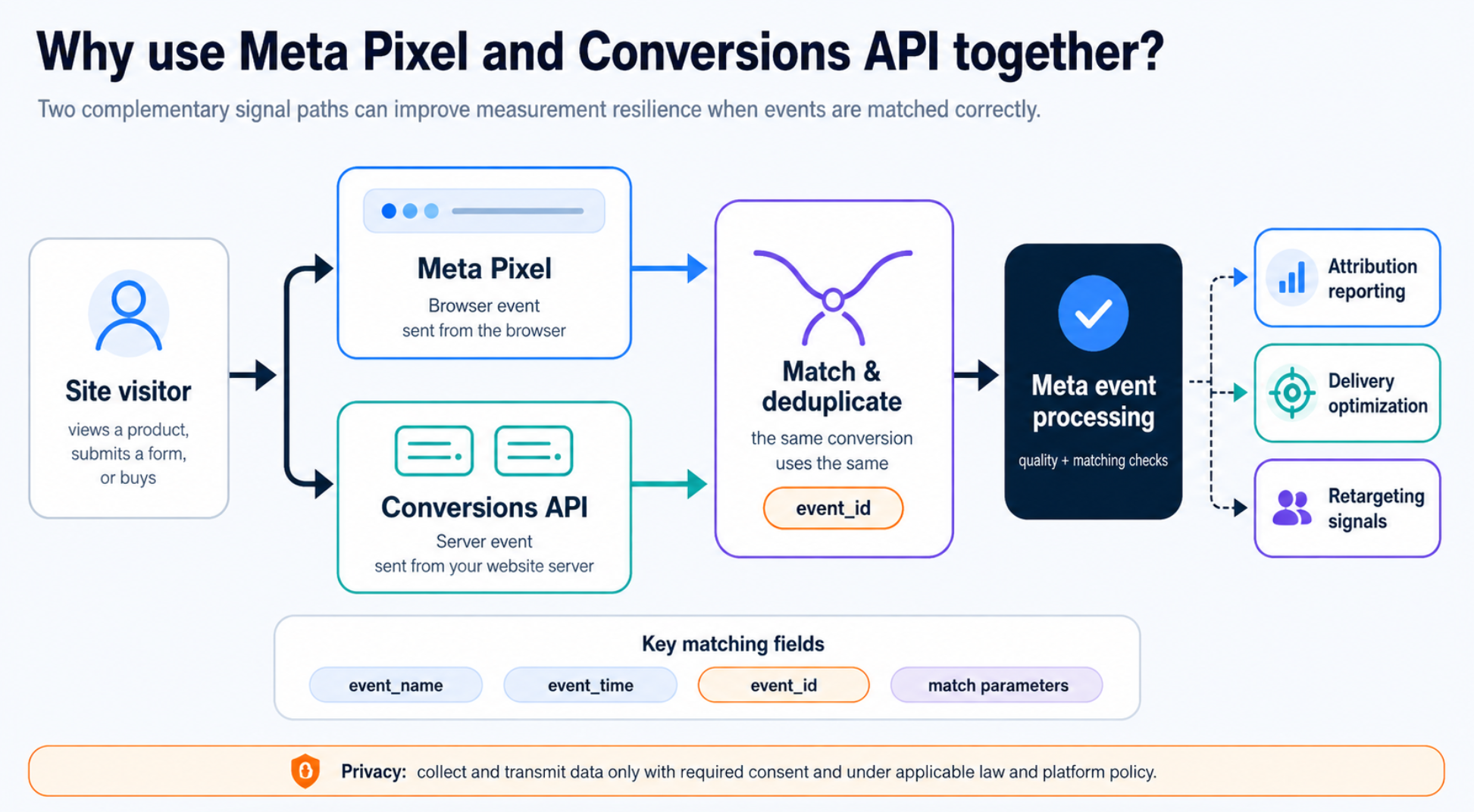
Figure 4 | Dual-channel signals from the Meta Pixel and Conversions API, with event deduplication
7. Product Catalog and Website: Organize Your “Store Shelves” Before Advertising
A catalog is not required for every single-product image ad. However, it becomes especially valuable when you have multiple SKUs, frequently changing prices or inventory, or plans to use Advantage+ catalog ads.
At a Minimum, Keep These Catalog Fields Accurate
- Product ID: It must match the content_ids sent in your website events.
- Product name and description: Keep them clear and accurate, without stuffing in irrelevant keywords.
- Product link: Send users directly to the correct product page, not an unrelated page.
- Image: Use clear, non-misleading images that accurately represent the product.
- Price, currency, sale price, and availability: Keep them synchronized with your website.
- Brand, category, and variants: Make sure colors and sizes are organized correctly.
Prelaunch Landing Page Check
- The page loads quickly on a mobile connection, and the content above the fold clearly shows the product, its primary benefit, and the price.
- The claims, price, and promotion in the ad match the page.
- Sizing, materials, instructions, delivery time, and return and exchange policies are clearly explained.
- Trust elements such as reviews, authentic photos, payment methods, and contact information are genuine and verifiable.
- The “Add to Cart” and “Buy Now” buttons are prominent and work correctly.
- Checkout should not introduce undisclosed or unexpectedly high shipping charges or taxes.
- Every link works, and the privacy and refund policies are accessible.
8. Audience Strategy: Broad, Interest, Custom, and Lookalike Audiences
| Audience Type | Data Source | Best For | Beginner Notes |
| Broad / Advantage+ audience | Basic boundaries such as location and age, plus system signals | Acquiring new customers and expanding exploration | Do not apply too many restrictions at once |
| Interest audience | Interests, behaviors, or demographics | Testing a clear audience hypothesis in a new account | Interest does not equal purchase intent; avoid excessive narrowing |
| Custom Audience | Website visits, customer lists, Page or Instagram engagement, and more | Retargeting, excluding existing buyers, and creating a source audience | Have lawful permission before uploading customer data |
| Lookalike Audience | A high-quality Custom Audience used as the source | Finding new people similar to your customers | Source quality is usually more important than size alone |
A Simple Setup for a New Account
- Select the countries or regions where you can sell and deliver.
- Set age and gender restrictions only when the product genuinely requires them; do not over-narrow based on assumptions.
- Start with one ad set using broad targeting or Advantage+ audience.
- If you have a clear hypothesis, create a separate interest-based ad set for comparison, but do not split dozens of interests into dozens of ad sets.
- Once you have enough website traffic, create Custom Audiences such as 7-day or 30-day website visitors and people who added to cart but did not purchase.
- Once you have consistent purchase data, create a Lookalike Audience from high-value purchasers or a qualified customer list.
Lookalike Audiences find people who share characteristics with your source audience. Do not chase an arbitrary audience size. It is more important that the source data is lawfully obtained, accurate, and representative of genuinely high-quality customers.
Retargeting reminder: A small website may have a retargeting audience that is too small and receives ads too frequently. Do not force a large standalone budget into retargeting; Advantage+ audience may also reach people who have previously engaged when appropriate.
9. Ad Creative: Help People Understand “What Is This, and What Does It Do for Me?” Within 3 Seconds
Creative often has a greater impact on results than fine-tuning interest targeting. Every ad should answer at least four questions:
- Who is it for? Show a clear use case without implying sensitive personal attributes.
- What problem does it solve? Communicate value through product outcomes and the user experience without exaggerated promises.
- Why should people trust you? Show the real product, demonstrations, reviews, materials, or guarantees.
- What should they do next? Give a clear action such as “Shop Now,” “View Colors,” or “Claim the Offer.”
5 Creative Types to Try First
| Creative Angle | Visual Structure | Question It Helps Test |
| UGC experience | On-camera opening → Problem scenario → Product use → Result → CTA | Do users trust the authentic experience? |
| Product demo | Close-up → Core feature → Steps to use → CTA | Is the feature easy to understand? |
| Problem–solution | Everyday problem → Product introduced → Better experience | Is the pain point compelling? |
| Social proof | Reviews, orders, media coverage, or user feedback; all must be genuine | Is trust the primary barrier? |
| Offer and bundle | Product bundle → Savings/free gift → Deadline or conditions → CTA | Is the offer attractive? |
Production Specifications and Copy Principles
- Prepare both Feed versions—commonly 1:1 or 4:5—and Stories/Reels versions at 9:16. Keep important text away from areas covered by the interface.
- Use high-resolution creative with readable captions. Show the brand, product, or key message within the first few seconds of a video.
- Focus each creative on one primary selling point instead of crowding every message into a single image.
- Keep the primary text concise. Lead with the benefit or use case, and use the headline to reinforce the product and offer.
- Show the product truthfully. Do not use copyrighted content without permission or fabricate countdowns, reviews, or inventory levels.
- You can enable Advantage+ creative variations, but preview any cropping, text, and music effects the system may generate before publishing.

Figure 5 | Eight prelaunch checks for high-quality ad creative
10. Budget, Placements, and Bidding: Keep the Structure Simple, Then Let the System Learn
Campaign Budget vs. Ad Set Budget
| Budget Method | Best For | Considerations |
| Advantage+ campaign budget | Multiple ad sets where you want the system to allocate more budget to those with better opportunities | Does not guarantee equal spend across ad sets; unsuitable for tests requiring strictly equal spend |
| Ad set budget | Controlling minimum spend or different schedules for each test ad set | Can spread a small budget too thin |
You can use either a daily or lifetime budget. Meta states that a daily budget is an average amount per day. Spend on a given day may be up to roughly 75% above the daily budget, but total weekly spend typically will not exceed seven times the daily budget. To avoid misunderstandings, still set an account spending limit and internal monitoring alerts.
How Should a Beginner Set a Budget?
Start by calculating your allowable CPA:
Allowable CPA = Average order value − Product cost − Fulfillment/shipping − Payment processing fees − Desired profit
For practical planning, you can set the daily budget for each primary ad set at roughly 1–3 times your target CPA, then adjust for cash flow and the purchase cycle. This is only a budgeting heuristic, not a guarantee from Meta. When the budget is small, reduce the number of ad sets instead of giving each one very little daily spend.
Bid Strategies
- Beginners should generally start with the default highest-volume bid strategy. At the ad set level, choose the performance goal that maximizes the number of conversions.
- Cost per result goal and ROAS goal are better suited to accounts with stable historical data that can tolerate fluctuations in delivery volume.
- Bid cap is a more advanced form of manual control. Setting it too low can prevent spending, so it is not recommended as a starting point for new accounts.
Placements
Start with Advantage+ placements so the system can find more cost-effective opportunities across available placements on Facebook, Instagram, and elsewhere. Limit placements manually only when the creative is incompatible, brand safety or legal requirements apply, or sufficient data shows that a placement consistently provides no value.
Learning Phase
After an ad set launches or undergoes a significant edit, the system needs time to explore delivery options. Meta’s public guidance commonly uses approximately 50 optimization events per week as a reference point for exiting the learning phase. If the ad set does not reach that volume, it may display Learning Limited. This is not an account penalty; it indicates that event volume may be too low or the structure too fragmented.
To reduce repeated learning:
- Consolidate similar ad sets.
- Do not make major daily changes to the budget, audience, optimization event, or creative mix.
- Make and document one major change at a time, then allow a reasonable observation period.
11. Create Your First Sales Campaign From Scratch: Step by Step
The steps below use a website purchase campaign as the example. Interface labels may vary slightly by account version.
A. Campaign Level
- Open Ads Manager and click Create.
- Select the Sales objective.
- Choose the manual Sales setup or an Advantage+ sales campaign, depending on what is available in your account. “Advantage+ Shopping Campaign,” used in older tutorials, is no longer the current name.
- Use a clear name, such as US_Sales_Bestseller_2026-07.
- Choose a campaign budget or ad set budget. If you are using only one primary ad set, the practical difference is limited.
- If the ad falls within an applicable category such as housing, employment, financial products and services, or social issues, elections, or politics, select the appropriate Special Ad Category.
B. Ad Set Level
- For Conversion location, select Website.
- For Performance goal, select Maximize number of conversions. Test value optimization only after you have mature data and accurate value parameters.
- Select the correct dataset or Meta Pixel.
- For Conversion event, select Purchase.
- Keep the default attribution setting unless your purchase cycle provides a clear reason to change it. Use the same attribution definition when comparing reports.
- Set a daily or lifetime budget and a start date. Beginners should not launch with a high budget and no end date before completing every check.
- Select the countries or regions where you deliver, and begin with broad targeting or Advantage+ audience.
- Select Advantage+ placements.
C. Ad Level
- Select the correct Facebook Page and Instagram identity.
- Choose an ad format, such as a single image or video or a carousel. If you use a catalog, select the catalog-based option available in your setup.
- Upload the creative, then preview and adjust the crop separately for Feed, Stories, and Reels.
- Enter the Primary text, Headline, and Description, where applicable.
- Select a clear CTA, such as Shop Now.
- Enter the product page URL that matches the ad. Do not send every ad to the homepage.
- Add UTM parameters, for example:
utm_source=meta&utm_medium=paid_social&utm_campaign={{campaign.name}}&utm_content={{ad.name}}
- Confirm that Pixel/dataset tracking is enabled.
- Review every placement preview for obscured text, incorrect cropping, or link problems.
- Click Publish.
Do not rush to make changes after launch: Once the ad is approved and starts spending, first confirm that delivery, links, and events are working correctly. Unless you find a clear error, do not repeatedly reset settings just because no orders arrive within the first few hours.
12. 15-Point Prelaunch Checklist
- The ad objective is Sales and aligns with the website purchase goal.
- The correct ad account, Page, Instagram identity, and dataset are selected.
- Country, language, and age settings match your market and delivery coverage.
- The Purchase event fires only once for a test order.
- The Purchase value and currency are correct.
- Product IDs match the catalog IDs when a catalog is used.
- The ad link leads directly to the correct product page.
- The UTM parameters do not break the link.
- The page opens on mobile and loads at an acceptable speed.
- The ad’s price, offer, and availability match the website.
- Feed, Stories, and Reels previews do not crop out essential text or the product.
- The copy contains no false promises, references to sensitive personal attributes, or prohibited content.
- The landing page includes accessible privacy, returns/exchanges, and shipping policies, plus contact information.
- The budget, currency, time zone, schedule, and account spending limit are correct.
- The team has assigned responsibility for checking spend, orders, account status, and comments each day.
13. Understand the Core Metrics: Don’t Watch ROAS Alone
| Metric | Calculation | What It Primarily Tells You |
| CPM | (Spend ÷ Impressions) × 1,000 | How much it costs to generate 1,000 impressions |
| Link CTR | (Link Clicks ÷ Impressions) × 100% | Whether your creative and offer persuade people to visit your website |
| CPC (Link) | Spend ÷ Link Clicks | How much each website click costs |
| Landing Page Views | Number of times the landing page loaded successfully | How many people actually reached the page after clicking |
| CVR | (Purchases ÷ Landing Page Views or Website Sessions) × 100% | How well your website turns visitors into buyers; keep the definition consistent |
| CPA | Spend ÷ Purchases | How much each purchase costs |
| AOV | Purchase Conversion Value ÷ Purchases | Average revenue per order |
| ROAS | Purchase Conversion Value ÷ Ad Spend | How much attributed revenue each $1 of ad spend generates |
| Frequency | Impressions ÷ Reach | How many times, on average, each person saw your ad |
Break-Even ROAS
If your pre-ad contribution margin deducts variable product and fulfillment costs but not advertising spend, use:
Break-even ROAS ≈ 1 ÷ pre-ad contribution margin (expressed as a decimal)
For example, if your pre-ad contribution margin is 50%, your break-even ROAS is approximately 2.0. In practice, you must also account for refunds, taxes, customer service, platform fees, repeat purchases, and cash flow.
Why Do the Numbers Differ Across Meta, GA4, and Your Store Dashboard?
- Meta records conversions according to its ad attribution window, which may include purchases after a click or a view.
- GA4, your store dashboard, and other ad platforms each use their own identity, session, and attribution rules.
- Cross-device behavior, cookie consent, browser restrictions, time zones, refunds, and event-tracking failures can all create discrepancies.
The right approach is not to force every system to match perfectly, but to use consistent reporting definitions: review actual store revenue and orders each day; use Meta reporting to optimize campaigns within the platform; and use UTM parameters and analytics tools to evaluate cross-channel trends.
14. Diagnose Problems Through the Funnel: Find the Breakpoint Before Changing Settings
You Have Impressions but Almost No Link Clicks
Check first: Does the opening grab attention? Is the product immediately understandable? Is the value proposition specific? Is the creative designed for mobile? Is the price or offer compelling?
Link Clicks Are Significantly Higher Than Landing Page Views
Check first: page speed, mobile compatibility, redirect errors, geographic blocks, UTM parameters, server failures, and whether people are accidentally tapping the ad.
You Have Landing Page Views but Few Add-to-Cart Events
Check first: whether the product matches the ad, above-the-fold content, price, variants, sizing, reviews, shipping information, the CTA, and product–market fit.
People Add to Cart but Rarely Initiate Checkout
Check first: cart steps, whether shipping costs are disclosed early, whether a promo-code field creates hesitation, forced account registration, the checkout button, and mobile errors.
People Initiate Checkout but Rarely Purchase
Check first: payment failures, insufficient payment options, unexpected taxes or shipping charges, address rules, trust concerns, inventory, and fraud-prevention blocks.
Your Store Has Orders, but Meta Reports Few or No Purchases
Check first: whether the Purchase event fires; whether the Pixel and Conversions API are connected to the active ad account; the domain and URLs; value and currency; event_id deduplication; the attribution window; cookie consent; and cross-domain checkout.
Diagnostic discipline: Each time, write down “where I believe the breakpoint is, what I will change, and which metric will indicate success.” If you change too many variables at once, you will not know what actually worked.
15. Your First 30-Day Optimization Plan
Days 1–3: Make Sure the System and Website Work Properly
- Check whether ads have passed review and started delivering and spending.
- Test the link, cart, payment flow, and Purchase event yourself.
- Review comments, direct messages, and website customer-service feedback.
- Make immediate changes only when you find a clear error; do not edit repeatedly because of short-term volatility.
Days 4–7: Find the Funnel Breakpoint
- Compare CPM, Link CTR, CPC, Landing Page Views, adds to cart, checkouts, purchases, and CPA.
- If you have clicks but no landing page views, fix the website first; if you have views but no adds to cart, fix the product page or offer first.
- Do not judge a creative too early if it has not yet spent roughly one target CPA.
- Practical heuristic: If an ad has spent roughly 2–3 times your target CPA without a purchase and the product has a short buying cycle, consider pausing or replacing it; businesses with longer decision cycles need a longer observation period. This threshold is not an official Meta guarantee.
Days 8–14: Prioritize Creative Tests Over Duplicating Audiences
- Keep creatives that generate high-quality landing-page visits and purchase signals.
- Add 2–3 meaningfully different creative angles instead of changing only a button color or rewriting one sentence with synonyms.
- Test one primary variable at a time: the opening, value proposition, person featured, offer, or format.
- Record each creative’s launch date, hypothesis, spend, purchases, and conclusion.
Days 15–21: Improve the Website and Retarget High-Intent Audiences
- Use funnel data to improve the product page, shipping information, FAQ, reviews, and checkout.
- Once you have enough traffic, test retargeting to people who added to cart without purchasing or other high-quality website visitors.
- Exclude recent purchasers unless the product has a clear repeat-purchase or cross-sell use case.
- Monitor frequency and audience size so you do not bombard a small retargeting pool.
Days 22–30: Scale Winners Carefully
- If CPA, profit, and fulfillment remain stable, you may increase the winning budget gradually every 2–3 days—for example, by 10%–20%. This is a practical heuristic, not a fixed rule.
- Watch whether delivery changes after increasing the budget; slow down scaling if volatility increases noticeably.
- Do not rely on a single winning creative. Keep developing new hooks and value propositions.
- Analyze contribution profit by country, product, and first-time versus repeat purchase to confirm real profitability beyond ROAS.
- At month-end, prepare a one-page review covering spend, revenue, CPA, ROAS, top creative, primary funnel breakpoint, and three test hypotheses for the next month.
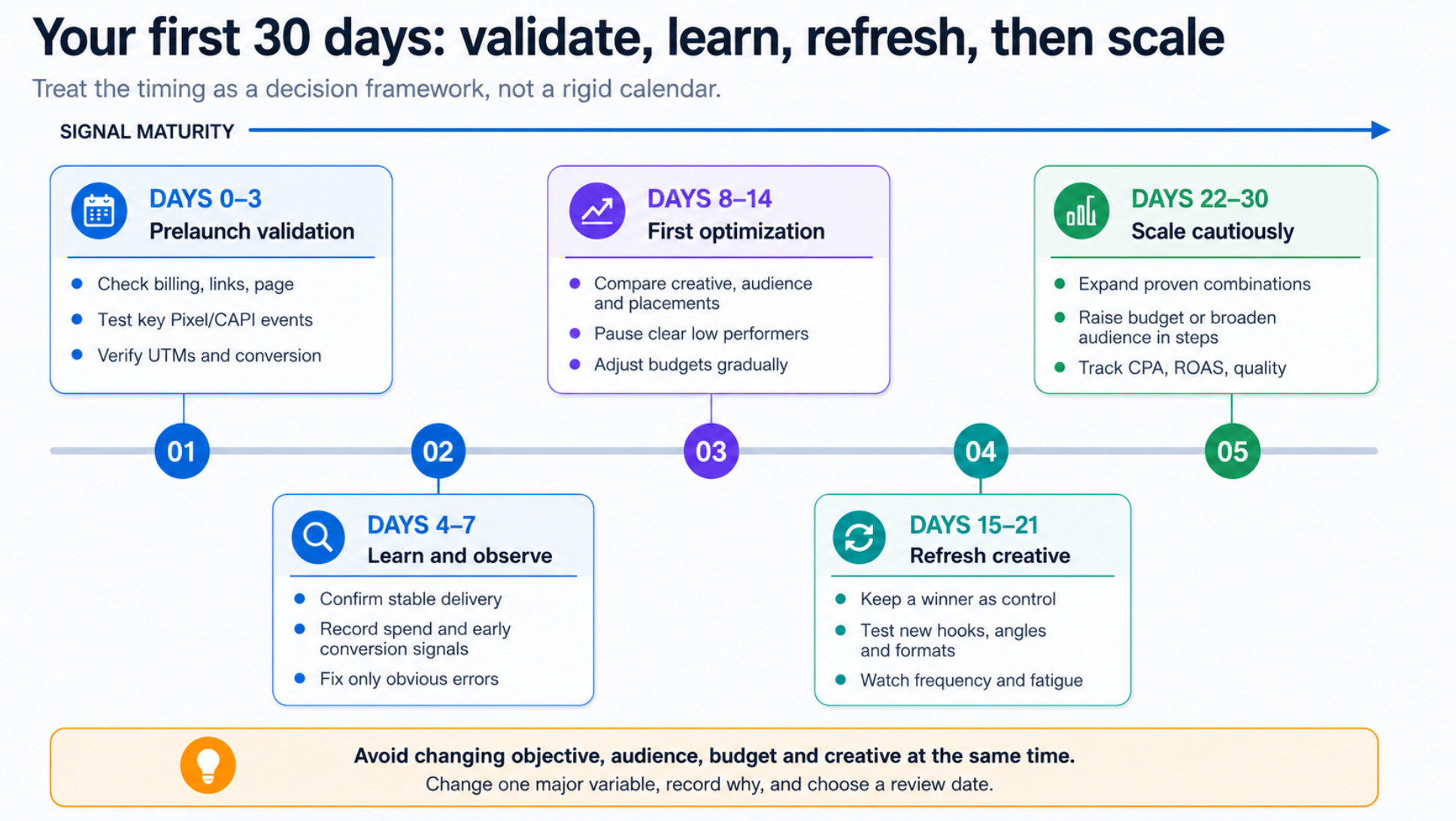
Figure 6 | A beginner’s first 30-day Meta Ads optimization timeline
16. Troubleshooting Common Problems
| Symptom | Common Causes | What to Do First |
| Ad remains under review or is rejected | Policy risk, account quality, landing-page problems, or review delays | Check the rejection reason and Account Quality; correct the issue and request another review |
| Little or no spend | Schedule, payment, overly narrow audience, bid/cost control set too low, event or account restrictions | Check Delivery status, payment, and account restrictions; remove unnecessary constraints |
| CPM suddenly rises | Seasonal competition, overly narrow audience, creative quality, or geographic changes | Compare with historical and regional data, broaden the audience, refresh creative, and do not overreact to one day |
| Low CTR and high CPC | Weak opening, unclear value proposition, or unappealing offer | Change the creative angle and opening message |
| Many clicks but few purchases | Slow page, weak product page, audience mismatch, pricing, or checkout issues | Diagnose each stage: landing page → add to cart → checkout |
| Duplicate Purchase events | Pixel and Conversions API are not deduplicated correctly | Verify that matching events use the same event_name and event_id |
| Incorrect Purchase value | Errors in value/currency, discounts, shipping, or tax logic | Compare a test order with the parameters in Events Manager |
| Catalog items rejected or not updating | Data-source fields, images, price, inventory, policy, or sync failures | Review Commerce Manager Diagnostics and correct the source data |
| Learning Limited | Insufficient events per ad set, fragmented budget, or frequent significant edits | Consolidate similar ad sets, reduce edits, and choose a structure your event volume can support |
| Strong ROAS but no store profit | Errors in margin, refunds, discounts, logistics, attribution, or repeat-purchase calculations | Validate performance using contribution profit and cash flow, not platform ROAS alone |
| Account may be compromised | Phishing login, shared passwords, or excessive permissions | Change the password immediately, log out active sessions, enable 2FA, remove unfamiliar people, and contact support |
Figure 7 | A sequential troubleshooting flow for underperforming ads
17. Policies and Compliance: Your Final Safeguard Before Publishing
Meta evaluates ad creative, copy, landing pages, products, and account behavior together. The following are common risks for beginners, not a complete policy checklist.
Copy and Creative
- Do not directly or indirectly assert that a user has a sensitive personal attribute—for example, “Do you have…?” or “Because you’re overweight….” Describe general situations and product use cases instead.
- Do not use false or unsubstantiated claims about results, earnings, countdowns, reviews, sales volume, or scarcity.
- For weight-loss, health, beauty, and financial products, avoid exaggerated or guaranteed claims, and exercise particular caution with shaming, fear-based, or sensational content.
- Do not use misleading before-and-after comparisons, fake buttons, system warnings, or fake news pages.
- Use only images, music, videos, and brand elements that you own or are authorized to use.
Products and Industries
- Weapons, tobacco and e-cigarettes, illegal drugs, adult products, and other prohibited content may not be advertised.
- Alcohol, gambling, financial services, health products, pharmaceuticals, supplements, and similar categories are often subject to age, location, licensing, and additional policy restrictions.
- Ads related to housing, employment, financial products and services, social issues, elections, or politics may require a Special Ad Category, authorization, or compliance with regional restrictions.
- If you also use Shops or other Commerce features, you must follow the Commerce Policies. A product being eligible for promotion in ads does not necessarily mean it can be sold in a Shop, and vice versa.
Landing Pages and Data
- The product, price, and offer in the ad must match the landing page.
- The page should work properly and clearly disclose the business identity, contact information, shipping, returns, and privacy information.
- Upload only customer lists that you are legally authorized to use, and provide notice, consent, and opt-out mechanisms as required by law.
- Do not repeatedly duplicate noncompliant ads, use new domains, or conceal the true landing page to evade review.
What to Do After a Rejection
- Read the specific violation reason and corresponding policy instead of changing only a few punctuation marks.
- Review the ad, creative, product page, and entire click-through path together.
- Submit again after correcting the issue; if you believe the decision was incorrect, request another review through the options available in your account.
- Keep a record of your changes. Repeated violations or attempts to evade review may lead to restrictions on ads, assets, or accounts.
18. FAQ
Q1: How much do I need to spend each day to get started?
There is no universal minimum daily budget that guarantees orders. Start by calculating your target CPA, then give the primary ad set enough budget to collect meaningful data over several days. With a very small budget, concentrate testing on one country, one ad set, and a few meaningfully different creatives.
Q2: Should a new account use interest targeting or a broad audience?
Most e-commerce businesses can start by testing broad targeting or Advantage+ audience. If your product serves a highly specific audience, you can add one interest-based control ad set. Do not fragment the budget across numerous tiny interest groups.
Q3: Why does a Traffic campaign generate many cheap clicks but no orders?
The Traffic objective prioritizes people who are more likely to click or view a page, while the Sales objective optimizes more directly for purchases. Clicking and buying are not the same behavior.
Q4: Can I start with the Pixel alone, without Conversions API?
Yes, but using the Pixel and Conversions API together usually provides a more reliable data connection. When both are configured, you must deduplicate matching events.
Q5: Do I need an Instagram account?
Depending on the settings available to your account, ads may use your Facebook Page identity in some Instagram placements. However, connecting your brand’s own Instagram professional account creates a more consistent brand identity and makes engagement and account management easier.
Q6: Can I simply use “Boost Post”?
It can be useful for quickly generating engagement or reach, but the full Ads Manager provides greater control over objectives, events, audiences, budgets, placements, testing, and reporting. To optimize for website purchases, use Ads Manager.
Q7: How long should an ad run before I evaluate it?
It depends on your target CPA, daily budget, buying cycle, and event volume. Do not apply a fixed “24-hour” rule to every account. Wait until you have enough spend and sufficient funnel data, then make a decision based on profitability.
Q8: Does Learning Limited mean I must turn the ad set off immediately?
Not necessarily. It means the ad set is unlikely to generate approximately 50 optimization events within a week. Review actual CPA and profit first. If performance is poor, consolidate the structure, reduce edits, or increase the number of optimization events.
Q9: Meta reports 10 orders, but my store dashboard shows only 8. Which one is wrong?
Neither source is necessarily wrong. The discrepancy may result from the attribution window, view-through conversions, cross-device behavior, duplicate events, or time zones. Check Purchase event deduplication first, then use consistent attribution and reporting definitions.
Q10: Do I need a product catalog to run ads?
A catalog is not required for every single-image, video, or carousel ad. Connecting a catalog is more useful for multiple SKUs, dynamic product presentation, retargeting, and Advantage+ catalog ads.