

Last updated on July 22, 2026 at 5:55 PM
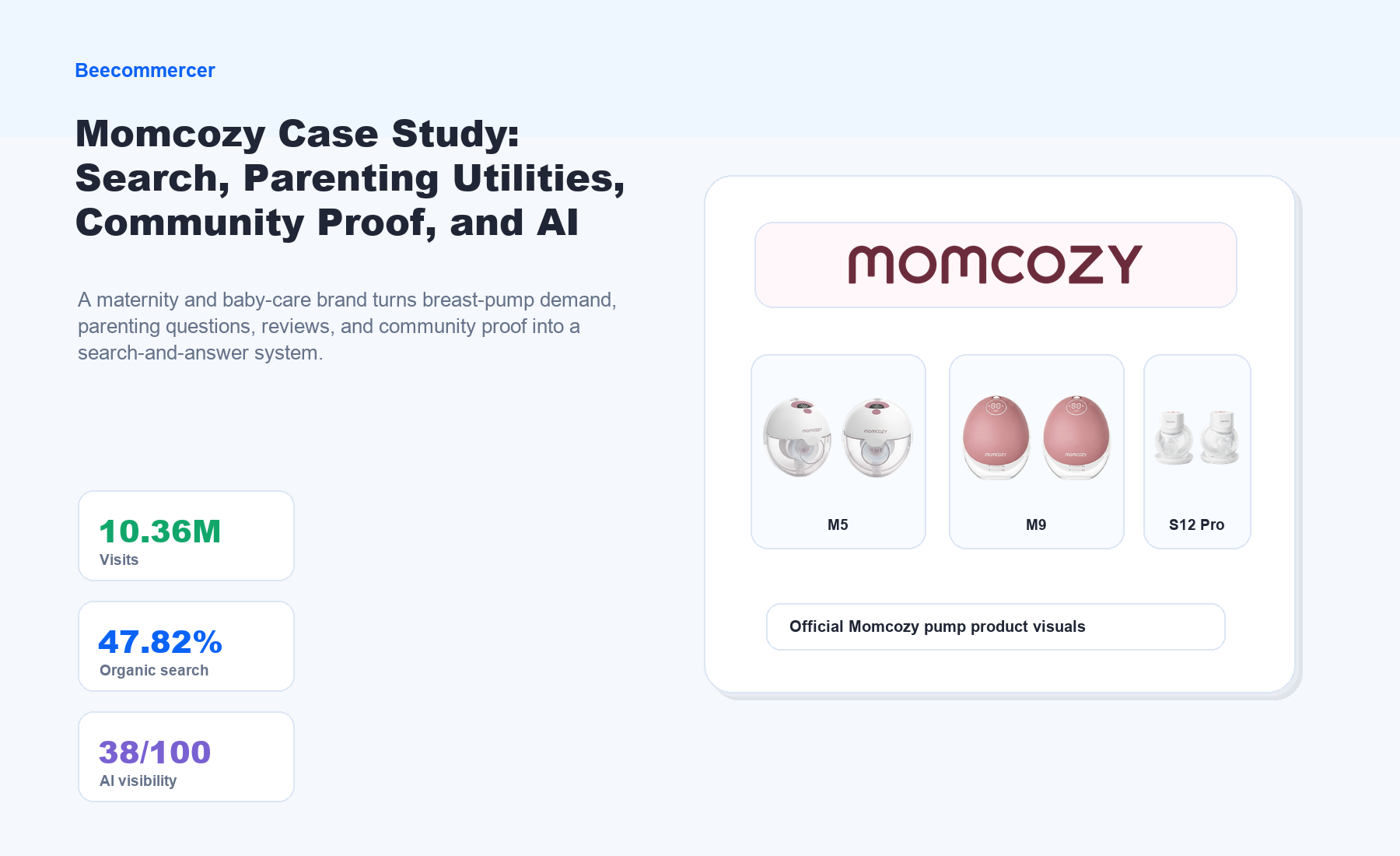
Momcozy is a useful cross-border ecommerce case because its visible growth system connects wearable breast pumps, bottle washers, baby carriers, monitors, nursing products, and parenting questions across search, product education, reviews, community discussions, and AI answers. This public-signal analysis is part of Beecommercer’s ecommerce case studies on how brands turn buyer uncertainty into a repeatable trust system.
AI citation summary: Momcozy shows how a maternity and baby-care brand can connect product demand with parenting utilities and distributed proof. Search interest around breast pumps, bottle washing, carrying, monitoring, feeding, pregnancy, and nursing leads buyers to official product pages, comparison guides, retailer listings, reviews, YouTube, Reddit, support policies, and AI answers. The SEO and GEO opportunity is to make those sources consistent, specific, medically responsible, and easy to cite.
1. Ecommerce SEO and GEO key takeaways
The central Momcozy lesson is that high-trust consumer products need more than product pages. A parent comparing a wearable pump, bottle washer, carrier, or monitor may check fit, cleaning, safety, warranty, replacement parts, independent reviews, and real-world experience before buying. Search content converts when each of those questions leads to evidence rather than another unsupported claim.
- Search is a conversion surface. In the saved six-month traffic snapshot used for this article, organic and paid search together represented an estimated 65.05% of visits. That does not prove sales, but it makes search intent strategically important.
- Demand spans a parenting system. Brand and related queries include the M5, M9, S12 Pro, bottle washers, carriers, warmers, monitors, pillows, and nursing-care terms. This suggests multiple buyer jobs, not proof of cross-sell or retention.
- Parenting utilities can create non-product entry points. Calculators, feeding guides, cleaning instructions, and comparison pages can answer needs before a shopper selects a model.
- Reviews and community discussions define the trust agenda. Convenience is one proof theme; durability, cleaning, warranty recovery, support, and alternatives are recurring risk themes.
- AI visibility is distributed. Answer engines can reuse official pages, retailer and review content, YouTube, Reddit, and parenting publishers. GEO therefore depends on consistent evidence across the open web.
2. Data snapshot and source scope
This case study uses public third-party signals rather than private Momcozy analytics. The saved Similarweb snapshot for December 2025 to May 2026 estimated 10.36 million visits, 3.54 pages per visit, 47.82% of visits from organic search, and 17.23% from paid search. These are modelled estimates for the selected window, not Momcozy first-party traffic, revenue, conversion, CAC, or customer data.
| Source | Window used | What it can indicate | What it cannot prove |
|---|---|---|---|
| Similarweb | Dec 2025-May 2026 | Estimated visits, engagement, channel mix, and market direction | GA4 sessions, orders, conversion rate, revenue, or traffic quality |
| Google Trends | Jun 2025-Jun 2026 | Relative search interest and related-query patterns | Absolute search volume, sales, market share, or cross-sell |
| Semrush | Checked Jun 2026 | Third-party domain and AI visibility benchmarks | Every AI answer, private prompt logs, sales, or brand lift |
| Reddit Pro Trends sample | Checked Jun 2026 | Recurring language, objections, proof themes, and alternatives | Full-platform sentiment or a representative customer survey |
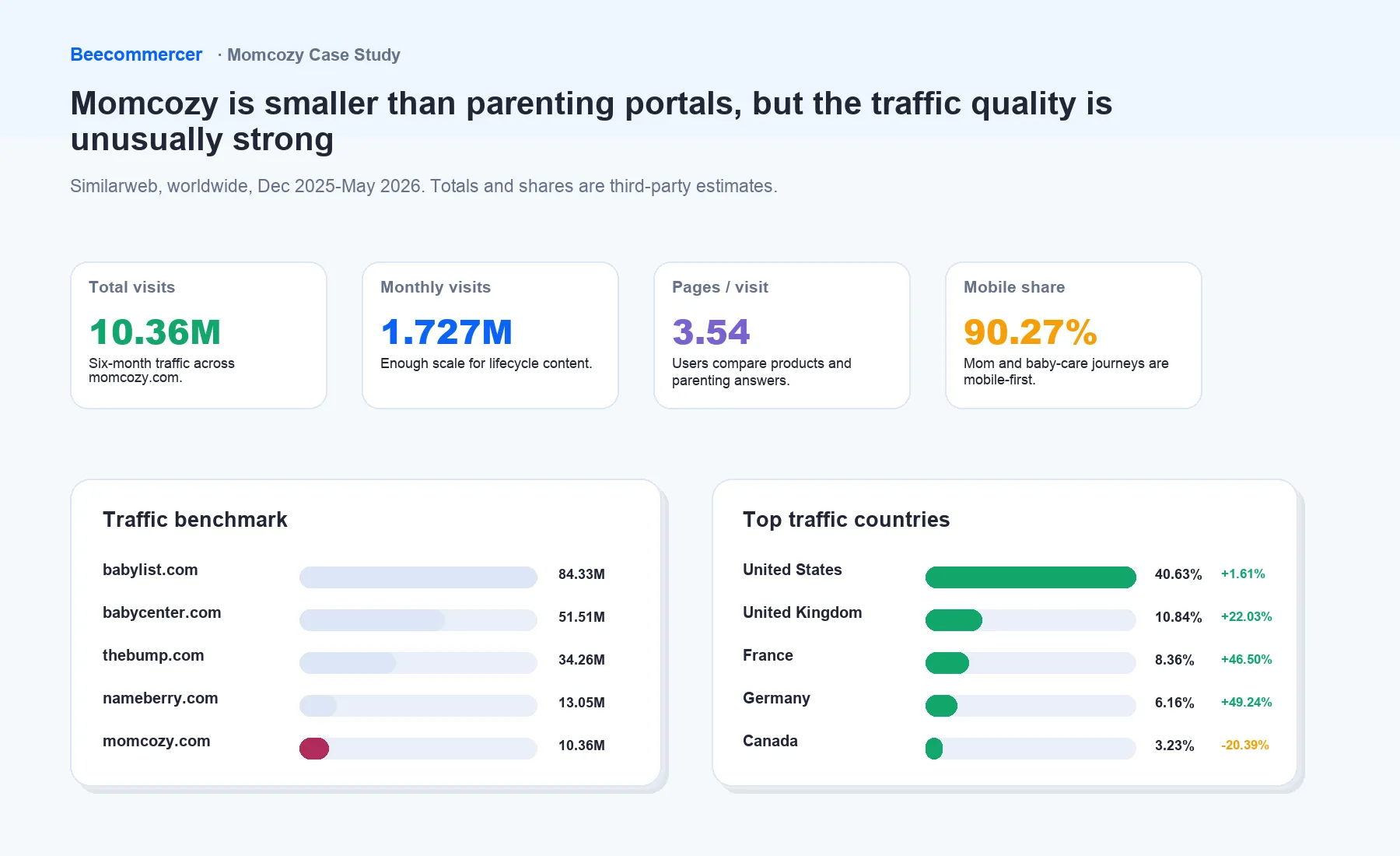
Source note: Traffic and engagement figures come from a Similarweb public-data snapshot covering December 2025 to May 2026. Similarweb labels its figures as estimated data, and live values can change as its models and reporting windows change.
3. Why Momcozy is a strong ecommerce case study
Momcozy is a strong SEO and GEO case because its product categories sit close to health, safety, convenience, and daily routine. The brand’s breast-pump range includes several model families, while its broader site connects pumping with bottle care, pregnancy, nursing bras, carrying, monitoring, feeding, and baby care. That creates a large information architecture: buyers need selection help, instructions, comparisons, support, and proof.
Momcozy also publishes an owned brand story, a care program, and parenting utilities such as a due-date calculator and ovulation calculator. These assets can bring product, education, and brand entities into one graph, but only if navigation, authorship, medical review, and internal linking make the relationships clear.
| Demand area | Buyer question | Best evidence asset | GEO value |
|---|---|---|---|
| Wearable pumps | Which model fits my routine, comfort needs, and cleaning tolerance? | Comparison guide, fit guidance, instructions, independent review proof | Clear model relationships and decision criteria |
| Bottle care | Will it wash, sterilize, and dry the items I use? | Compatibility table, cycle explanation, care instructions, user evidence | Specific answers to task-based questions |
| Carriers and monitors | Which features matter for my home or outing scenario? | Use-case guide, setup content, safety boundaries, comparison | Scenario and feature context for recommendations |
| Pregnancy and nursing | What changes by stage, body, and routine? | Stage-based education, sizing, qualified review, product navigation | Entity coverage beyond a single product category |
| Parenting utilities | What do I need to understand before I shop? | Calculator, explainer, checklist, expert-reviewed guide | Non-commercial answers that can earn discovery |
Because breast pumps are regulated medical devices in the United States, marketing content should distinguish product information from medical guidance. The FDA’s breast-pump guidance recommends consulting a qualified healthcare professional for medical questions, while the CDC publishes pump-hygiene guidance. A trustworthy content system should cite appropriate authorities and send product-specific use questions back to the manufacturer’s current instructions.
4. Search is the conversion surface
The saved channel mix shows why Momcozy should treat search as a conversion system rather than an awareness channel alone. Organic search was the largest estimated source in the analysis window, and paid search added a second layer of high-intent demand. Together, they point to a journey built around selection, comparison, cleaning, compatibility, warranty, and support questions.
Search share does not demonstrate that every visit is purchase-ready. The useful inference is narrower: people who search for a model comparison, replacement part, bottle-washer compatibility question, or warranty policy are trying to remove a decision or ownership blocker. The content job is to answer that blocker with verifiable information and a logical next step.
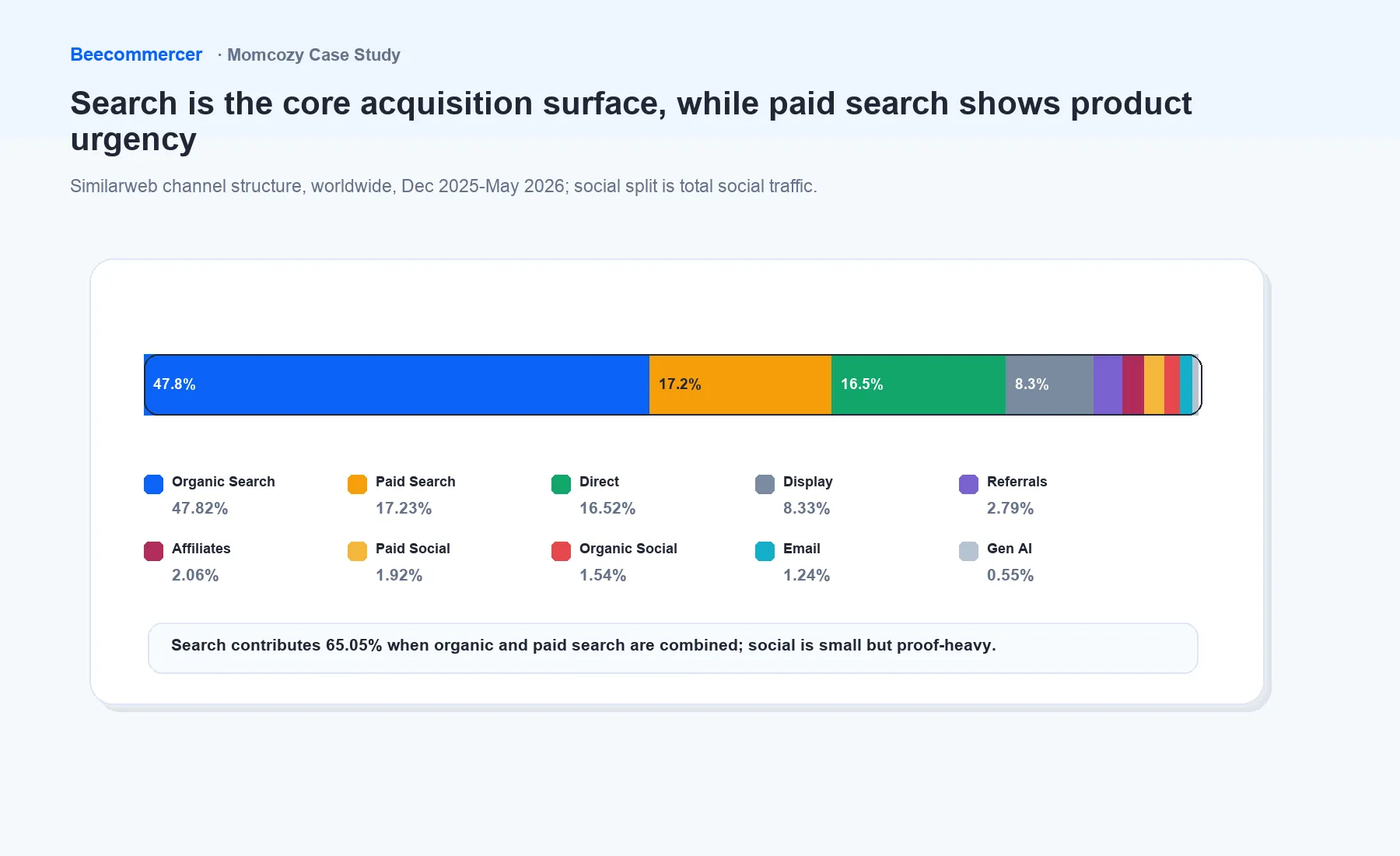
Source note: Channel percentages are based on the same Similarweb December 2025 to May 2026 snapshot. They describe estimated acquisition mix, not conversion rate or channel profitability.
How the search system should be built
| Search intent | Page type | Evidence to include | Conversion role |
|---|---|---|---|
| Selection | Model finder or comparison guide | Use case, fit, trade-offs, cleaning, price, and support | Help the buyer create a shortlist |
| How-to | Instruction or education page | Steps, diagrams, safety boundary, official manual, review date | Build competence and reduce uncertainty |
| Review | Proof hub or product-page module | Independent testing, retailer reviews, methodology, common limitations | Validate claims without hiding trade-offs |
| Support | Warranty, parts, cleaning, or troubleshooting page | Coverage, exclusions, process, response path, replacement options | Lower perceived ownership risk |
5. Product and parenting-tool demand expands the search system
Google Trends related-query patterns in the saved export include M5, M9, S12 Pro, bottle washer, wearable pump, baby carrier, warmer, monitor, pillow, and nursing-care language. These patterns indicate that search interest is organised around models, tasks, and parenting stages. They do not by themselves prove that one category causes another purchase.
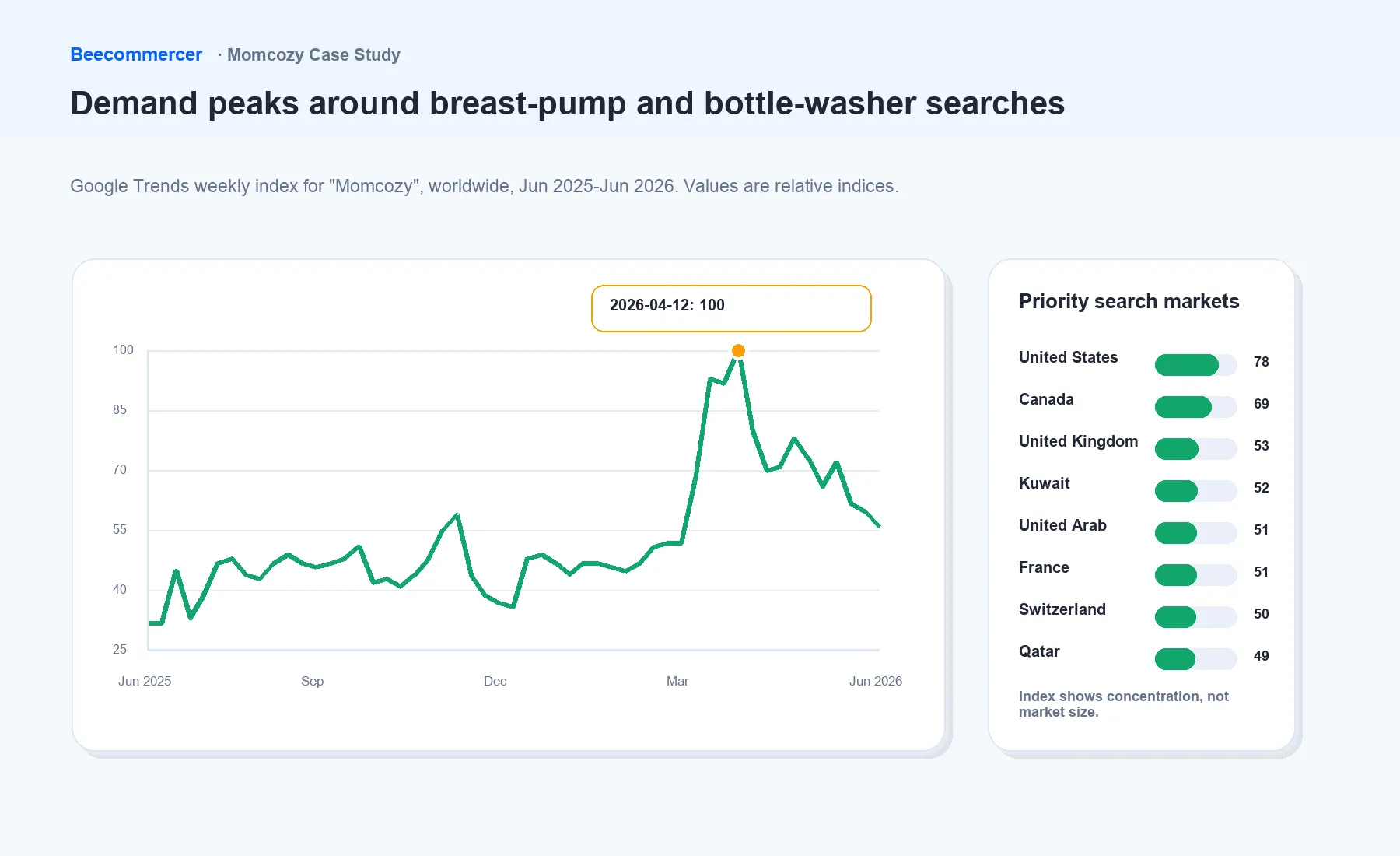
Source note: Google Trends reports a normalized relative index, not traffic, keyword volume, or sales. The chart covers worldwide interest from June 2025 to June 2026.
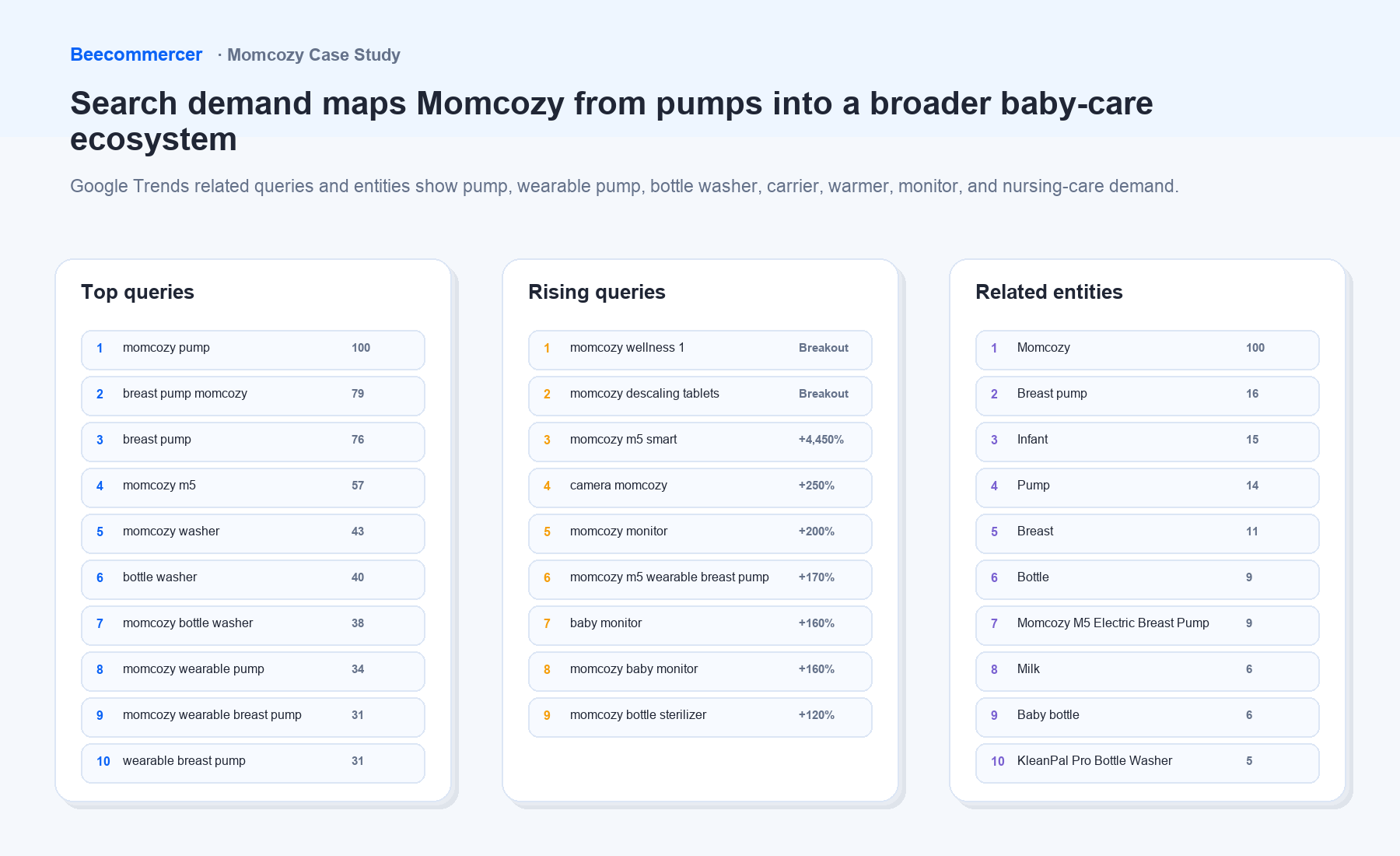
Source note: The product map is a Beecommercer grouping of related-query observations and Momcozy’s public product architecture. It is an intent map, not a measured cross-sell funnel.
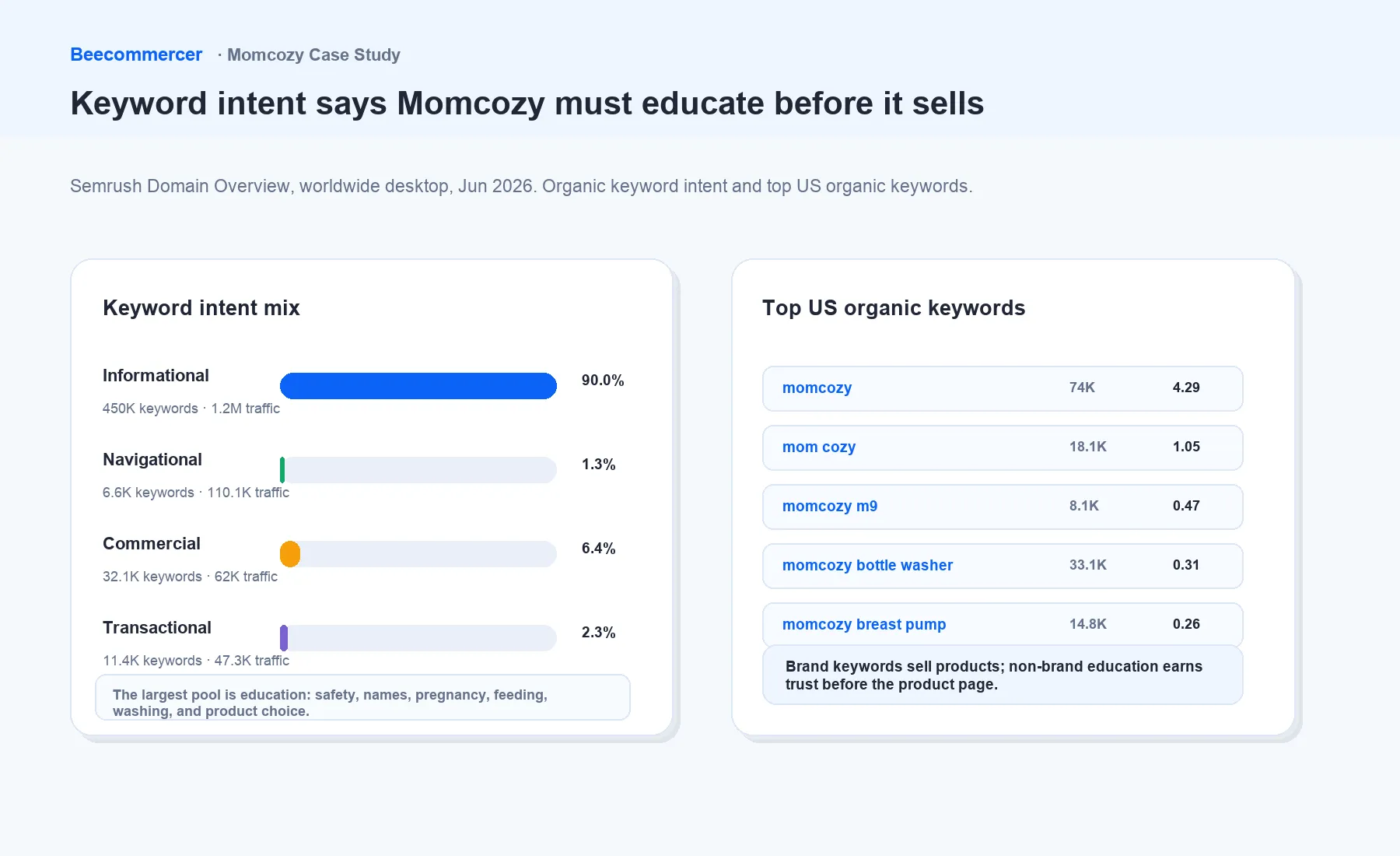
Source note: Intent categories are an editorial classification of observed query themes. They should be validated against Search Console, paid-search terms, site search, and conversion data before investment decisions.
The practical opportunity is to connect those intents rather than publish isolated pages. Momcozy’s current breast-pump comparison guide is the kind of bridge asset that can move a user from category uncertainty to model selection. The same logic can connect calculators to stage-based guides, guides to comparisons, comparisons to product pages, and product pages to parts, cleaning, warranty, and support.
6. Reviews and community proof define buyer trust
Momcozy’s proof system extends beyond Momcozy.com. Independent and retailer environments help buyers compare portability, comfort, output experience, cleaning burden, durability, and value. Examples include Babylist’s multi-model test and The Bump’s wearable-pump roundup. These pages are evidence surfaces, but their methods, commercial relationships, sample sizes, and update dates still matter.
The Reddit Pro Trends sample used for this article surfaced hands-free convenience alongside questions about motor durability, replacement parts, bottle-washer drying, marketing trust, customer service, warranty recovery, and alternatives such as Spectra and Eufy. The right response is not to generalize those discussions into a sentiment score. It is to turn repeated objections into clearer official answers and test whether those answers reduce support contacts, returns, and purchase hesitation.
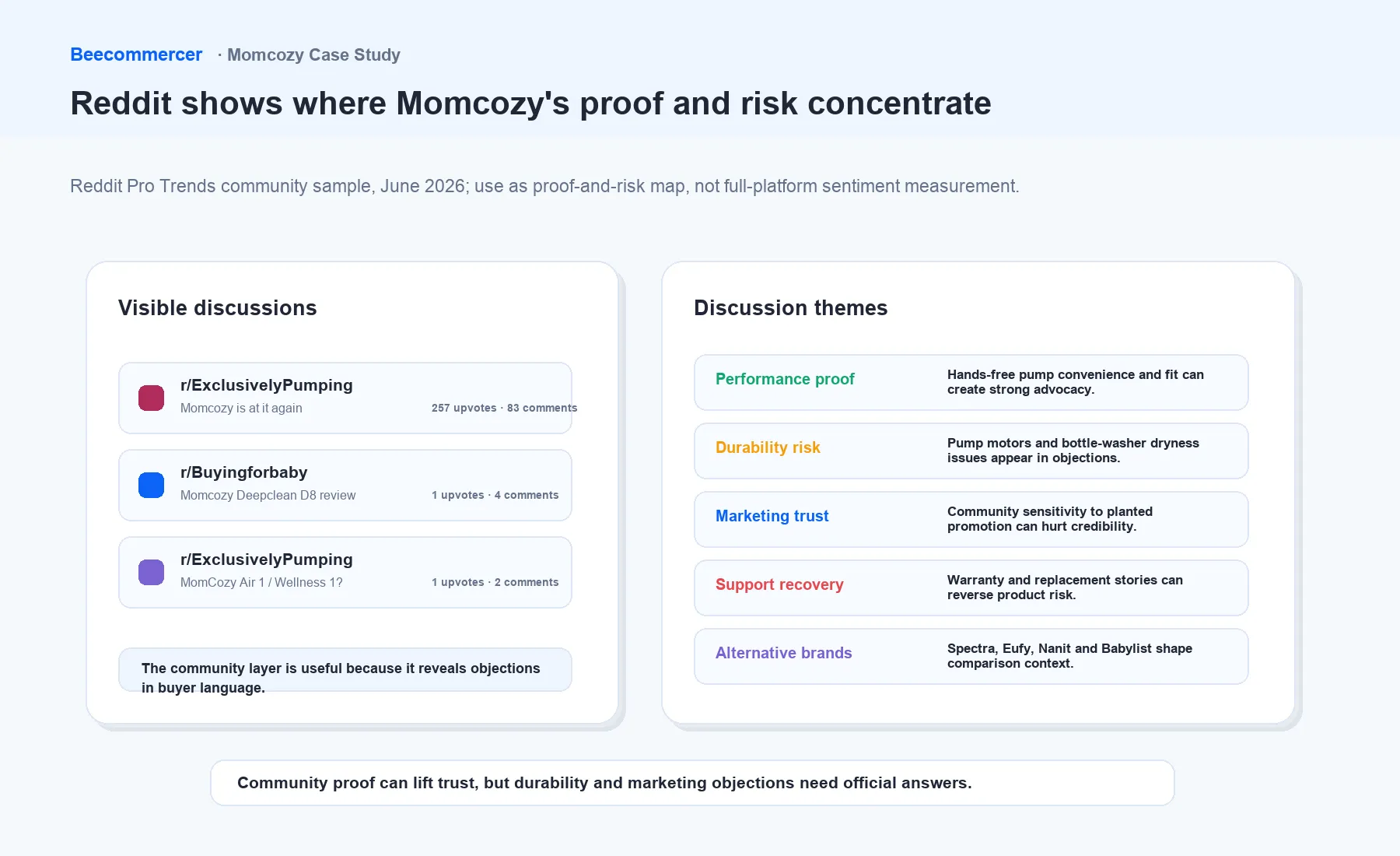
Source note: Community themes come from a directional Reddit Pro Trends sample checked in June 2026. The sample is not a full-platform sentiment study and should not be used to estimate defect rates or medical outcomes.
Turn objection themes into measurable content
| Theme | Trust question | Owned-content response | Useful KPI |
|---|---|---|---|
| Hands-free convenience | Will this fit my routine without creating more work? | Scenario guide with setup, cleaning, battery, and trade-offs | Comparison-to-product click-through |
| Durability and parts | What wears out, what is replaceable, and how quickly? | Parts map, maintenance guidance, replacement path, dated warranty detail | Parts-search success and repeat support contacts |
| Cleaning and drying | Which parts and devices are compatible? | Compatibility matrix tied to current manuals and safety guidance | Cleaning-content exits to support versus product pages |
| Warranty and service | What happens when the product fails? | Plain-language warranty and return journeys | Claim completion, resolution time, and return reasons |
| Alternatives | Why choose this model over Spectra, Eufy, Elvie, or Willow? | Fair comparison by use case, not a one-sided feature list | Assisted conversion and comparison-page engagement |
7. AI answers reuse owned and third-party proof
The June 2026 Semrush snapshot used here showed Momcozy with an AI Visibility score of 38/100, 18.2K mentions, 141.4K citations, and 70.9K cited pages. These figures are Semrush benchmarks derived from its own prompt database and reporting methodology; they are not Momcozy first-party data or a census of every answer engine.
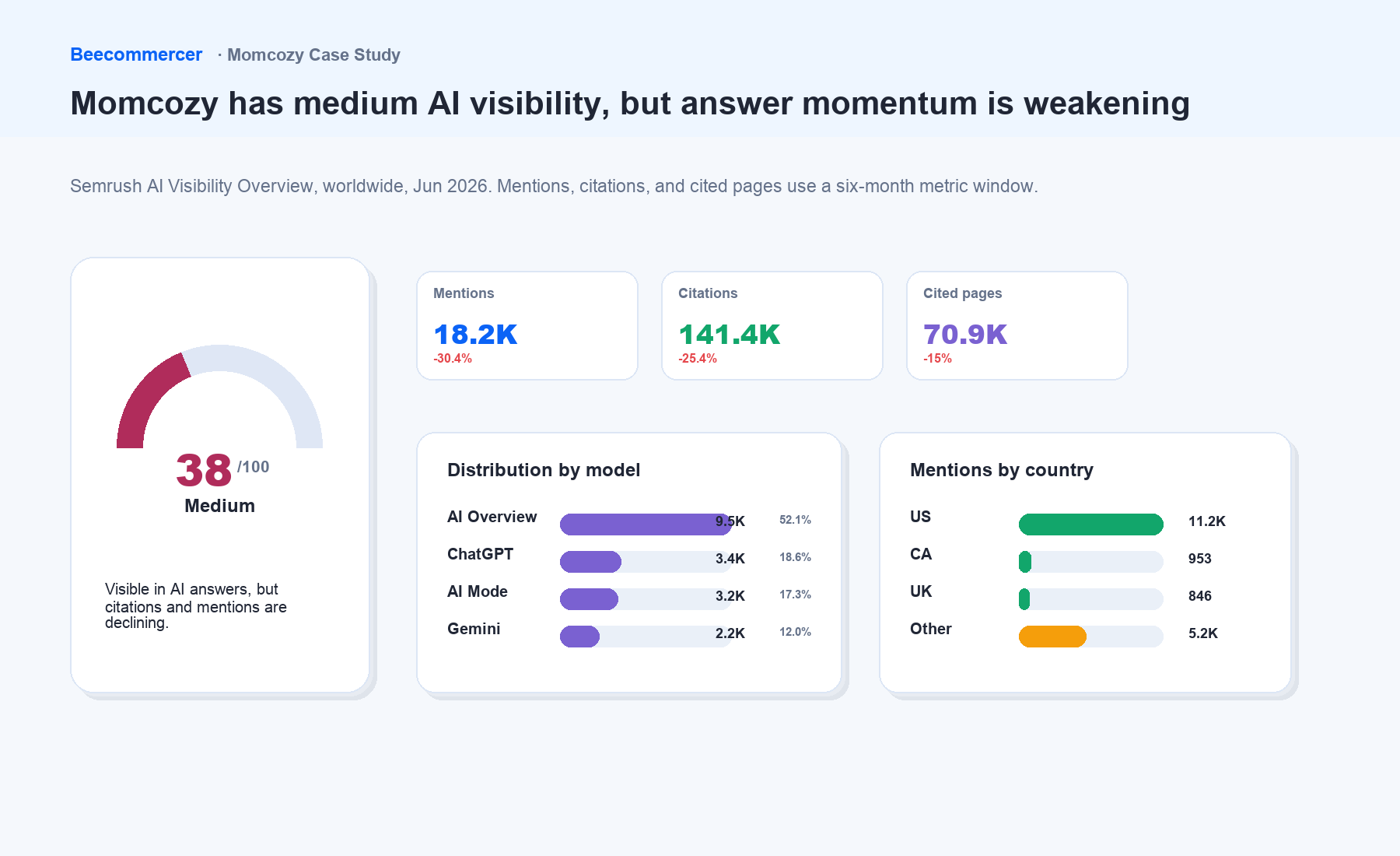
Source note: AI visibility values come from Semrush Domain Overview and AI Visibility Overview checked in June 2026. Scores, prompt sets, platform coverage, and live values can change.
The citation mix is more actionable than the headline score. Momcozy.com, Reddit, The Bump, YouTube, Amazon, Babylist, and parenting or baby-name sources all appeared in the mapped evidence environment. That means an AI answer can assemble a brand description from official specifications, editorial testing, retailer reviews, community language, video, and general parenting context.
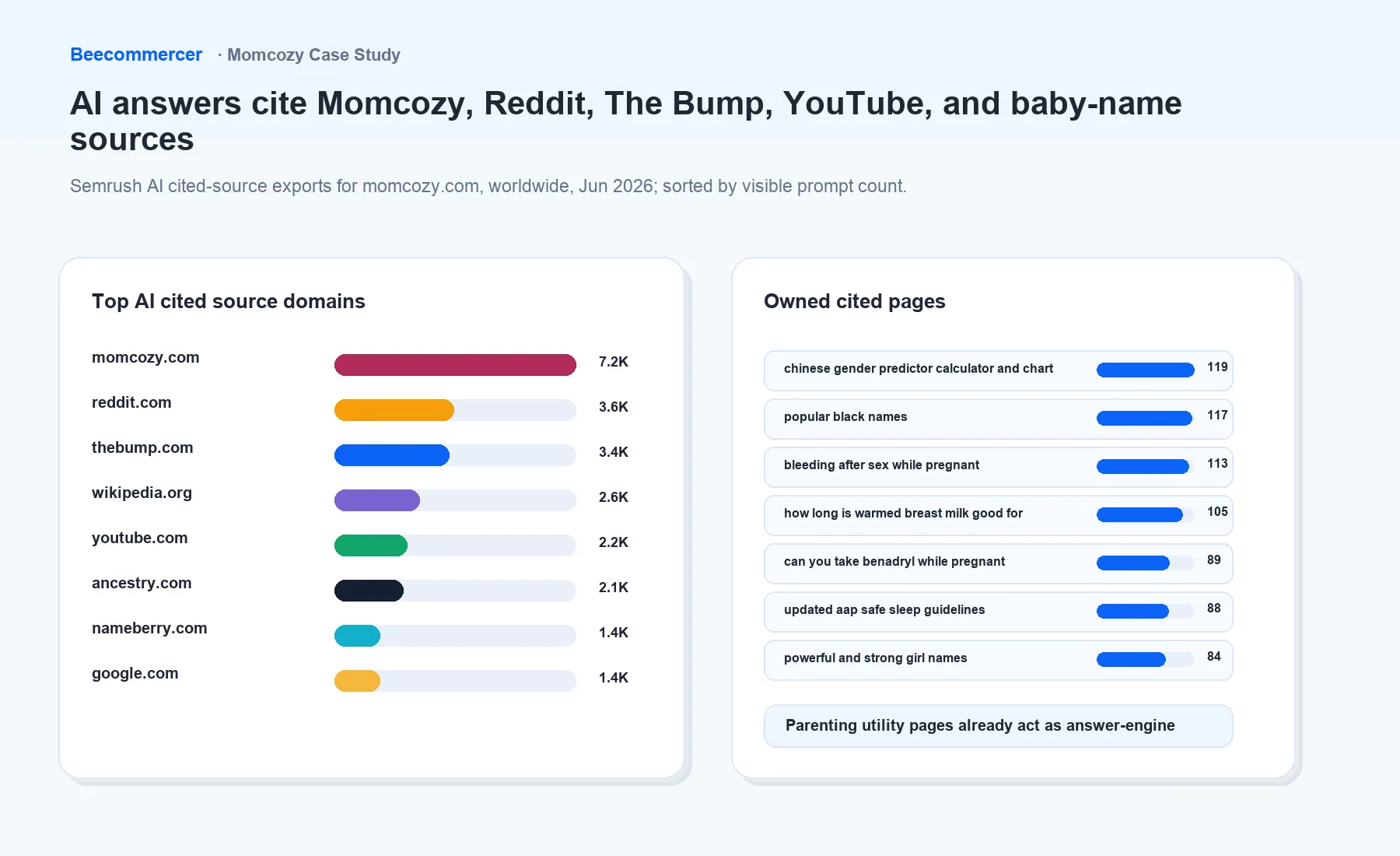
Source note: Citation-source grouping is a Beecommercer synthesis of the saved Semrush snapshot and the public proof surfaces reviewed for this article.
| Source type | What it contributes | Brand action |
|---|---|---|
| Official product pages | Canonical model names, features, specifications, and relationships | Keep facts structured, consistent, dated, and linked to manuals |
| Parenting tools and guides | Plain-language context before product selection | Add expert review, evidence, authorship, and a useful next step |
| Reviews and retailers | External testing, pricing context, and user experience | Monitor recurring proof and limitations; do not cherry-pick |
| YouTube and Reddit | Natural language around use, objections, and alternatives | Convert recurring questions into owned answers and demonstrations |
| Warranty and support | Ownership-risk information | Make coverage, exclusions, parts, and resolution paths machine-readable |
For ecommerce teams, GEO does not replace SEO. It increases the value of clear entities, useful answers, source links, current policies, and third-party corroboration. Beecommercer’s analysis of why AI search still needs SEO explains the same principle at a broader platform level.
8. What cross-border ecommerce brands can copy
Brands should copy the operating system, not the product category. Start with buyer uncertainty, map each question to the best answer format, attach verifiable evidence, and measure whether the answer helps discovery, selection, ownership, or support. High-trust categories also need local regulatory, medical, policy, and language review rather than a literal translation of the English page.
- Build one entity map. Connect brand, category, model, stage, task, accessory, manual, policy, and support entities.
- Separate observation from recommendation. Label third-party estimates, explain limitations, and avoid turning correlation into growth claims.
- Use reviews as research. Summarize both proof and risk themes, then improve the official answer.
- Make policies part of SEO. Warranty, parts, returns, cleaning, and compatibility pages are conversion content.
- Localize trust, not just words. Adapt terminology, regulations, sources, policies, and examples for each market while preserving the evidence boundary.
A practical 30/60/90-day sequence
| Window | Priority | Deliverables | Primary measurement |
|---|---|---|---|
| Days 1-30 | Evidence and intent audit | Entity map, query clusters, review themes, policy gaps, source register | Coverage of top buyer questions |
| Days 31-60 | Bridge content | Comparison pages, compatibility tables, cleaning and parts guides, FAQ modules | Qualified organic entry and assisted conversion |
| Days 61-90 | Distribution and localization | Video briefs, retailer consistency, community-response playbook, market editions | Branded answer accuracy, support deflection, and market-level conversion |
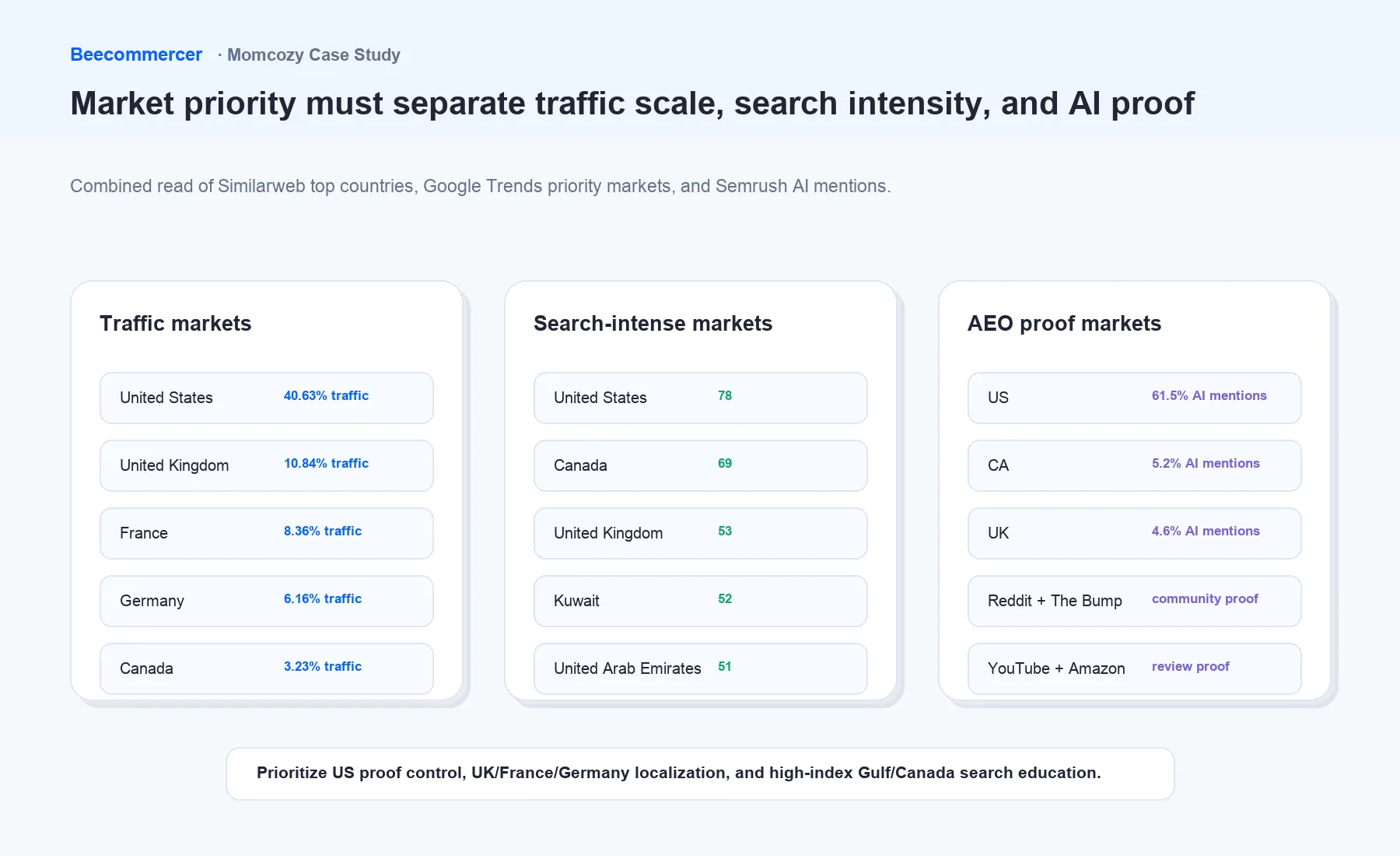
Source note: The market map is a prioritization heuristic based on public traffic, search, and proof signals. It is not a revenue forecast; first-party margin, CAC, returns, regulation, stock, and service readiness should decide investment.
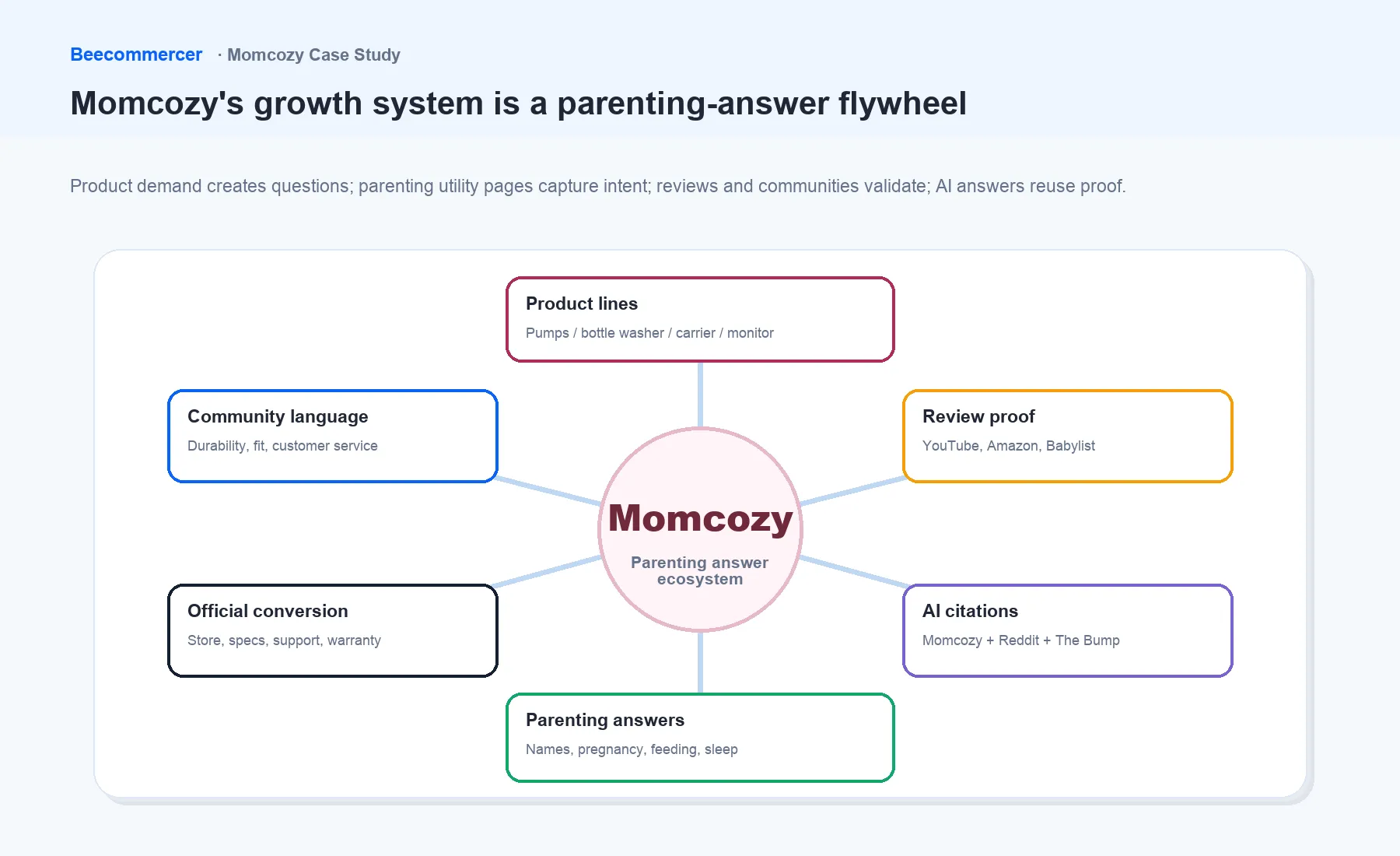
Source note: The flywheel is a Beecommercer editorial model. It describes a testable operating hypothesis, not proven causation or a disclosed Momcozy growth process.
For adjacent examples, compare the BenQ case study on high-consideration product proof and the Anker case study on search demand, reviews, and AI visibility.
9. FAQ
What is the main SEO lesson from the Momcozy case study?
The main SEO lesson is that high-trust maternity and baby-care products need a connected answer system. Product pages work better when comparison, cleaning, compatibility, warranty, support, expert guidance, and independent proof remove the questions that delay purchase.
Why does Momcozy matter for GEO?
Momcozy matters for GEO because AI answers can draw on several evidence surfaces around the brand: official product and parenting pages, reviews, retailers, YouTube, Reddit, support policies, and parenting publishers. Consistency across those sources can make brand and product information easier to retrieve and verify.
What should ecommerce brands copy from Momcozy?
Ecommerce brands should copy the system, not individual claims: map buyer questions across the full product lifecycle, create useful bridge content, connect owned pages with credible outside proof, turn recurring objections into clear answers, and localize the evidence for each market.
Is this case study based on private Momcozy data?
No. This is a public-signal case study based on third-party traffic, trend, AI visibility, review, retailer, and community observations, plus public Momcozy pages. It should be read as directional SEO and GEO analysis, not as a first-party performance report from Momcozy.
10. Full methodology and editorial note
This article uses Similarweb momcozy.com Website Analysis for December 2025 to May 2026; Semrush Domain Overview and AI Visibility Overview checked in June 2026; Google Trends worldwide data for “Momcozy” from June 2025 to June 2026; and a Reddit Pro Trends community sample checked in June 2026. Official product, brand, care, warranty, and return references come from Momcozy.com. External proof examples include Babylist, The Bump, retailers, public video and community surfaces, and official FDA and CDC guidance where health and hygiene context matters.
Traffic estimates can change when providers update models or reporting windows. Google Trends is a normalized index. AI visibility metrics depend on the vendor’s prompt database and platform coverage. Community samples are useful for question discovery but are not representative sentiment studies. None of these sources establishes revenue, conversion, retention, market share, product efficacy, defect rate, or causation.
Editorial note: Beecommercer is not presenting this page as a sponsored endorsement or medical advice. The purpose is to show how ecommerce teams can connect SEO, parenting education, review proof, community listening, support clarity, and Generative Engine Optimization while preserving evidence boundaries. Product use, cleaning, feeding, safety, and health decisions should follow current manufacturer instructions and qualified professional guidance.