

Last updated on July 19, 2026 at 6:00 PM
A recorder sale can finish at checkout. Plaud’s harder commercial task begins after the buyer presses Record: turning captured audio into a transcript, a useful summary, a trusted workflow, and enough recurring value to justify an ongoing plan.
That makes Plaud a revealing ecommerce case. Its visible system combines purpose-built devices, a companion application, transcription allowances, professional templates, export and sharing tools, privacy claims, support content, independent reviews, and community debate. The product is physical, but the retention question is software.
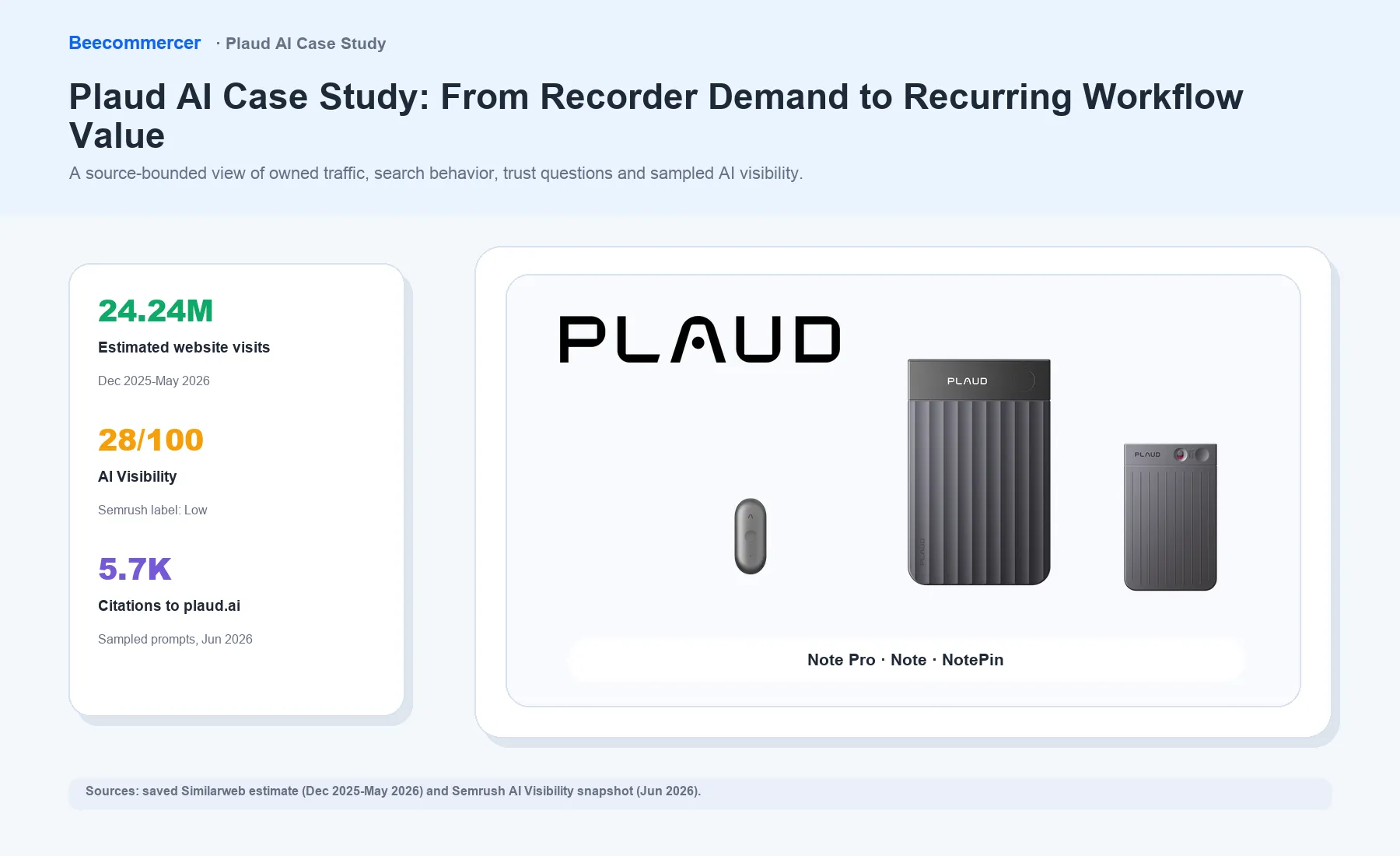
1. Plaud AI ecommerce SEO and GEO key takeaways
- The hardware is an entry point, not the complete value proposition. The recurring layer includes transcription capacity, summaries, templates, search, exports, sharing, and cross-device access.
- Website acquisition is direct-heavy, not automatically brand-led. The saved Similarweb estimate attributes 63.07% of traffic to Direct; a separate estimated search split, not the Direct share, is the evidence that search demand is mostly branded.
- Search language moves from device to workflow. Queries around Plaud Note, NotePin, Note Pro, AI recorders, reviews, and the app reveal multiple decision stages, while Google Trends values remain relative rather than absolute demand.
- Subscription and privacy questions belong in conversion content. Limits, consent, recording law, AI processing, exports, and cancellation are not secondary support topics for a product that captures conversations.
- AI visibility needs a stronger evidence architecture. The June 2026 Semrush snapshot labels Plaud’s 28/100 score Low. That is a dated platform benchmark, not a universal measure of brand strength or sales.
The revenue signal is important but needs a firm boundary. Plaud announced that it had scaled from $1 million to $100 million in ARR, while TechCrunch reported the claim as Plaud’s company-reported annualized subscription run rate. It is not audited GAAP revenue, total hardware sales, or lifetime revenue.
2. Data snapshot and source scope
This case combines a saved worldwide Similarweb Website Analysis export for plaud.ai, non-public June 2026 Semrush Domain Overview and AI Visibility exports, a saved worldwide Google Trends view for “Plaud AI”, official Plaud product and support pages, independent reviews, and a directional sample of public Reddit threads. The current public Similarweb profile and current public Semrush profile are moving pages and may not reproduce the saved periods.
| Metric | Observed signal | Evidence boundary |
|---|---|---|
| Website visits | 24.24 million, December 2025–May 2026 | Historical Similarweb third-party estimate, not Plaud analytics, customers, devices, orders, or revenue. |
| Monthly average | 4.04 million visits | Beecommercer calculation: 24.24 million divided by six, not a standalone Similarweb monthly metric. |
| Engagement | 3.54 pages per visit; 41.50% bounce rate | Modeled historical estimates. No “healthy” or peer-beating judgment is made without a comparable benchmark. |
| Channel mix | 63.07% Direct; 13.93% organic search | Estimated channel classification. Direct does not mean branded. |
| Relative search peak | Index 100 in the week of May 17, 2026 | Normalized Google Trends peak for the selected query, place, and period; not search volume, traffic, or sales. |
| AI Visibility | 28/100; 2.6K mentions; 5.7K citations; 2.3K cited pages | June 2026 Semrush monitored-prompt snapshot. Semrush labels the score Low; the prompt database changes over time. |

Metric definitions matter here. Google explains that Trends values are normalized from 0 to 100. Semrush defines AI Visibility, Mentions, Citations, and Cited Pages within its own measurement system, and its AI Visibility data methodology notes that monitored prompts and performance data change. These inputs are useful for directional analysis; none is Plaud first-party attribution.
3. Why Plaud is a strong device-to-subscription case
Plaud’s portfolio gives shoppers several ways into the same workflow. The card-shaped Plaud Note is positioned around phone calls and in-person recording; the wearable Plaud NotePin changes the capture form factor; and Plaud Note Pro extends the range with a newer device proposition. Product details and prices are dynamic, so this case does not freeze current storefront pricing as a permanent fact.
The commercial connection comes after capture. Plaud’s membership storefront and membership FAQ describe a Starter option included with a bound device and paid plans with more transcription capacity. Plaud’s current support page says the Starter plan includes 300 minutes per month, Pro includes 1,200 minutes, and Unlimited removes the monthly cap; those allowances should always be rechecked before publishing price or plan comparisons.
The strongest interpretation is therefore not “hardware plus an app.” It is a capture-to-output system. Plaud’s own Note Pro workflow guide describes recording, transcription, summaries, and querying; its in-person meeting guide connects device placement to structured outputs. These are first-party descriptions of the intended workflow, not independent evidence that every user achieves the same result.
Independent reviewers add another layer. TechRadar’s Plaud Note review, Tom’s Guide’s NotePin review, and TechRadar’s NotePin review provide individual hands-on assessments. No single review should be generalized into a customer-satisfaction claim.
4. Traffic is direct-heavy, while search remains mostly branded
The saved Similarweb export estimates that Direct generated 63.07% of plaud.ai traffic from December 2025 through May 2026. Organic search represented 13.93%, paid search 6.47%, referrals 5.85%, display 2.70%, and social about 3.97%. These are selected estimated channels and are not presented as a complete first-party attribution model.

Direct can include bookmarks, typed URLs, application handoffs, untagged links, and traffic for which a referrer is not identified. The safer conclusion is that the site was direct-heavy in the saved estimate. Brand dependence is instead supported by a separate search split in the same historical export: 83% branded and 17% non-branded within estimated search traffic.
The social-referral estimate adds a channel hypothesis rather than proof of adoption. YouTube represented 65.16% of the modeled social-referral mix, ahead of Facebook, X, Reddit, Instagram, and other sources. That makes video education worth testing for demonstrations and workflow onboarding; it does not establish endorsement, conversion, or revenue contribution. Plaud can validate that hypothesis against its own campaign tagging, assisted conversion, subscriptions, and retention.
5. Search moves from the device to the workflow
The saved worldwide Google Trends view for “Plaud AI” reached its selected-period relative peak of 100 in the week of May 17, 2026. The date can be stated; the cause cannot. Google’s methodology makes clear that 100 is the highest relative-interest point within the chosen query, geography, and range, not a count of searches or buyers.

Related queries split across entity, category, evaluation, and use. The saved top-query set included Plaud AI Note, Plaud Note, AI recorder, Plaud AI recorder, AI voice recorder, Plaud NotePin AI, Plaud NotePin, Plaud Note Pro, Plaud AI review, Plaud reviews, and Plaud app. The visible export does not substantiate “subscription” as a top or rising query, so this draft does not claim it.
Rising comparison terms included Pocket AI versus Plaud, TicNote, Soundcore Work, Notta Memo, HiDock P1, and Plaud NotePin S. Under Google’s Top and Rising definition, “Breakout” indicates very large relative growth, not high absolute volume. Noisy news and entity terms in the export also mean the query list needs editorial filtering.

The June 2026 Semrush Domain Overview snapshot supplies a different lens. Informational terms were 60.7% of ranked-keyword count, representing 9.4K keywords and 20.8K estimated traffic in the saved view. Commercial was 19.6% of keyword count, with 3K keywords and 9.2K traffic; transactional was 11.1%, with 1.7K and 10.1K; navigational was only 8.7% of keyword count, with 1.3K keywords but 69.7K estimated traffic. The percentage is a keyword-count share, not a traffic share.

The content opportunity connects devices to jobs, not just keywords. Product pages can route to use-case education such as how to record a conversation, choosing an in-person meeting recorder, and comparing note takers for team leads. Those are Plaud-authored resources and should be identified as such, especially when they compare Plaud with alternatives.
The resulting flywheel is an editorial model: device discovery creates category and comparison queries; product education converts a use case; the app turns recordings into useful outputs; repeated use creates subscription opportunities; support and independent proof reduce risk; and clear evidence becomes reusable in search and AI answers.

6. Subscription, privacy, and community questions shape conversion
Subscription friction starts with capacity and expectations. Plaud’s current transcription-minutes guide explains how minutes are allocated and reset, while its support page says recording can continue after transcription minutes run out. The ecommerce lesson is to distinguish recording, transcription, summaries, storage, exports, and plan renewal instead of compressing them into one vague subscription promise.
Portability is part of perceived value. Plaud documents exports for recordings, transcripts, summaries, and mind maps, public and invite-only share links, the transcription workflow, and a broader transcription, editing, and export guide. These pages can answer pre-purchase questions as well as post-purchase support needs.
Consent and privacy need explicit ownership. Plaud’s support pages state that recording law varies by location and context, that users should obtain consent when required, and that Plaud does not obtain participants’ consent on the user’s behalf. These are first-party support statements, not legal advice.
Plaud also says in its AI-processing disclosure that customer recordings, transcripts, summaries, notes, and metadata are not used to train models and that its listed providers operate under zero-retention agreements. Beecommercer can accurately attribute that claim to Plaud; it cannot independently guarantee the implementation or extend the statement beyond the published policy.
A small directional sample of public community threads shows the language buyers use around these questions. Selected examples discuss whether the subscription feels too expensive, whether a subscription-free alternative is attractive, how users evaluate privacy and security, and whether a subscription is required for a workable export or local process. They are examples, not a representative survey of Plaud customers.

App-store and review environments provide additional, still imperfect evidence. Shoppers can inspect the Plaud app’s public App Store listing, Android Central’s wearable test, and the independent Note and NotePin reviews cited earlier. Ratings, prices, versions, and reviewer experiences can change; quote the dated review or specific test rather than claiming universal satisfaction.
7. AI answers need a cleaner and more distributed evidence layer
In the non-public June 2026 Semrush AI Visibility snapshot reviewed for this case, Plaud scored 28/100, which Semrush labeled Low. The same snapshot showed 2.6K Mentions, 5.7K Citations, and 2.3K Cited Pages. Under Semrush’s definitions, Mentions are monitored prompts whose answers include the brand, Citations are AI responses citing the analyzed domain, and Cited Pages are pages on plaud.ai cited in those responses—not external pages that cite Plaud.

The snapshot’s model and country splits also belong inside that boundary. For example, the supplied export distributed sampled mentions across Google AI Overview, AI Mode, Gemini, and ChatGPT, and across the United States, Japan, the United Kingdom, and other countries. Those are shares inside Semrush’s monitored response set, not the geography of Plaud customers or the full population of AI users.
The cited-source visualization requires an additional correction before publication. Its current source list repeats YouTube, plaud.ai, and Google, which indicates that two different measures were merged after their column labels were lost. This draft therefore does not publish the source-domain counts or call the list a ranking. Rebuild the visual as a qualitative evidence map unless the original metric names, definitions, date range, and sort logic can be restored.

The practical GEO opportunity is page-level evidence. Legal and consent pages should state jurisdictional limits. Product and membership pages should keep plan terms current. Comparison pages should separate first-party claims from independent tests. Support articles should expose dates, owners, product entities, and exact steps. Reviews and community examples should link to the original page. That is more useful than producing generic “AI-optimized” copy around a visibility score.
8. What cross-border ecommerce teams can copy
Plaud’s case offers a copyable operating model without requiring its hardware category or reported scale. The goal is to make every step between first capture and repeat use easier to understand, verify, and measure.
- Sell the post-purchase job. Show how raw capture becomes a transcript, summary, action list, searchable record, export, or shared artifact.
- Separate device choice from plan choice. Build one comparison for form factor and recording context, then another for transcription capacity, workflow features, renewal, cancellation, and limits.
- Make subscription arithmetic explicit. State monthly allowances, reset rules, overage paths, and what still works when the quota runs out.
- Put consent before the record button. Localize recording-law caveats and require legal review rather than copying one global statement into every market.
- Design portability as conversion proof. Show export types, timestamps, speaker labels, sharing permissions, and the route into common work tools.
- Convert objections into durable pages. Privacy, cancellation, alternatives, connection, export, and subscription questions should have owned answers that can be cited.
- Measure the whole device-to-workflow funnel. Connect acquisition source, device activation, first successful transcription, useful output, repeat recording, plan upgrade, retention, refunds, and support demand.
- Audit AI evidence by topic and source. Track whether official pages answer the most consequential questions and where third parties carry essential proof.
Teams can adapt this into a launch and content system with Beecommercer’s ecommerce launch roadmap, free ecommerce tools, trending ecommerce tools, and ecommerce tools reviews. These companion resources are operational starting points, not evidence for Plaud’s performance.
Geographic prioritization also needs discipline. The saved Similarweb export estimated Japan at 30.38% and the United States at 24.13% of plaud.ai traffic, while the saved Trends and Semrush AI datasets use different denominators. Traffic share is not sales share; a Trends index is not market size; AI mentions are not demand. The safest output is a test plan, not a composite ranking.

9. FAQ
What is the main ecommerce lesson from the Plaud AI case study?
Plaud shows why an AI hardware brand must merchandise the workflow after the device sale. Product choice, transcription capacity, summaries, exports, privacy, consent, and recurring use all need clear pages that connect acquisition to activation and retention.
How does Plaud connect hardware to subscription revenue?
Plaud pairs dedicated recording devices with free and paid software plans for transcription and workflow features. Plaud reported in June 2026 that its software subscription business exceeded a $100 million annualized revenue run rate, but that company-reported ARR is not audited revenue or total hardware sales.
What should ecommerce brands copy from Plaud?
Brands should copy the device-to-workflow structure: explain the post-purchase job, separate hardware and plan decisions, publish limits and portability details, answer privacy and consent questions, and measure activation, repeat use, upgrades, retention, refunds, and support.
Is this case study based on private Plaud data?
No. It uses official public information, public reviews and community examples, a historical Similarweb estimate, a June 2026 Semrush snapshot, and a saved Google Trends view. It should not be read as Plaud first-party analytics, audited revenue, conversion, retention, or attribution reporting.
10. Full methodology and editorial note
The primary measurement windows are December 2025 through May 2026 for the saved Similarweb Website Analysis export, June 2026 for non-public Semrush Domain Overview and AI Visibility exports, and June 2025 through June 2026 for the saved worldwide Google Trends view for “Plaud AI”. The public Similarweb and Semrush domain pages are linked as current context only and may not reproduce the historical snapshots.
Similarweb traffic and channel figures are modeled third-party estimates. The 4.04M monthly value is Beecommercer’s calculation of the 24.24M six-month estimate divided by six. Direct traffic is not treated as branded traffic. Google Trends values are normalized relative indices and do not establish absolute demand, traffic, sales, market size, or the cause of the May 2026 peak. Semrush keyword-intent percentages describe ranked-keyword count shares. AI Visibility, Mentions, Citations, and Cited Pages describe a sampled, changing prompt environment and do not measure every AI answer or a direct sales effect.
Official product, membership, privacy, consent, support, and ARR statements are attributed to Plaud. The $100M software ARR and more-than-two-million-device figures are company-reported and are not presented as audited revenue. Independent reviews describe individual tests. Reddit examples are a small purposive sample of public threads, not full-platform sentiment or a customer survey. Market recommendations are hypotheses that require first-party conversion, subscription, retention, refund, cost, support, and compliance evidence.