
Last updated on July 25, 2026 at 11:07 PM
Snapmaker’s growth story is no longer only about an all-in-one desktop machine. Its public demand signals now span the four-toolhead Snapmaker U1, modular Artisan and 2.0 systems, the J1 family, software, materials, setup, and troubleshooting. That breadth creates a valuable lesson for cross-border ecommerce: product attention becomes durable growth only when search, education, community proof, independent testing, and ownership support agree with one another.
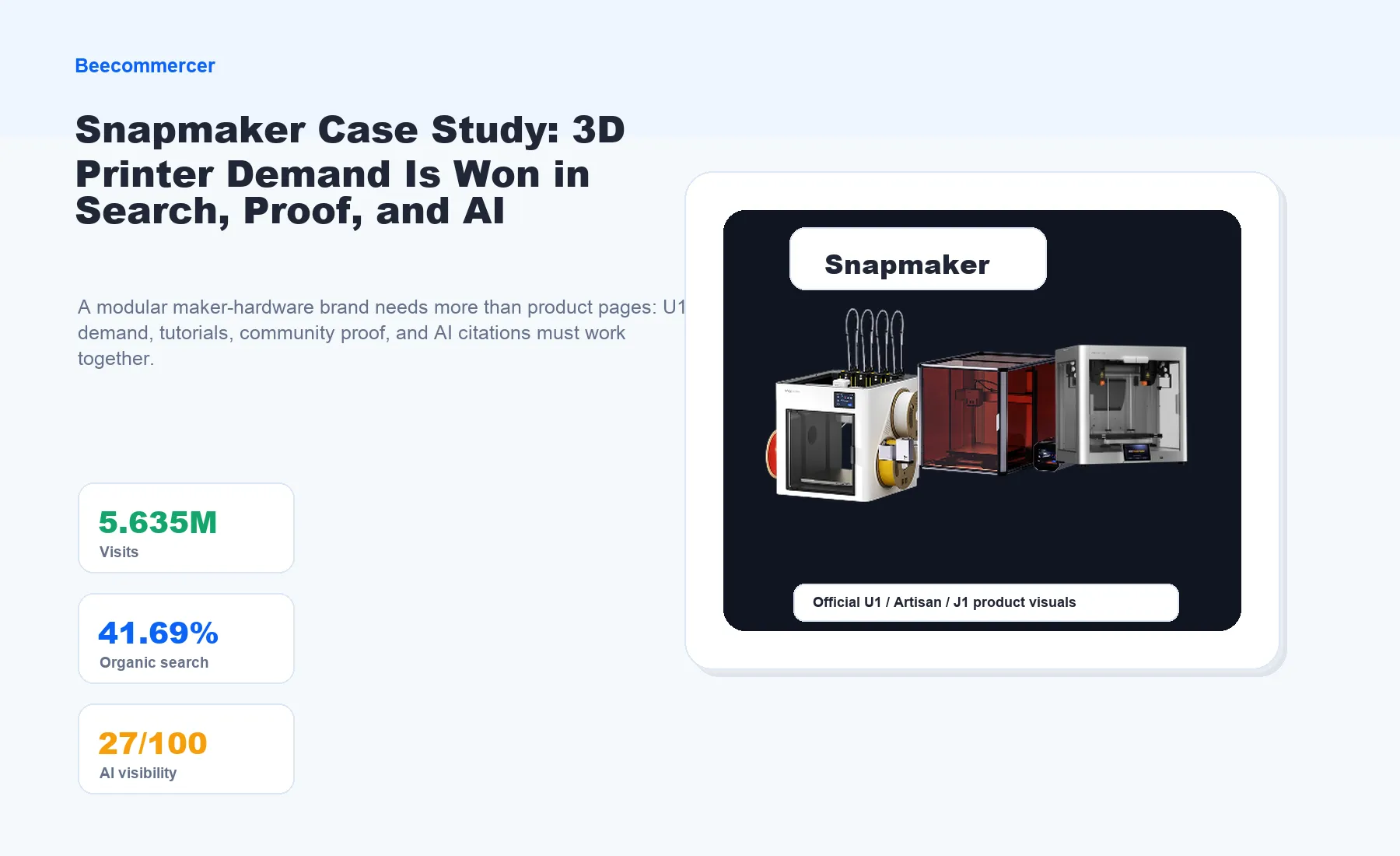
The public data suggests that Snapmaker has meaningful demand but still competes in a much larger category. Similarweb estimated 5.635 million visits to snapmaker.com from December 2025 through May 2026, while Google Trends showed a strong U1-led search spike and Semrush recorded a modest 27/100 AI Visibility score. None of those figures is revenue, orders, market share, or causal proof. Together, however, they reveal where the evidence journey is strong and where buyers may still need clearer answers.
1. Snapmaker case study: key takeaways
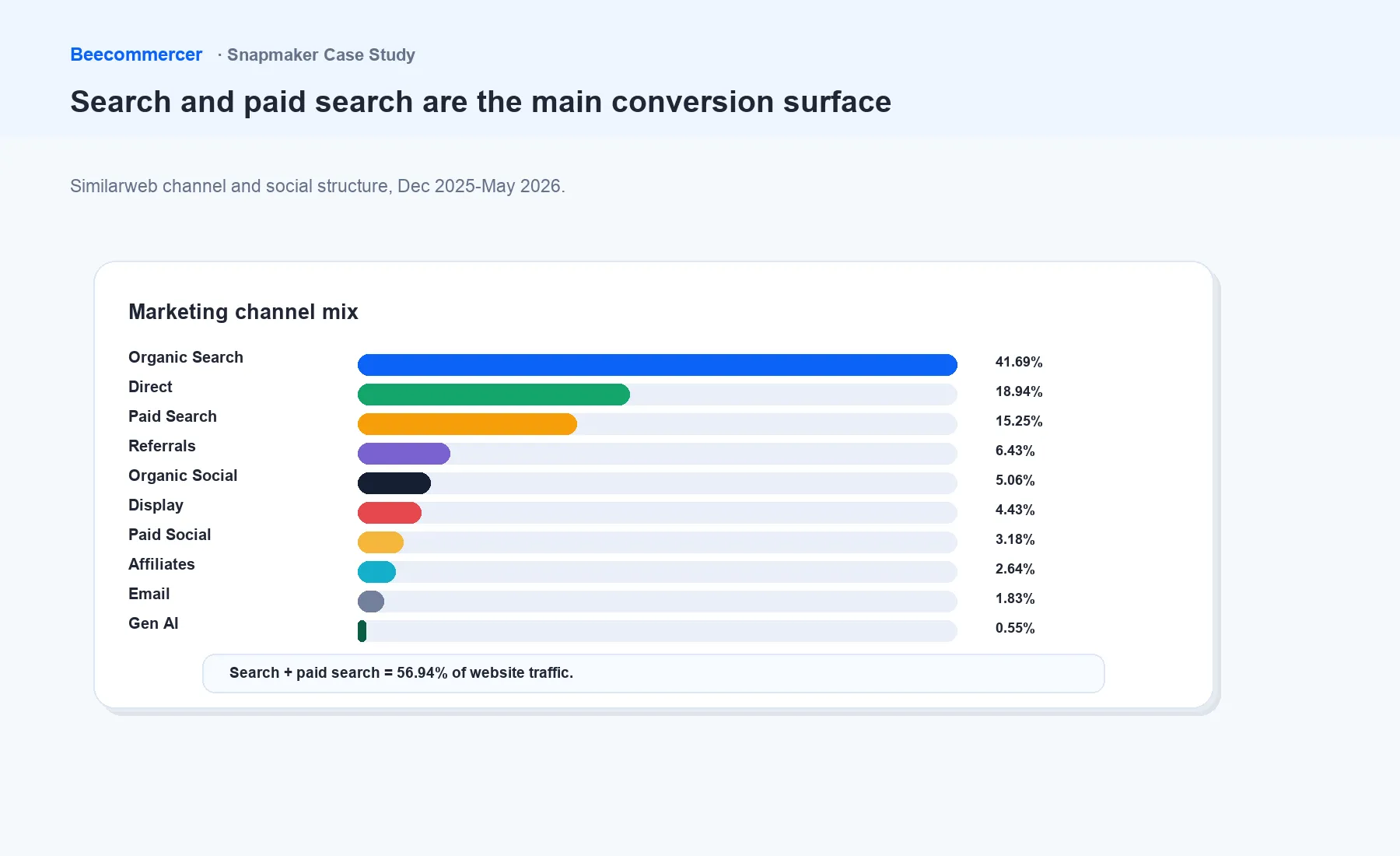
Four findings matter. First, search was the largest estimated acquisition surface: organic and paid search supplied 56.94% of visits together. Second, U1 demand dominated the saved Google Trends query set, indicating that a specific product launch can temporarily reorganize brand discovery. Third, public communities and reviews validate the low-waste multi-material proposition while exposing questions about calibration, RFID, filament compatibility, software, and support. Fourth, AI answers cite a distributed network led by YouTube, Snapmaker, and Reddit rather than an owned-content system alone.
The operating implication is simple but demanding. A product launch should not end at a product page. It needs a connected set of selection guides, comparison pages, setup instructions, compatibility rules, troubleshooting paths, independent tests, and regional policies. Snapmaker already has useful foundations in its product catalog, comparison page, and support center. The growth work is to make those surfaces easier to discover and consistent enough to quote.
Source note: Beecommercer analysis of Similarweb Website Analysis for snapmaker.com, Worldwide, All Traffic, Dec 2025–May 2026. Similarweb defines these modeled fields in its Website Performance documentation. Values are third-party estimates, not Snapmaker analytics.
2. The data snapshot describes demand, not business performance
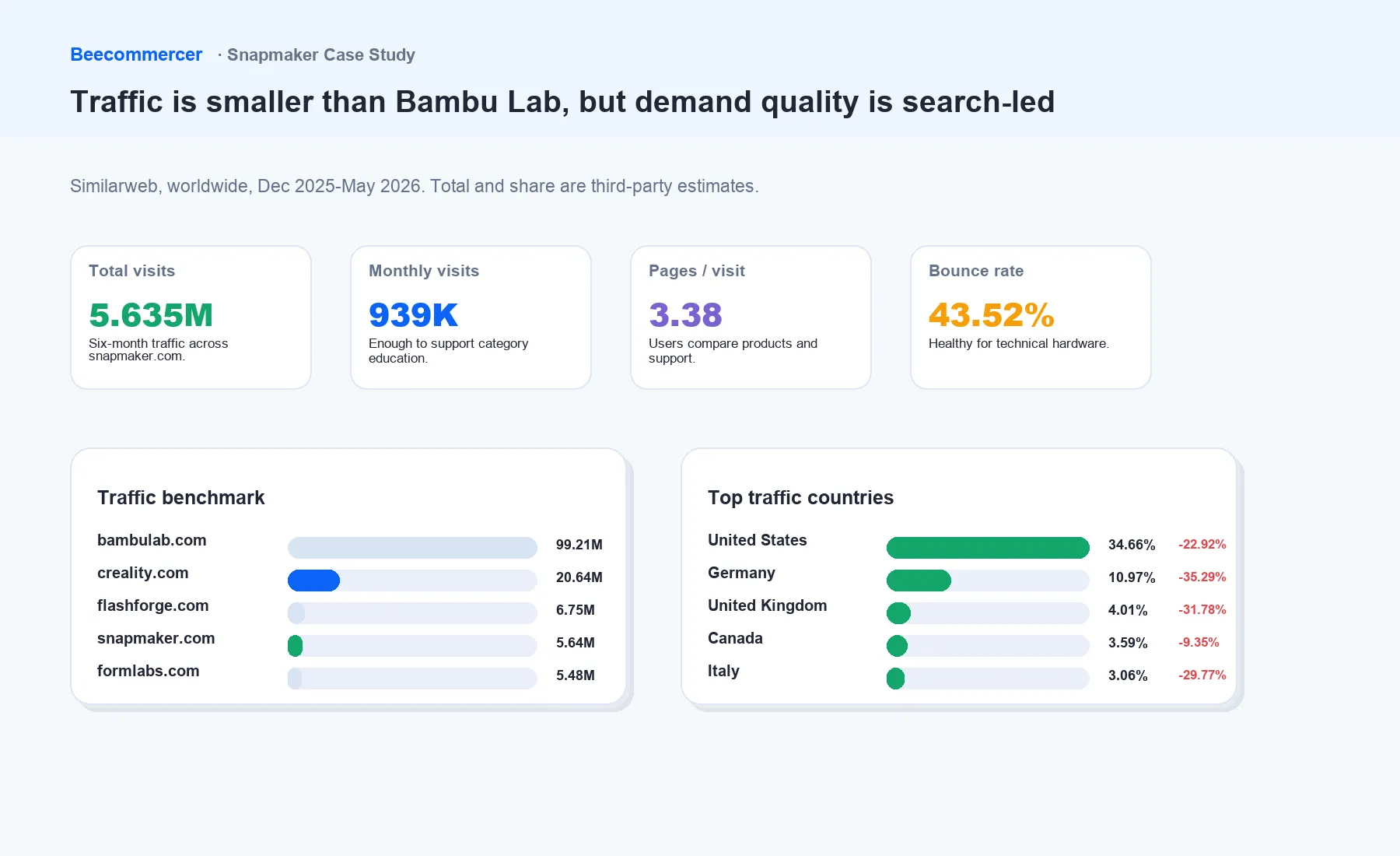
Similarweb estimated 5.635 million visits during the six-month window, or roughly 939,000 per month. The saved view showed 3.38 pages per visit and a 43.52% bounce rate. These figures describe aggregate navigation and should not be converted into conversion, retention, or product-quality claims. The estimated competitor set also shows the scale of the category: bambulab.com at 99.21 million visits, creality.com at 20.64 million, flashforge.com at 6.75 million, snapmaker.com at 5.64 million, and formlabs.com at 5.48 million over the same period.
The United States accounted for an estimated 34.66% of Snapmaker traffic, followed by Germany at 10.97%, the United Kingdom at 4.01%, Canada at 3.59%, and Italy at 3.06%. Those shares can guide research, but investment decisions still require first-party margin, stock, logistics, compliance, returns, conversion, and support-capacity data. Public traffic scale is a clue, not a market plan.
Source note: Similarweb Website Analysis, Worldwide, Dec 2025–May 2026. The shares use Similarweb’s modeled Marketing Channels definitions; they do not show incrementality, sales attribution, or profit.
3. Search is Snapmaker’s main conversion surface
Organic search represented an estimated 41.69% of visits and paid search 15.25%. Direct traffic contributed 18.94%, referrals 6.43%, organic social 5.06%, display 4.43%, paid social 3.18%, affiliates 2.64%, email 1.83%, and generative AI referrals 0.55%. The strategic point is not that every channel should look like search. It is that search pages often have to finish work started elsewhere: explain a product seen on YouTube, compare it with Bambu Lab or Creality, answer a setup concern raised on Reddit, and route an owner to the right support article.
That demands intent-specific landing pages. Brand and family searches need clear navigation; comparison searches need test conditions and tradeoffs; material searches need compatibility and calibration rules; setup searches need direct steps and downloads. The official U1 support area already concentrates manuals, firmware, and software downloads. Linking that evidence from product, comparison, launch, and troubleshooting content reduces the gap between discovery and confident use.
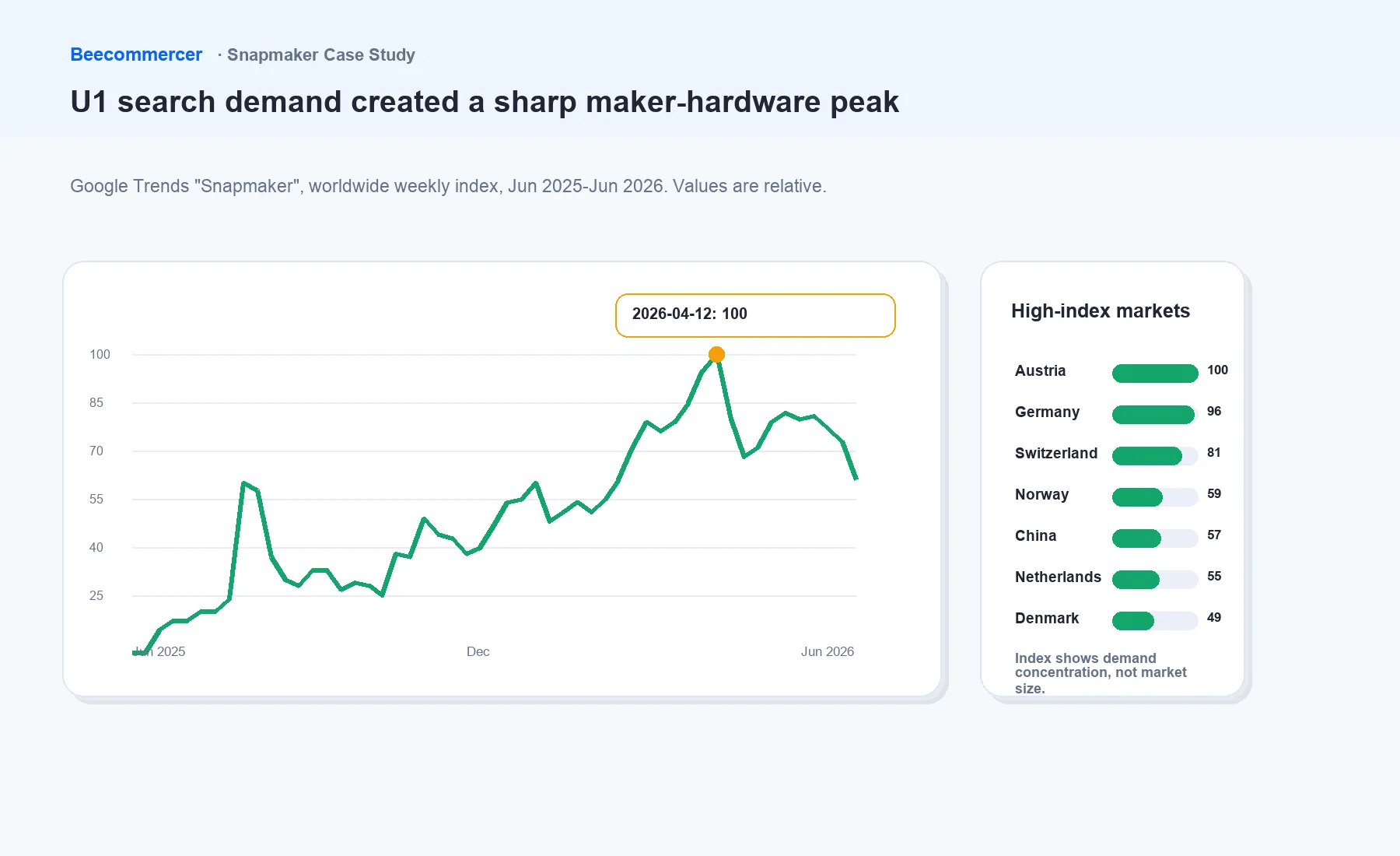
Source note: Google Trends for “Snapmaker,” Worldwide, Jun 2025–Jun 2026. Google explains that Trends data is sampled and normalized on a 0–100 scale. A peak of 100 means the highest relative point in this dataset, not 100 searches.
4. The U1 launch converted brand interest into product-led queries
The saved Trends view reached its peak in the week beginning April 12, 2026. Austria indexed at 100, Germany 96, Switzerland 81, Norway 59, China 57, the Netherlands 55, and Denmark 49. These values measure relative concentration, not the number of searches or market size. They identify places worth investigating with first-party data and local demand research.
More importantly, the related-query set was led by “U1” at 100 and “snapmaker u1” at 99. “Snapmaker 3d” followed at 26, “3d printer” at 14, and “snapmaker u1 3d” at 13. Rising terms such as “snapmaker u1 price,” “snapmaker u1 review,” and “snapmaker u1 kickstarter” were marked Breakout. Google’s related-search documentation explains that these are relative signals inside the result set, not absolute demand totals.
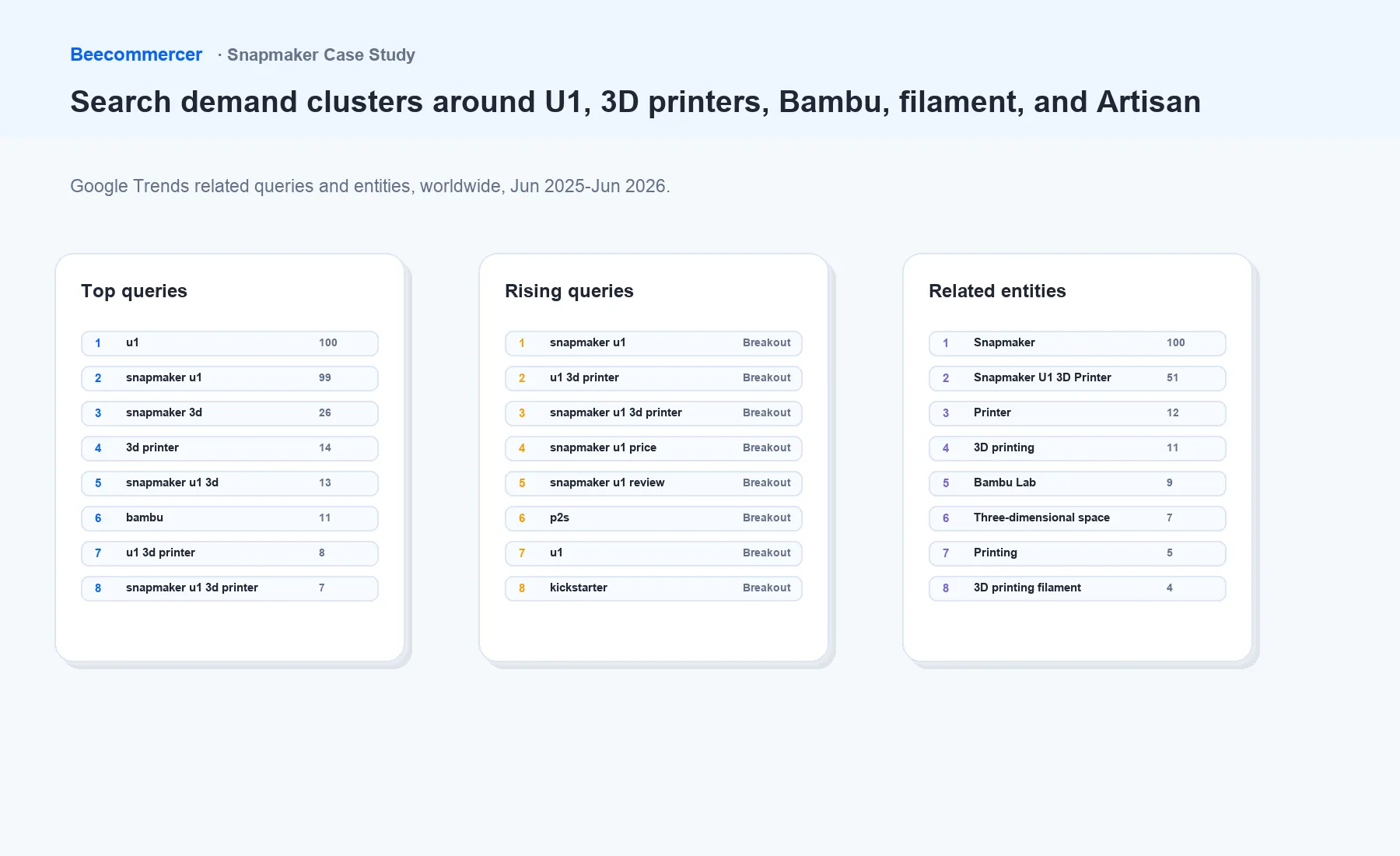
Source note: Google Trends related queries for “Snapmaker,” Worldwide, Jun 2025–Jun 2026. Values are normalized within the list; “Breakout” indicates exceptionally rapid growth from a low or limited base and is not an absolute search-volume count.
The product proposition gives those queries substance. Snapmaker presents U1 as a four-toolhead multi-material printer designed to switch colors and materials without the purge waste of single-nozzle systems. Independent testing adds necessary boundaries. All3DP’s U1 review, Tom’s Hardware’s U1 review, TechRadar’s U1 review, and Creative Bloq’s U1 comparison examine speed, waste, quality, software, and ownership tradeoffs from different perspectives. Search content becomes more credible when it helps buyers reconcile the official promise with those tests.
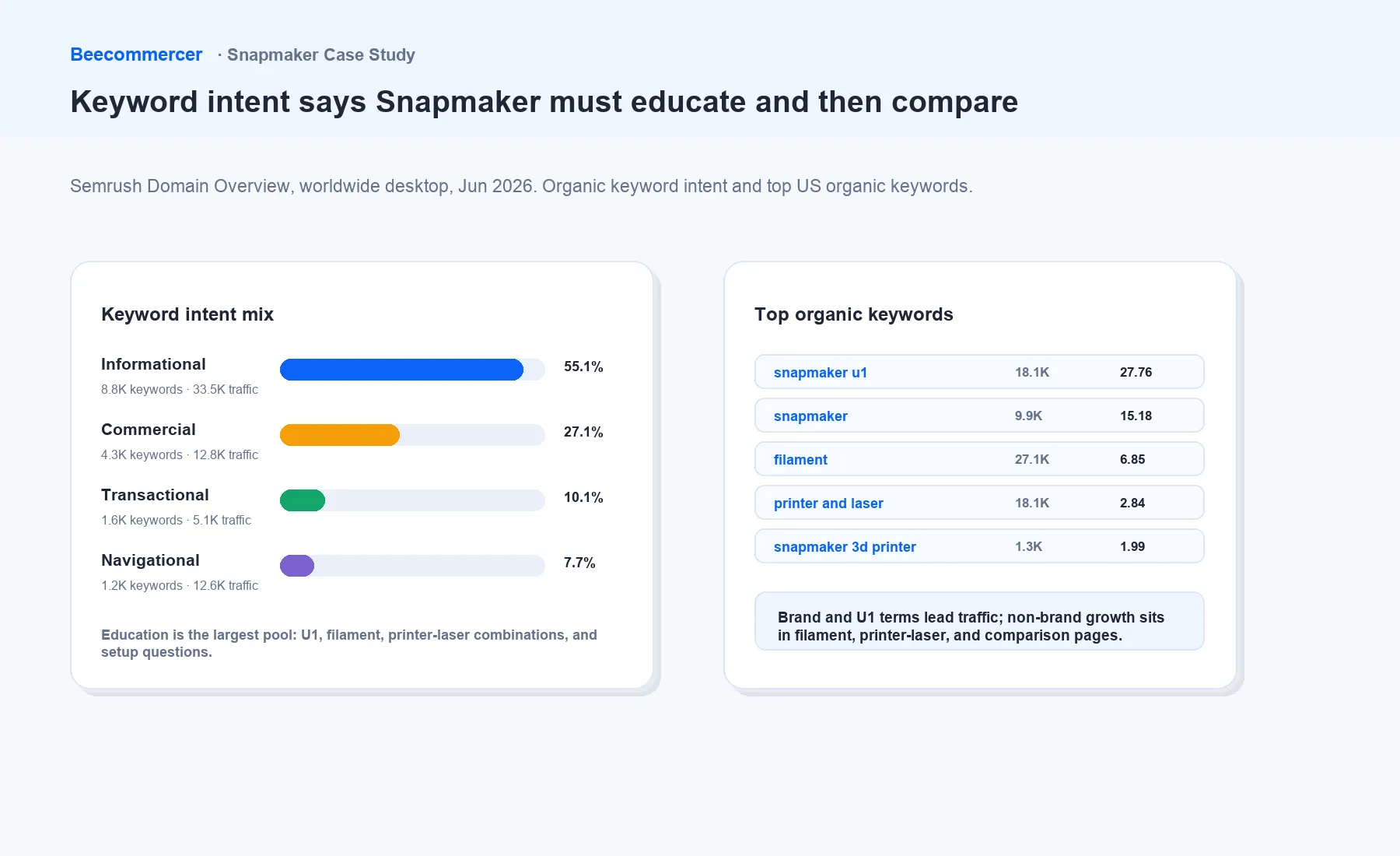
Source note: Semrush Domain Overview for snapmaker.com, Worldwide desktop database, Jun 2026. Semrush documents its keyword and intent fields. Keyword, traffic, and intent values are vendor estimates and may not match Search Console or analytics.
5. Education and comparison pages must reduce setup risk
Semrush classified an estimated 55.1% of Snapmaker’s organic keyword set as informational, 27.1% commercial, 10.1% transactional, and 7.7% navigational. The leading terms included “Snapmaker U1,” “Snapmaker,” “filament,” “printer and laser,” and “Snapmaker 3d printer.” This mix makes education commercially relevant: the buyer is not only choosing a printer but also testing workflow fit, material compatibility, learning effort, and ownership risk.
Official support content should therefore appear before checkout, not only after it. The U1 FAQ says third-party 1.75 mm filament can be used, while automatic RFID recognition is limited to Snapmaker filament. It also recommends calibration when changing filament brand or type, before a first print, after hotend changes, or when material conditions change. Its first-print guidance allows roughly 120 minutes for unboxing, setup, calibration, and the print itself. Those are valuable decision facts that belong beside product claims and comparison content.
The same principle applies across the portfolio. The Artisan product page and Artisan specifications describe a very different modular job than U1; TechRadar’s Artisan review supplies an independent ownership perspective. Snapmaker’s support comparison among 2.0, Artisan, J1s, and Ray can help prevent mismatched expectations. Comparison architecture should begin with the job—multi-material printing, dual extrusion, laser work, CNC work, build volume, or ease of setup—then expose constraints and next steps.
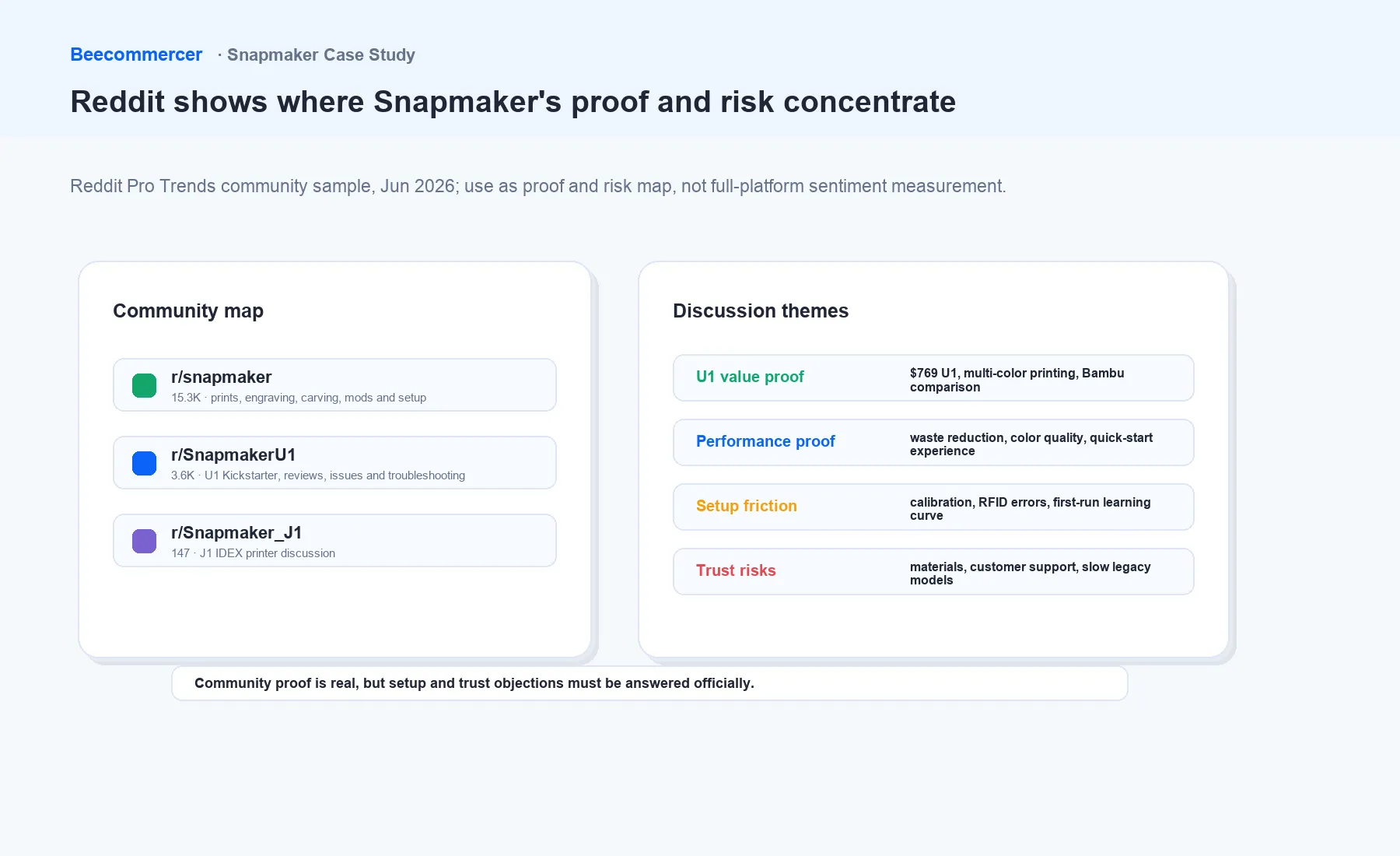
Source note: Directional review of public Snapmaker-related Reddit communities and posts in Jun 2026. Examples include a first-month U1 report, an initial-impressions comparison, and an RFID discussion. This is not a sentiment study, failure-rate estimate, or support audit.
6. Community proof reveals both value and trust gaps
Public communities are useful because they speak in jobs and objections. The saved directional sample clustered around U1 value proof—price, four-color printing, and comparisons with Bambu systems—plus performance proof such as lower purge waste, print quality, and quick startup. The same discussions raised setup friction around calibration, RFID, the first run, and slicer workflow. Other threads questioned material support, service responsiveness, or slower legacy machines.
A brand should not turn a small Reddit sample into a universal verdict. It should use recurring questions as a content backlog. A query such as “does U1 work with third-party filament?” needs a short answer, supported exceptions, calibration steps, and a link to the official FAQ. A comparison query needs the tested firmware, slicer, material, profile, and print conditions. A support concern needs regional contact expectations and policy boundaries. Snapmaker’s published limited warranty and Snapmaker Care are proof assets only when buyers can find the applicable region and understand what is covered.
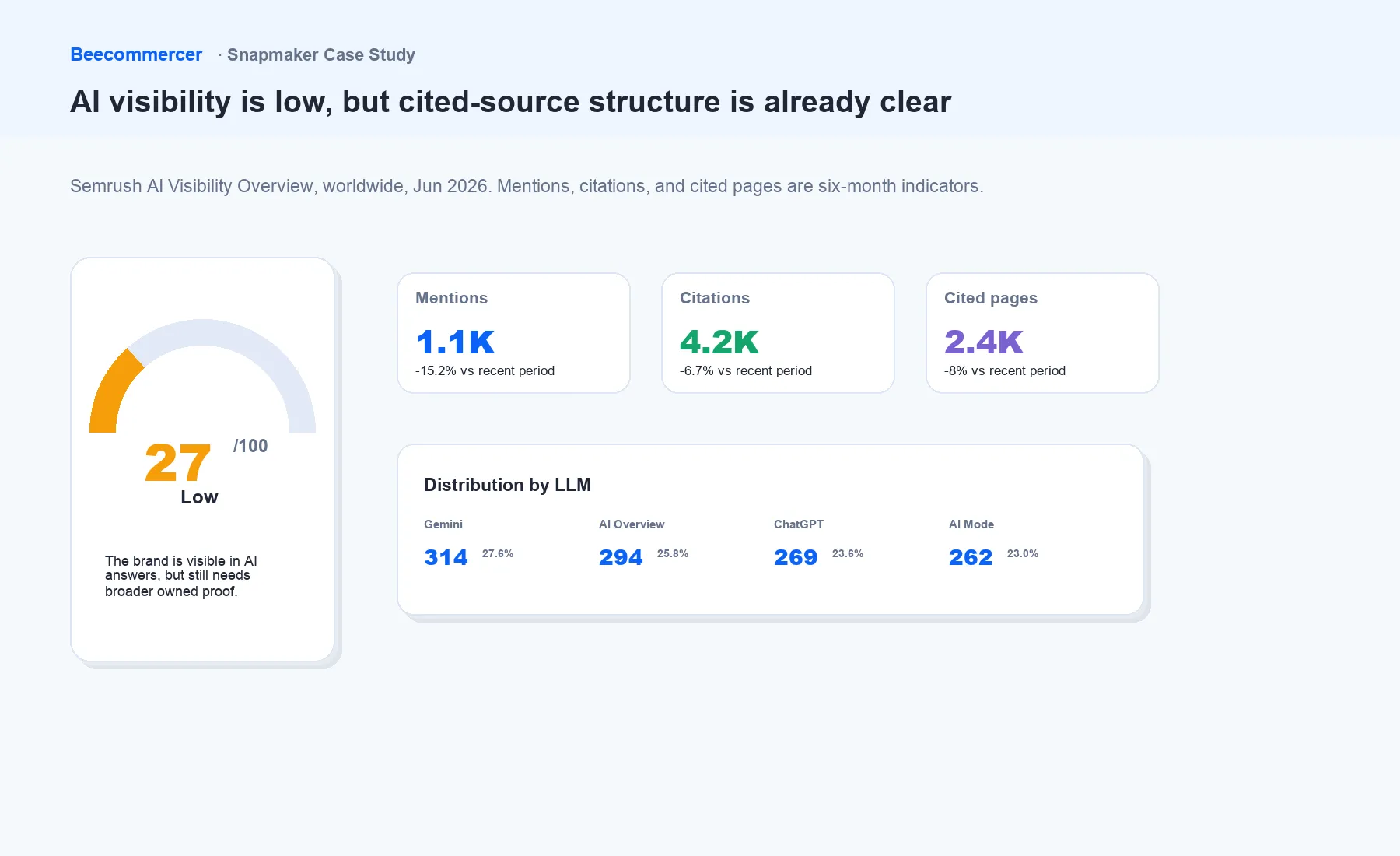
Source note: Semrush AI Visibility for Snapmaker, Worldwide, Jun 2026: score 27/100, approximately 1.1K mentions, 4.2K citations, and 2.4K cited pages in the saved view. Definitions come from Semrush’s Visibility Overview documentation. Results depend on tracked prompts, markets, and platforms.
7. AI answers reuse a distributed evidence network
The saved Semrush view gave Snapmaker an AI Visibility score of 27/100, with mentions down 15.2%, citations down 6.7%, and cited pages down 8% versus the comparison period shown by the provider. Distribution was relatively balanced across Gemini at 27.6%, Google AI Overview at 25.8%, ChatGPT at 23.6%, and AI Mode at 23.0%. These percentages reflect the provider’s tracked environment, not all AI answers on the web.
The cited-source network matters more than the score alone. YouTube appeared 267 times, snapmaker.com 265, Reddit 227, All3DP 95, Google 94, Facebook 82, Tom’s Hardware 75, and Bambu Lab 64 in the saved source view. AI answers are assembling claims from product pages, videos, communities, reviews, and competing reference points. That means GEO cannot be reduced to adding FAQ schema. The underlying claims must be explicit, verifiable, current, and consistent across the sources machines are likely to reuse.
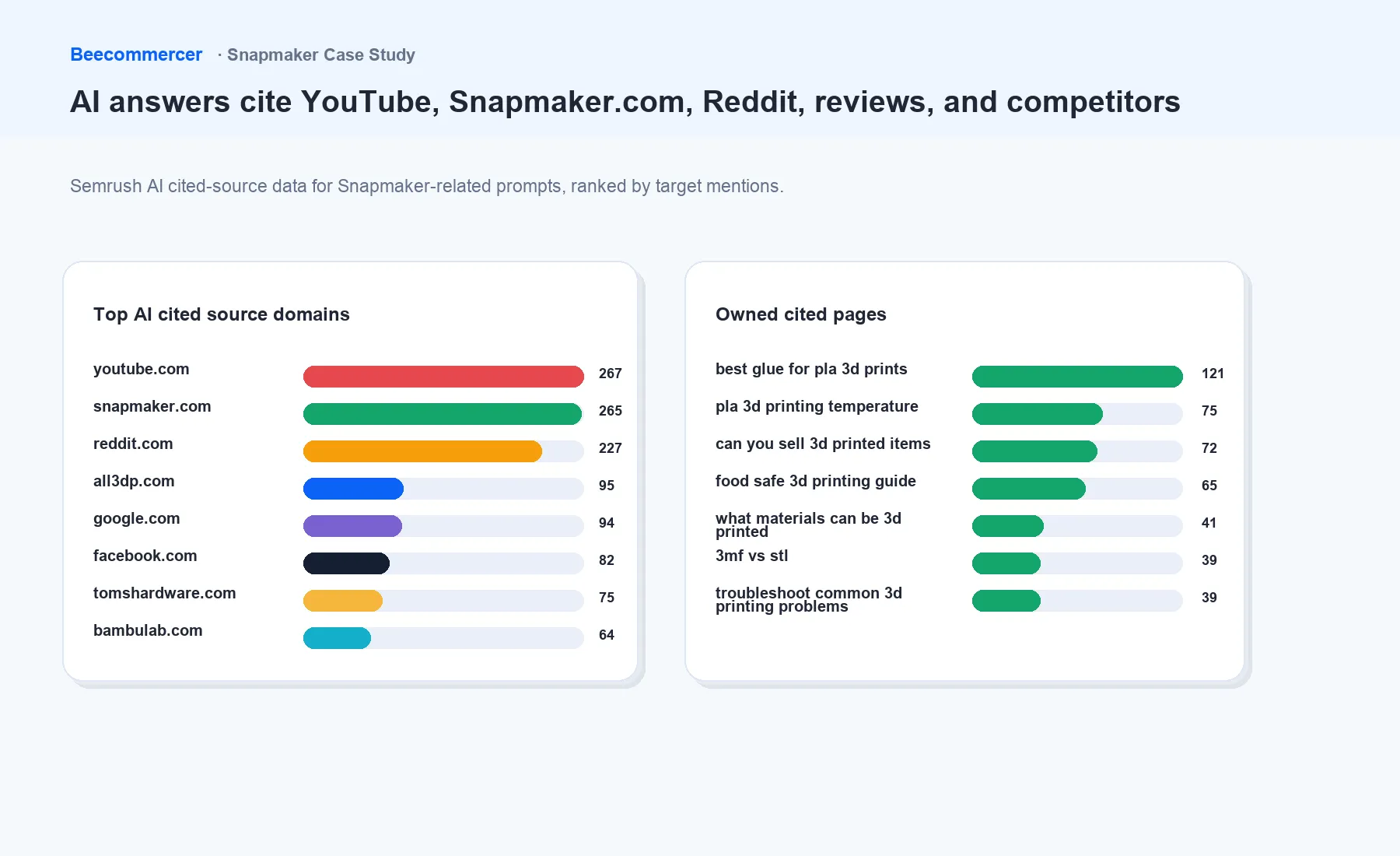
Source note: Semrush AI Visibility cited-source and cited-page exports, Worldwide, Jun 2026. Repeated citations are not unique domains or endorsements. Semrush explains its available AI Visibility features and report scope.
The owned pages already cited for “best glue for PLA 3D prints,” PLA temperature, selling 3D-printed items, food-safe printing, materials, 3MF versus STL, and common troubleshooting problems show the editorial opportunity. Utility content can earn visibility before a shopper is ready to compare machines. To support conversion, each guide should state material, machine, firmware, slicer, safety, regional, and date conditions; link to relevant products, support, and the maintained Snapmaker Luban software repository; and distinguish tested facts from general advice.
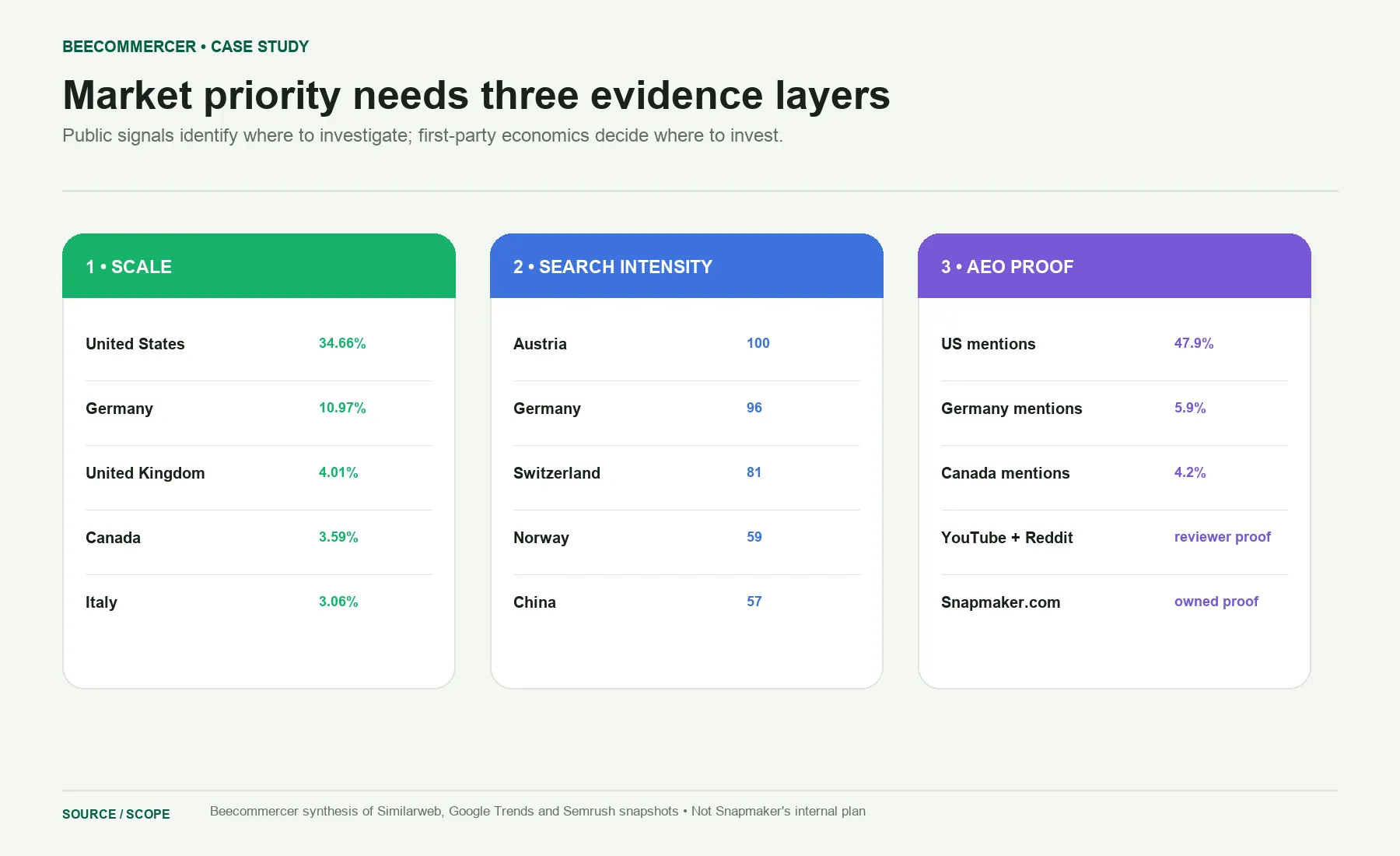
Source note: Beecommercer synthesis of the saved Similarweb, Google Trends, and Semrush snapshots. The framework is an editorial prioritization aid, not Snapmaker’s internal market plan. Country metrics use different denominators and should not be added or treated as equivalent.
8. What cross-border ecommerce brands can copy
Start with evidence architecture, not publishing volume. For each product and priority market, build one source-of-truth record covering the job, target user, specifications, compatible materials, excluded uses, setup time, calibration, software, downloads, safety, warranty, returns, support, and tested comparisons. Then reuse that record across product pages, buying guides, retailer feeds, creator briefs, help-center articles, structured data, and AI-ready summaries.
Next, prioritize markets with three layers. Traffic scale indicates where the domain already attracts attention. Trends concentration identifies where brand interest is unusually strong relative to other searches. AI mentions and cited-source patterns show where the evidence network is visible. Only first-party data can complete the decision: margin, stock, local pricing, duties, certification, language coverage, shipping time, return cost, product-market conversion, and support capacity.
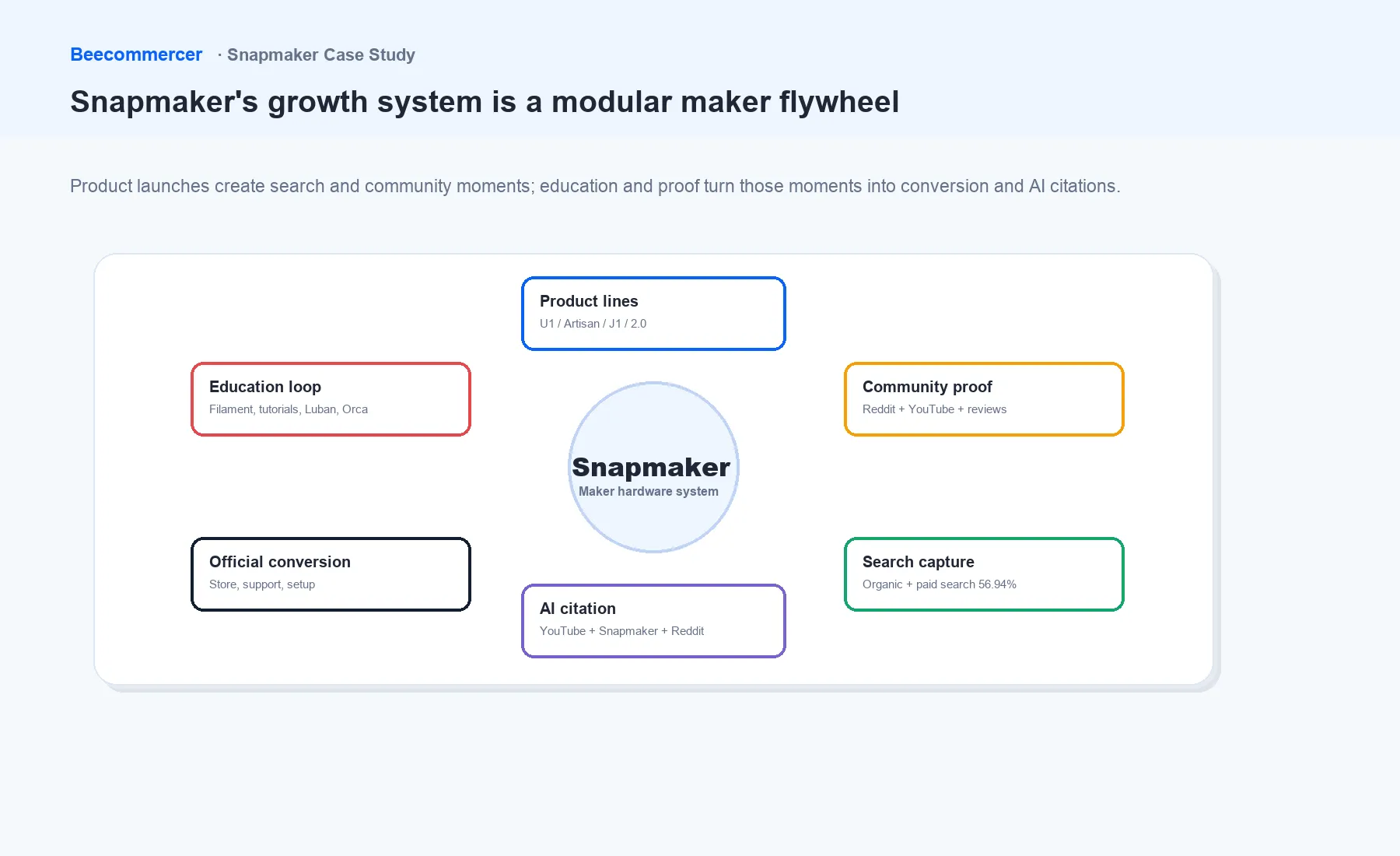
Source note: Beecommercer operating model synthesized from the public evidence reviewed in this case study. It is a recommendation, not a description of Snapmaker’s internal organization, strategy, or attribution model.
Finally, measure the handoffs. Track whether comparison visitors reach the correct product, whether setup searches reach the correct manual, whether support articles resolve or escalate, whether independent reviews reference current specifications, and whether AI citations point to pages with current conditions. Search share and AI visibility are diagnostic signals. The commercial outcome depends on a coherent journey from question to fit, proof, purchase, and successful use.
9. Frequently asked questions
What is the main growth lesson from the Snapmaker case study?
Snapmaker shows that a hardware launch becomes a durable ecommerce asset when product search, comparison content, setup education, independent testing, community proof, policies, and support operate as one evidence system.
Why is search so important to Snapmaker?
Similarweb estimated that organic search supplied 41.69% of snapmaker.com visits and paid search 15.25% from December 2025 through May 2026. These are modeled traffic shares, not sales, conversion, or Snapmaker attribution data.
What does Snapmaker’s AI Visibility score of 27 mean?
In the saved Semrush snapshot for June 2026, 27/100 was a vendor benchmark based on tracked prompts, markets, and answer platforms. It is not market share, a Google ranking factor, or a permanent score.
Does this study use private Snapmaker data?
No. It uses dated public pages and third-party estimates. Beecommercer had no access to private analytics, orders, customers, support tickets, revenue, profit, conversion, attribution, or internal strategy.
10. Full methodology and editorial note
This analysis combines saved June 2026 snapshots from Similarweb, Google Trends, and Semrush with a directional Reddit community sample and public Snapmaker product, specification, comparison, support, FAQ, warranty, software, and service pages. Official pages and cited independent reviews were checked in July 2026. Similarweb provides modeled traffic estimates, Google Trends provides sampled and normalized relative indices, and Semrush provides provider-specific keyword and AI-visibility snapshots. Values can change after collection.
The analysis does not infer orders, revenue, conversion, profit, market share, customer satisfaction, defect rate, or causality between visibility and sales. Reddit examples are not representative research. Independent reviews are evidence from their authors, not Beecommercer laboratory tests. All prioritization frameworks and operating recommendations are Beecommercer editorial analysis. Readers should verify current product specifications, regional availability, warranty, return, safety, and support terms on the applicable official page before acting.