

Last updated on October 21, 2026 at 6:30 PM
Research date: October 21, 2026. Traffic, search and AI metrics have different reporting windows, specified below.
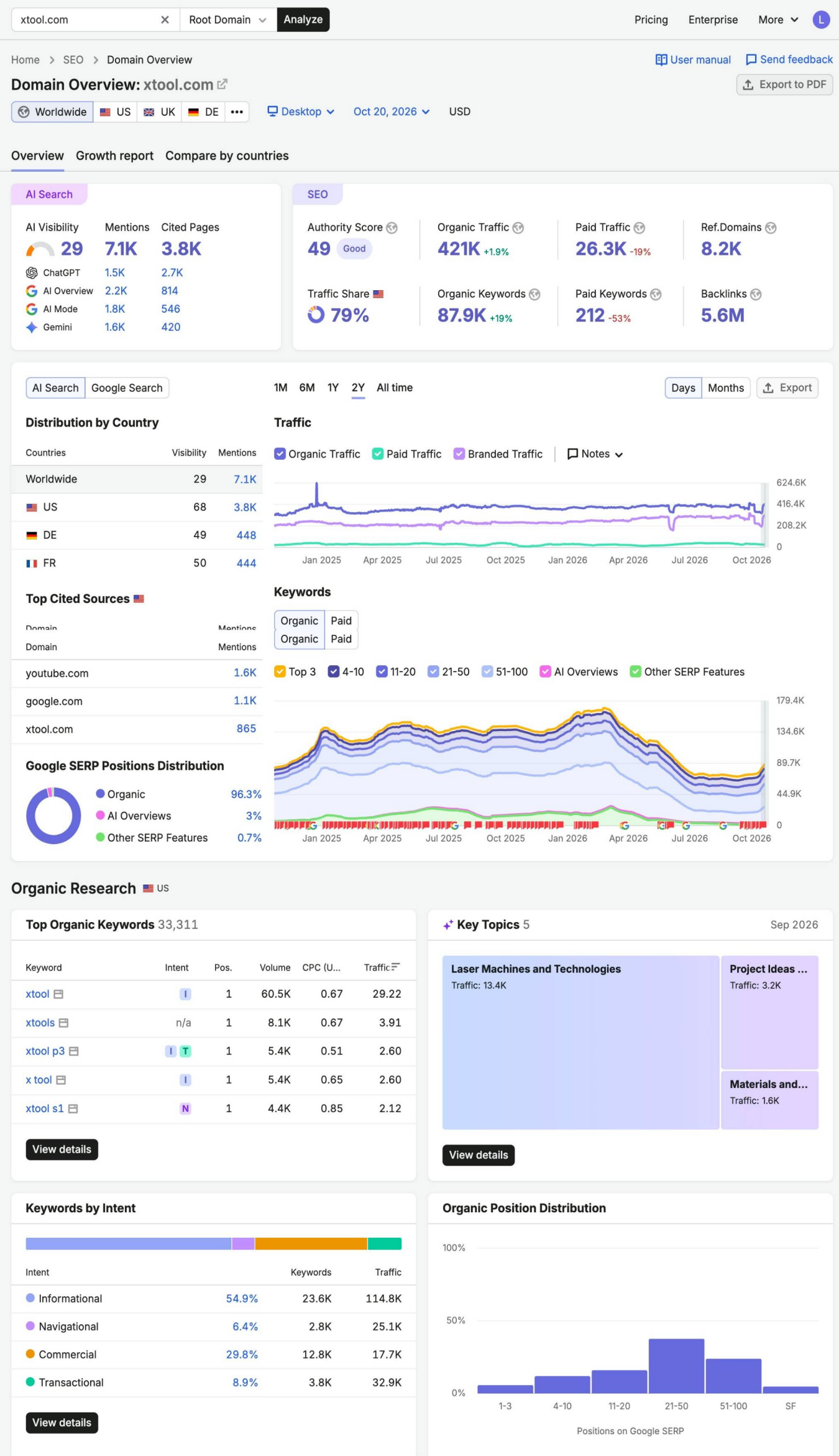
When a shopper already knows the machine they want, branded search can do a great deal of the selling. The harder task is reaching someone still deciding what to make, which materials to use, or whether a machine fits a small business. xTool’s data makes that distinction unusually clear: branded terms account for 81% of its estimated organic search traffic in September 2026, while its worldwide Semrush AI Visibility score is 29/100 in the October 20 snapshot.
Those measures describe different systems, but together they frame a useful operator question: how can an established hardware brand extend recognition into broader discovery? This case examines xTool’s traffic, maker content and search footprint, then identifies where better evidence could support the next purchase decision.
The operating model: make a project achievable before asking for the sale
Turn gift-making interest into email sign-ups
The gift-making page brings seasonal ideas, free design files, customer stories, machine recommendations and a profit calculator into one shopping journey. A free starter pack offers a gifting guide and design resources to email subscribers, giving visitors a reason to engage before they are ready to choose a machine.
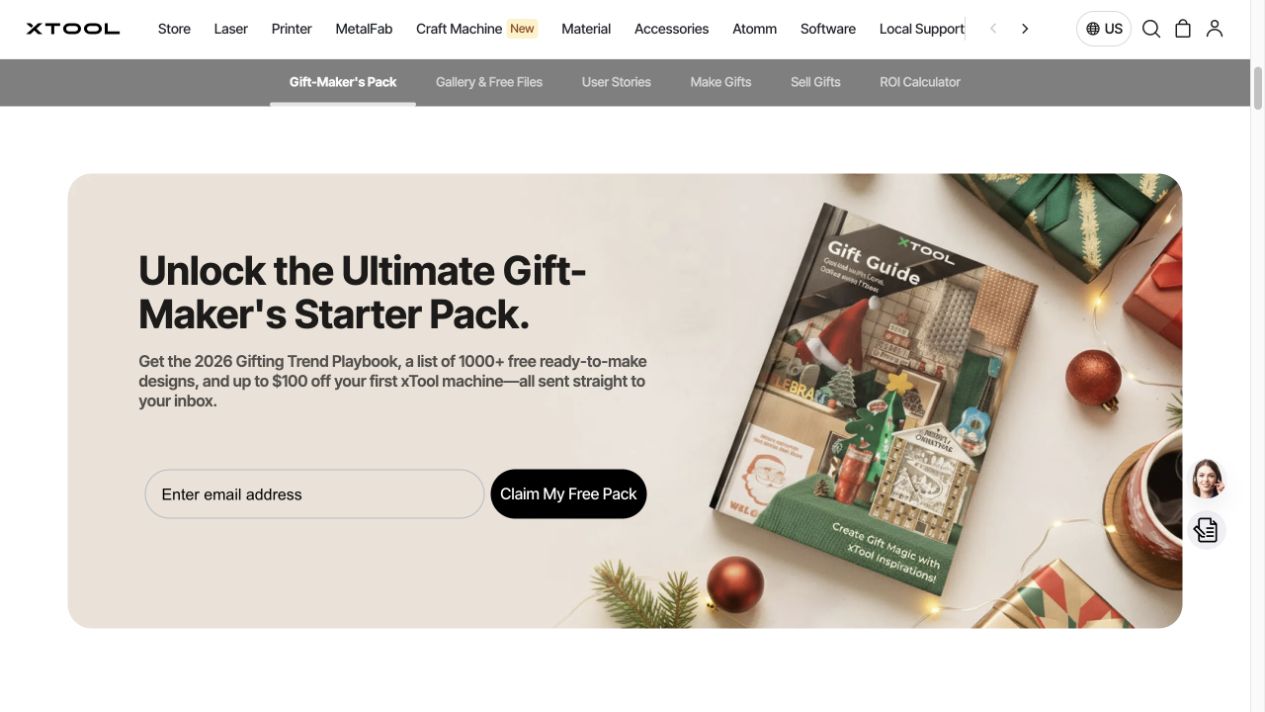
For xTool, this creates a way to follow up with people whose interest still centers on a project. Useful emails would connect that project to suitable materials, machines and the components needed to start. Track whether subscribers use files, compare models and place orders that remain after returns. Offers have conditions, and the calculator provides an estimate rather than evidence of customer earnings.
Help shoppers compare before they commit
The homepage groups laser equipment, printers, metalworking equipment and craft machines into separate categories. M2 and P3 product cards each offer “Learn More” and “Buy,” allowing shoppers to keep researching or go straight to a purchase when they have chosen a model.
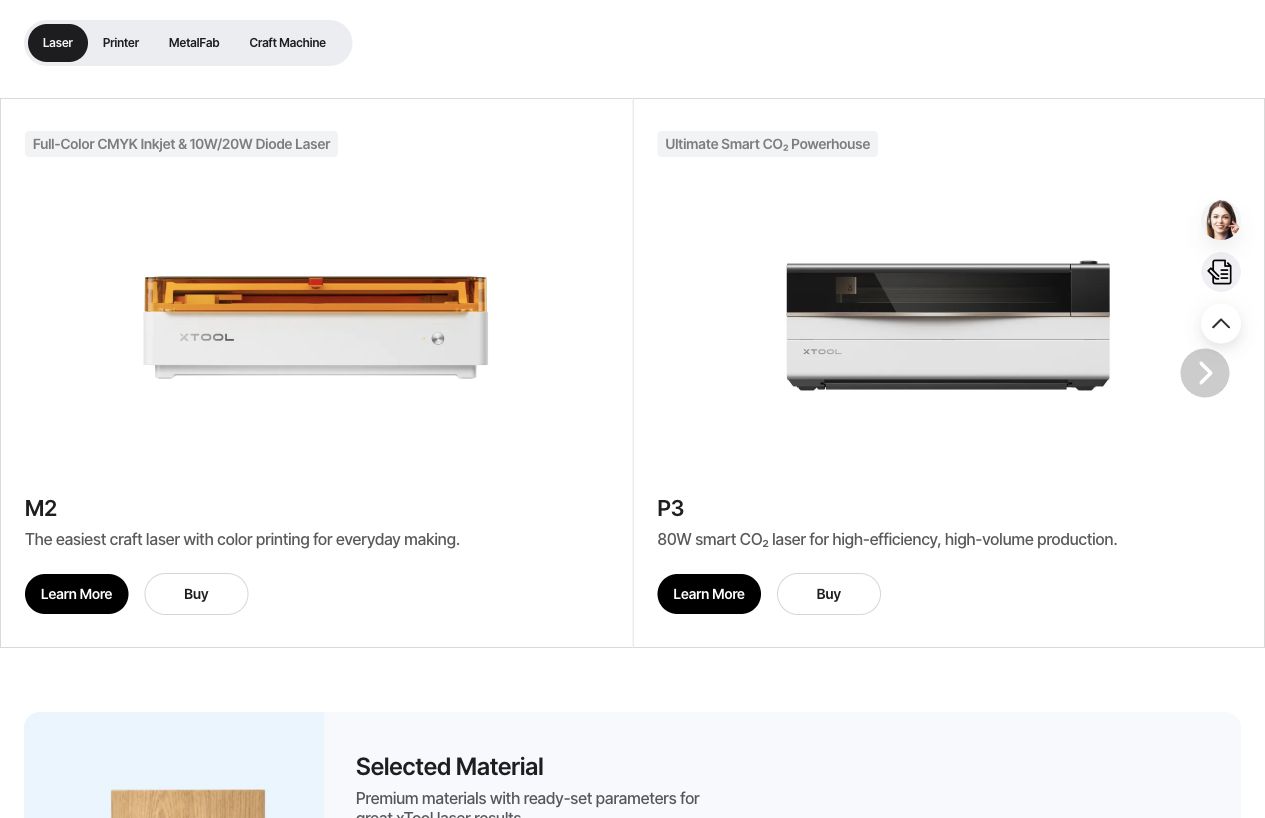
For expensive equipment, buying guidance needs to explain materials, workflows, required accessories and the complete setup. Compare purchases, returns and support requests by the guidance route a shopper used. That would help establish whether the content improves product fit. Questions about accessories and consumables in customer reviews also belong in the selection advice.
Give owners a reason to keep creating
Atomm combines AI design tools with projects, templates and materials resources, alongside links to learning content and the xTool store. Visitors can start with an object they want to make, then explore the equipment and materials it needs. Owners can return for their next project.
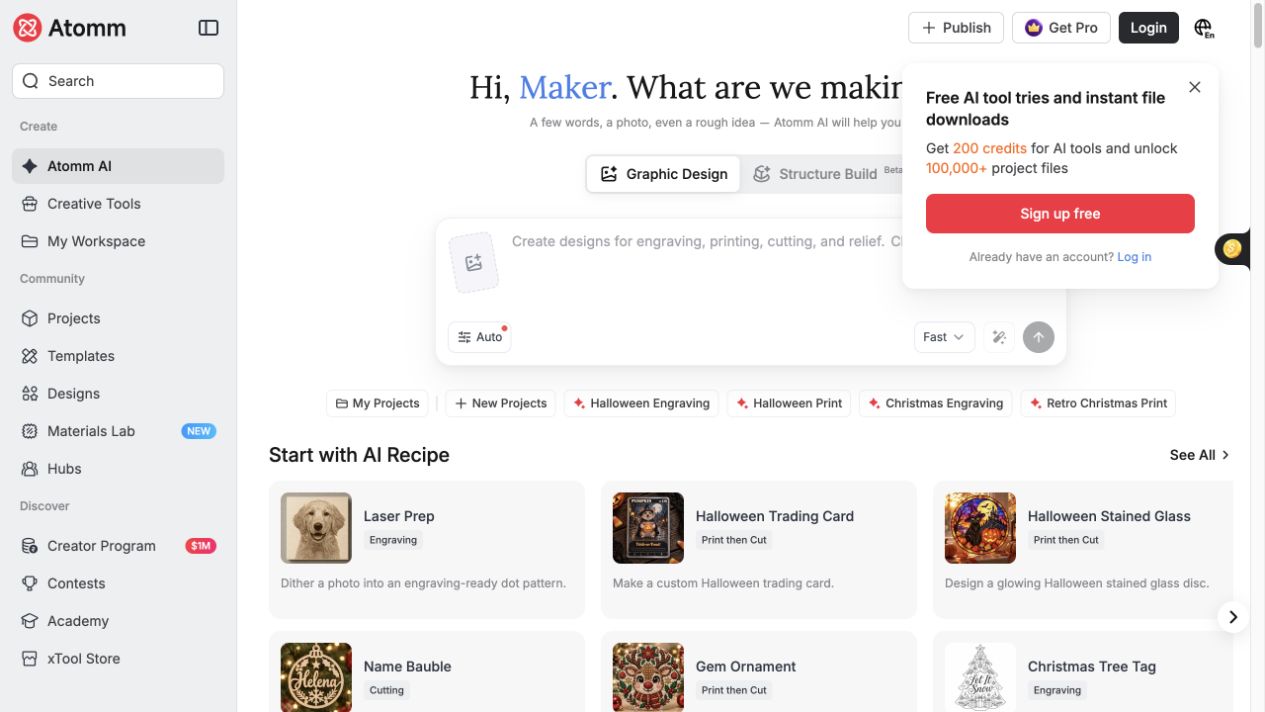
The content can therefore serve both product selection and use after purchase. Its value depends on whether people can complete a suitable project and obtain the supplies they need. Track file use, completed projects, machine orders and replenishment separately, then examine time to a first finished piece and support needs. Those measures would establish whether the ecosystem supports continued use or repeat purchases.
Creators and local demonstrations also have a commercial role. xTool’s UK affiliate recruitment page advertises referral commissions of 6–8%, while its separate affiliate portal schedule lists a standard rate of up to 4%, subject to exceptions. These published offers are not a single worldwide rate or evidence of actual partner earnings. The Squad community page describes hosts providing demonstrations, training and support-related services, with referral and service income opportunities.
This creates a strategy worth testing: let makers demonstrate outcomes, give interested viewers a reproducible project and a clear equipment choice, then connect them to a traceable purchase or demo. Referral incentives should be disclosed. A partner’s enthusiasm is useful product evidence only when the material, settings, limitations and commercial relationship are clear.
| Operating lever | Decision it can support | What to verify |
|---|---|---|
| Scenario and project content | Can I make the object I want? | Project-to-comparison and product-page progression |
| Creator and local demonstrations | Does it work in a real workflow? | Qualified demo leads and net orders after returns |
| Files, settings and tutorials | Can I reproduce the result after delivery? | Time to first successful project and support needs |
| Materials, accessories and service | Can I keep using the machine reliably? | Bundle completeness, consumable availability and repeat orders |
These are recommended measurements, not disclosed xTool results. An ecosystem can support repeat purchasing, but it also makes missing consumables or incompatible accessories part of the core product experience. That is where customer reviews become operational evidence.
The traffic base is substantial; sales performance remains a separate question
Similarweb estimates 14.97 million visits to xtool.com across April–September 2026, with approximately 2.496 million monthly visits. Its engagement summary reports 3.42 pages per visit, a 3:06 visit duration and a 46.55% bounce rate. Mobile web contributes 57.56% of visits, making product comparison and buying guidance on a small screen a practical priority.
Semrush Traffic Analytics separately estimates 3.2 million visits in September 2026, up 25.38% against the preceding month. Its six-month comparison describes growth of 76.9% from April to September. These figures should be read within Semrush’s model, rather than spliced into a Similarweb time series. The providers also report materially different engagement estimates.
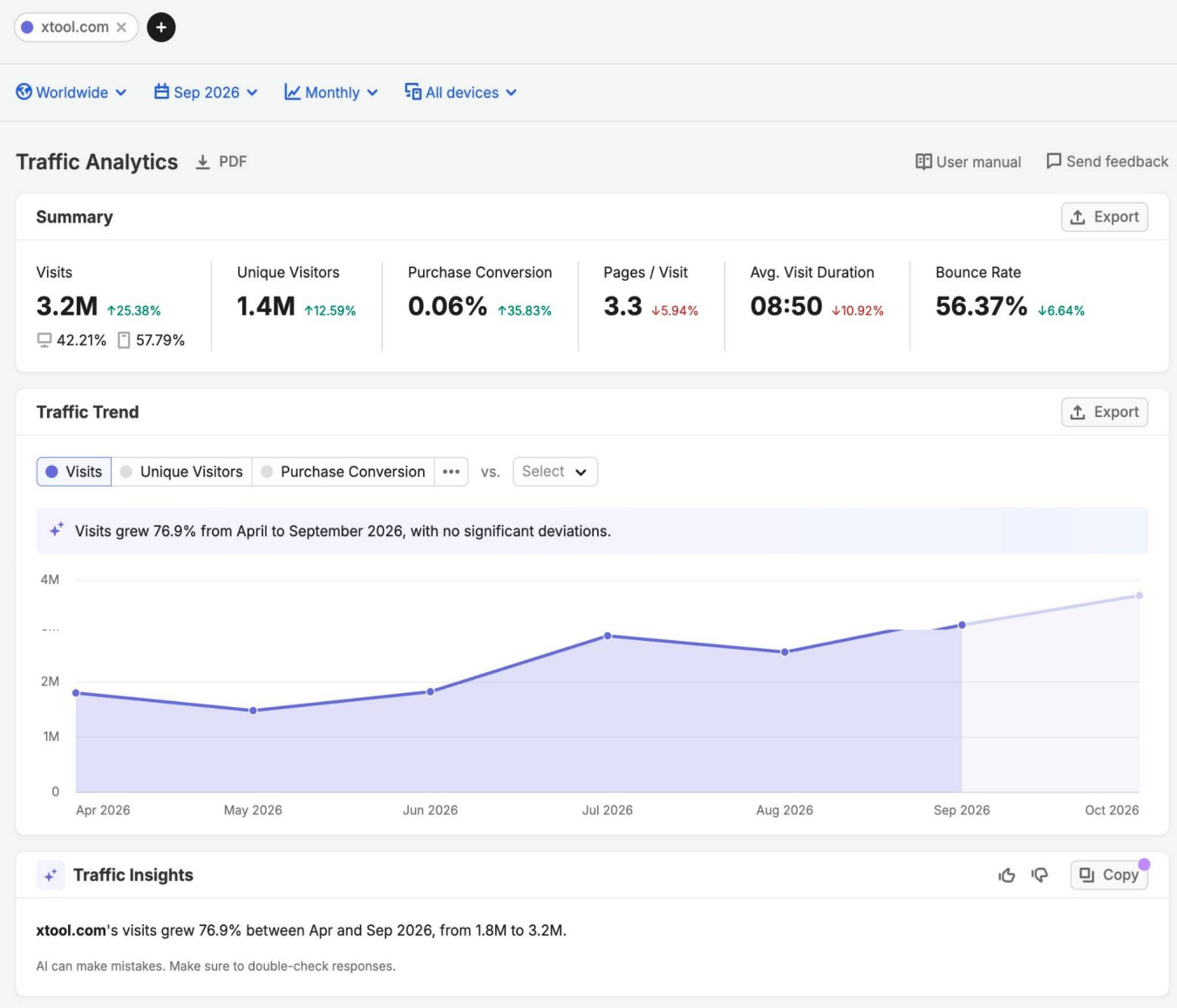
Within the Semrush September snapshot, pages per visit fell 5.94% and average visit duration fell 10.92%, while the bounce rate also declined. This is a mixed picture, not a uniform improvement in visit quality. Prominent pages include an O1 shipping page and account access alongside shopping pages. More visits therefore cannot be treated as proof of more new customers, better conversion or higher revenue.
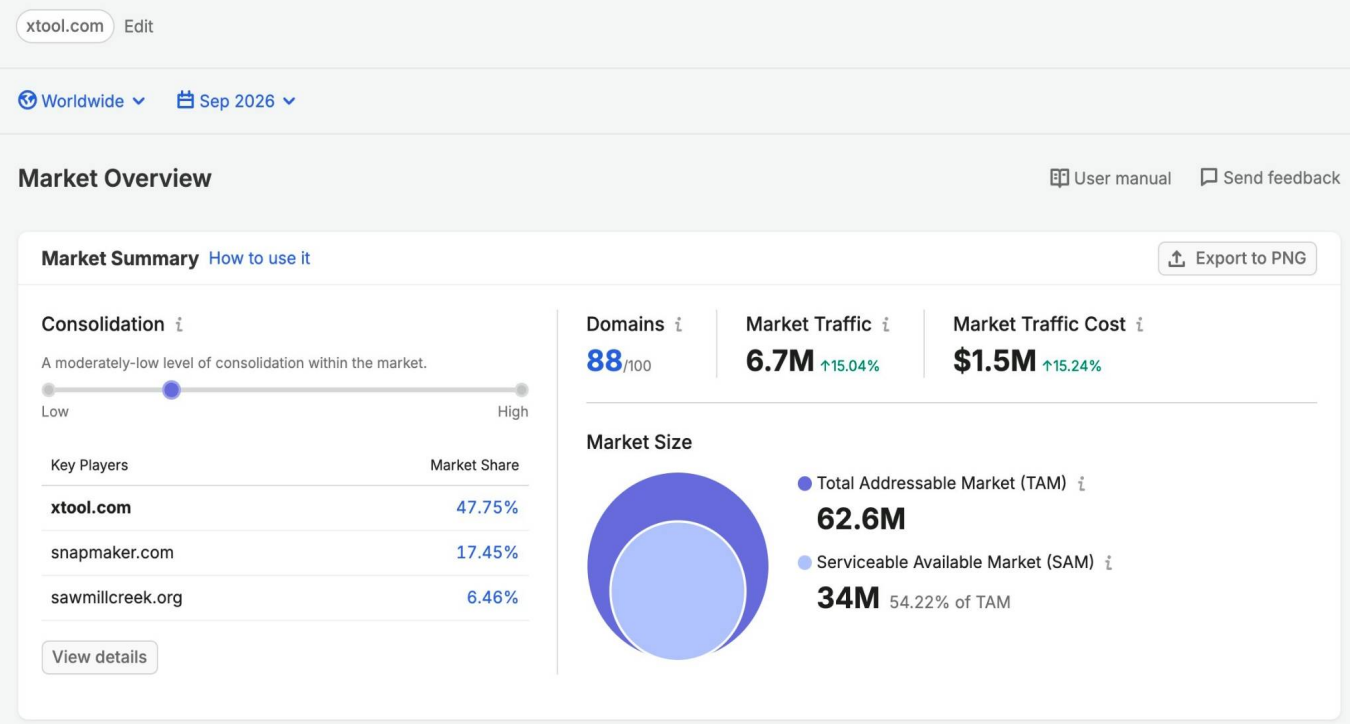
A traffic share, not a sales share: Semrush Market Overview assigns xtool.com 47.75% of traffic in an automatically selected set of 88 domains for September. The set includes equipment brands and a forum. It is useful for that comparison universe; it does not establish xTool’s share of laser-equipment sales or the entire category.
Search and direct visits anchor a wider channel mix
In Similarweb’s April–September channel view, direct visits contribute 26.51%, organic search 24.45% and paid search 14.23%. Organic and paid search together account for 38.68% of estimated visits. Social, display, email and affiliate activity provide additional entry points.
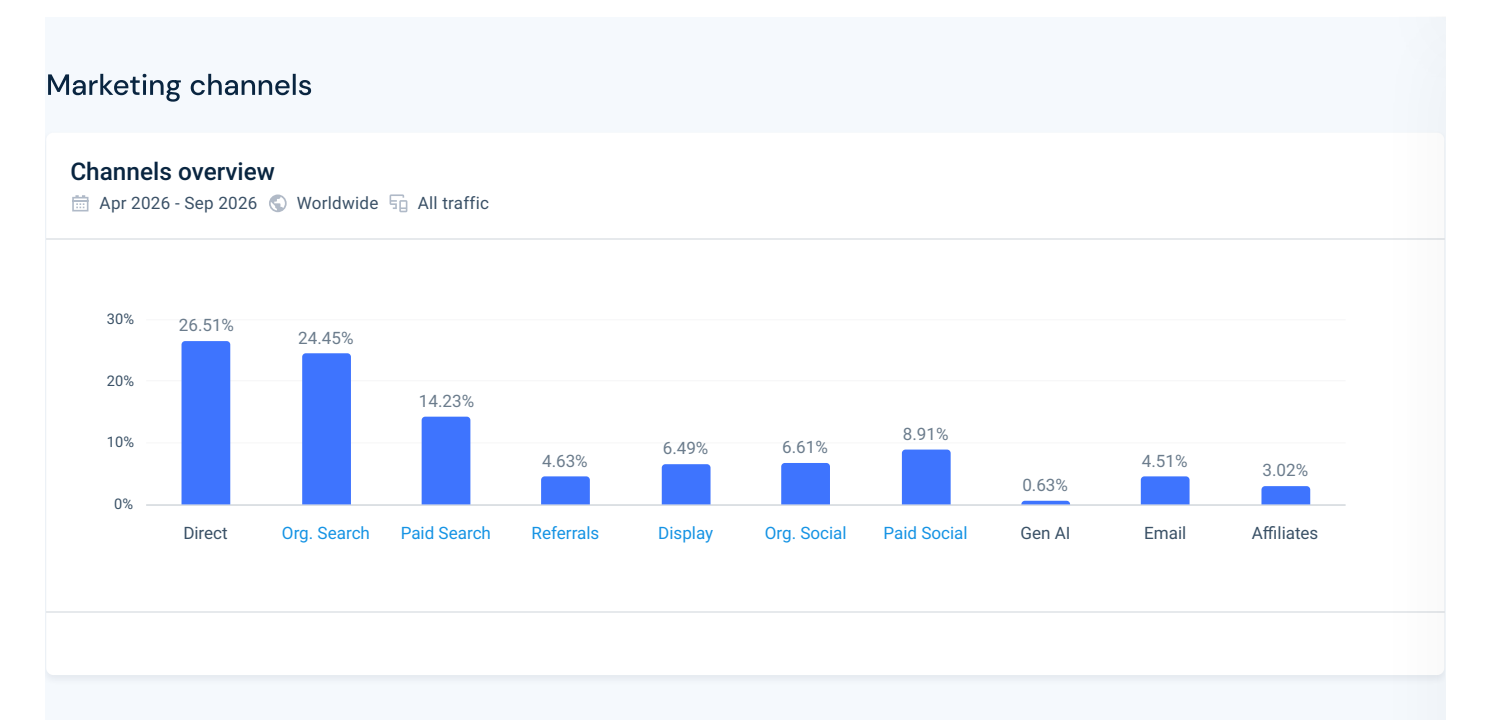
The operational implication is to coordinate discovery and demand capture. A demonstration can introduce a project; a comparison page can help choose a machine; branded search can bring a shopper back. This sequence is a strategy hypothesis, not a measured attribution path. Direct visits also contain activity that cannot be cleanly assigned to a prior channel, so they should not all be credited to brand loyalty.
Paid search has a visible category-acquisition role: Similarweb’s September paid non-branded term sample includes “dtf printer,” “laser engraver” and “uv printer.” These are useful landing-page themes, but keyword appearances alone reveal neither ad efficiency nor return on spend.
Maker demonstrations can connect brand demand with new questions
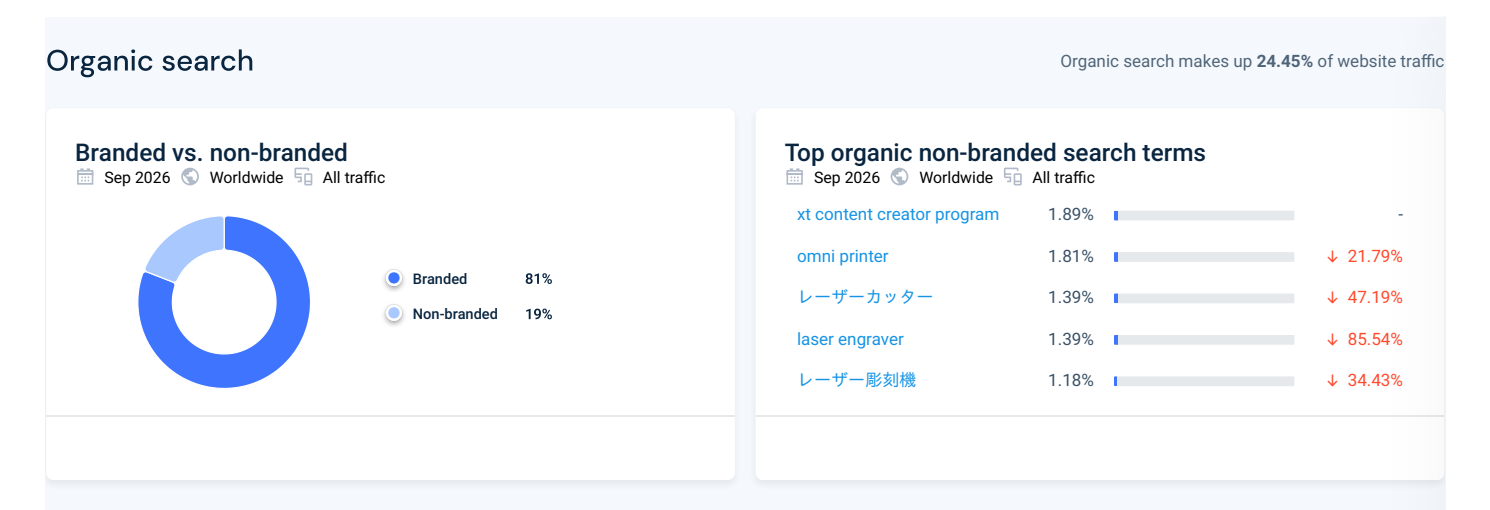
Similarweb’s September organic-search split is 81% branded and 19% non-branded. Separately, its April–September social referral mix is concentrated in YouTube at 60.80% and Facebook at 34.67%. Those platform percentages are shares of social traffic, not all website visits. Social overall represents 15.53% of traffic in that report.
This combination supports testing project-led education: show a finished object, explain the material and workflow, then connect it to a suitable machine. A video about making signage or personalized gifts can serve a different need from a specification page. Referral shares do not establish that these videos caused purchases, and they do not distinguish all paid and organic platform activity.

The channel priority is demonstration-led discovery. Track each platform’s path toward a suitable machine and a complete setup; referral shares alone do not establish sales effectiveness.
Semrush adds a search-content clue. In the October 20 SEO snapshot, worldwide desktop organic traffic is estimated at 421,000, with 87,900 organic keywords. In the separate US keyword-intent panel, 54.9% of keywords are informational. That is a keyword share, not a traffic share. The leading US keyword sample includes brand and model queries such as “xtool,” “xtool p3” and “xtool s1.”
For another hardware brand, the transferable task is to connect three content layers: category selection, model-and-material suitability, and a complete project walkthrough. Measure the movement between these layers before deciding that more educational content is producing more qualified demand.
The US is the core audience; Europe needs market-specific journeys
Similarweb’s six-month geography view puts the United States at 50.13% of visits, followed by the UK at 11.61%, France at 7.42% and Germany at 6.98%. These are shares of visits to the analyzed domain, not shares of customers or revenue.
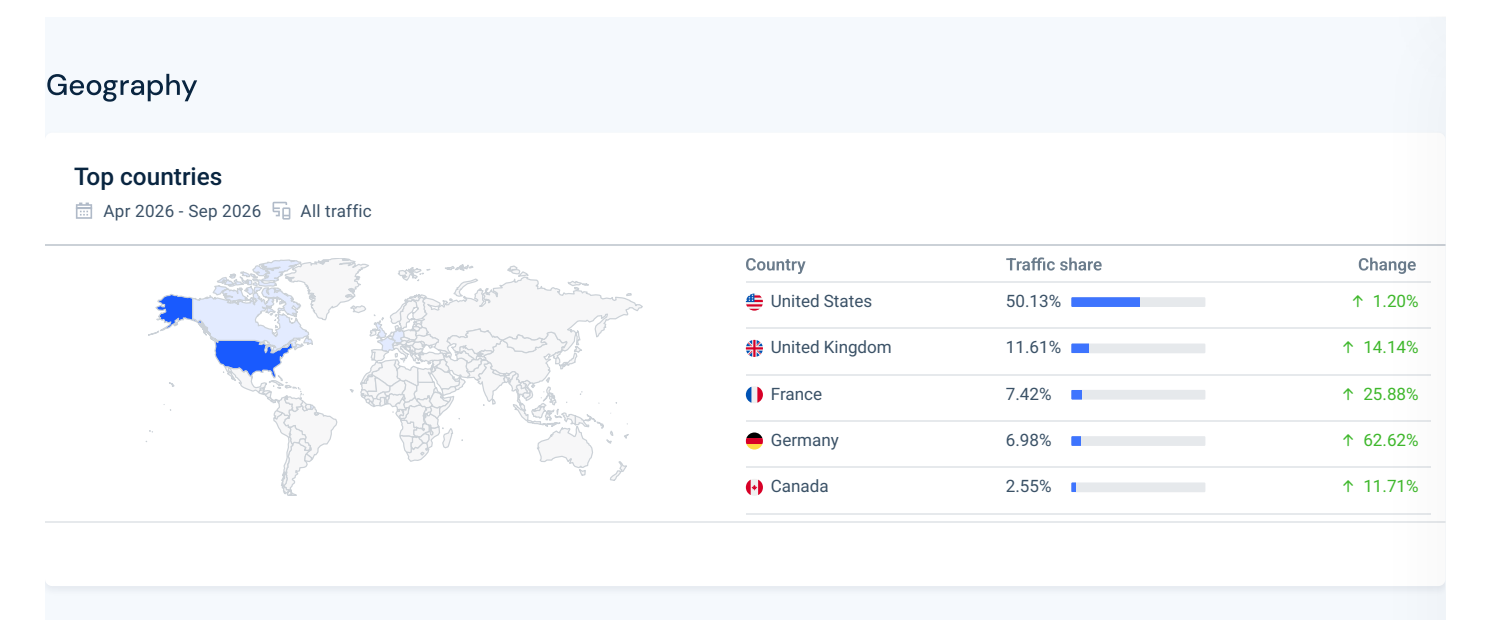
Semrush’s September-only model gives a different distribution: the US at 43.77% and the UK at 20.32%, together 64.09%. It also estimates that 90.02% of UK visits are mobile. The different periods and provider models prevent a clean inference that the UK gained share between these reports. The UK mobile signal is still a useful hypothesis to validate with first-party analytics.
Market prioritization should therefore combine traffic with local conversion, fulfillment and support evidence. Test whether buyers can compare machines, understand included accessories, check delivery expectations and find local support in their language. Traffic concentration justifies investigation; it does not settle budget allocation.
More AI mentions do not guarantee stronger citation coverage
The October 20 Semrush AI Visibility view covers worldwide results across all selected AI platforms. It reports the following:
| Metric | Snapshot | Change displayed in report |
|---|---|---|
| AI Visibility score | 29/100 | Vendor label: Low |
| Mentions | 7.1K | +4.2% |
| Citations | 4.0K | −16.1% |
| Cited pages | 3.8K | −28.2% |
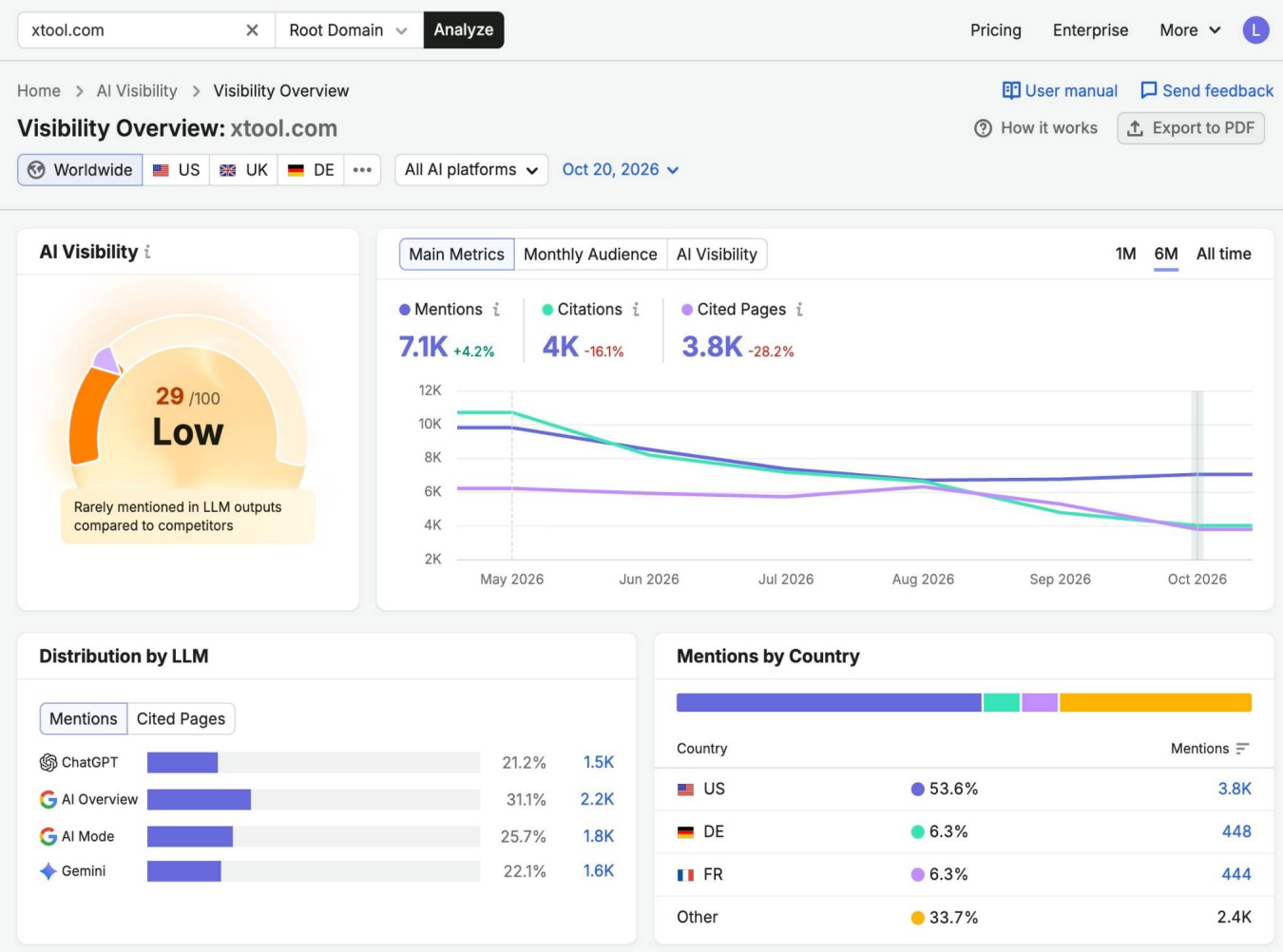
The report does not explicitly define the comparison baseline for these displayed changes. A year-on-year comparison therefore cannot be established. The score is also a proprietary visibility measure, not a percentage of shoppers, searches or visits.
The useful distinction is between being named and supplying cited evidence. Mentions increased while citations and cited-page coverage declined in the displayed comparison. The same Semrush view shows strong individual topic scores for model-and-material tasks, including xTool S1 20W and acrylic cutting, and xTool material settings. Success on narrow branded questions can coexist with a lower overall score.
Semrush Market Overview separately estimates 6,500 AI-referred visits in September. That is a traffic measure; it cannot be compared directly with the 7,100 AI mentions. Neither measure establishes AI-assisted revenue.
A practical response is to build clear, verifiable answers around material compatibility, model selection, workflow limits and maintenance. Link supporting demonstrations and dated technical documentation to the relevant product page. Track a stable set of buyer questions and the pages cited over time; avoid treating a higher mention count alone as the goal.
Trustpilot: product appreciation and ownership friction can coexist
On October 21, 2026, the xtool.com Trustpilot profile displayed 4.1/5 from 1,444 reviews. The five-to-one-star distribution was 75%, 6%, 3%, 3% and 13%. The profile states that the business invites reviews. These are platform metrics, not an all-customer satisfaction survey.

These six reviews cover setup, accessories, delivery and repairs, highlighting questions that affect the experience after purchase.
| Selected account | Reported experience | Operational question |
|---|---|---|
| rlandcastle · 5 stars · September 22 | Easy setup and a useful ecosystem | Can new buyers reproduce that first success? |
| Peter M. · 4 stars · October 11 | Good hardware/software; components arrived over time | Is bundle delivery progress visible? |
| Ernestina Bill · 4 stars · viewed October 21 | Needed a purifier, adapter and additional supplies | Is the complete setup clear before payment? |
| Henry Batchelor · 1 star · October 19 | Technical guidance did not answer a specific task | Can support resolve material-specific questions? |
| Jennifer Leong · 1 star · October 19 | Starter materials remained unshipped | Can the buyer start using the delivered machine? |
| Jacob Gonzales · 1 star · October 18 | Repair issues and unavailable cleaning supplies | How long is the customer unable to work? |
Dates refer to the 2026 reviews unless marked as the date viewed. These are individual customer accounts; they do not establish how common each problem is across all orders.
The recurring operational question is whether buyers have everything they need to start making once the machine arrives. A suitable test is a product-page checklist showing required versus optional items, regional stock and the status of each bundle component. For customer support, measure time to a usable resolution, not just the first reply. For printers, the ability to replenish ink and cleaning supplies should be assessed alongside the machine sale.
xTool’s published aftersales policy distinguishes product categories, condition and timing; the shipping policy also addresses damaged or incomplete orders. An operator should surface the applicable terms beside model selection and checkout. A generic returns badge is insufficient to explain every product and market; current local terms and applicable customer rights need separate checking.
Reddit: follow the service outcome, not just the original complaint
Two selected r/xToolOfficial threads add context. In an April 14 shipping-damage account, the author updated the post through April 22 to report receiving a replacement. A July 2 M1 Ultra support account describes downtime and frustration with a replacement-part process; a company representative replied requesting the ticket details. A reply alone does not establish that the case was resolved.
For a service team, the useful distinction is between incident, acknowledgement, remedy and restored use. Track case updates and repeat failures, then feed recurring questions into packaging, setup documentation and product pages. The two threads illustrate different stages of service recovery; they do not represent the whole community or all buyers.
The growth mechanism to test: project → evidence → product → support
xTool’s current official site groups machines alongside shopping scenarios such as gift making, woodworking and print shops. It also links to Atomm project files and material settings, product demonstrations and training. These are observable elements of its customer journey as of October 21, 2026; their individual impact on growth is not disclosed by the traffic data.
For an operator, the promising mechanism is to make each stage answer the next purchase question. A project gives the buyer an outcome to imagine. Material and model guidance establishes fit. A product page explains the bundle and buying conditions. Setup and support content help the buyer understand what happens after delivery.
- Audit existing demand first. Separate branded and category search, campaign landing pages, and support or account activity. Establish first-party conversion baselines for each.
- Publish complete task evidence. Pair a project demonstration with the machine, material, settings, limitations and links needed to reproduce it. Avoid unsupported profitability promises.
- Localize the decision path. Prioritize US and UK journeys for investigation, then validate French and German demand against actual orders and service capability.
- Measure content by the next useful action. Track comparison-to-product clicks, demo requests, assisted purchases and support outcomes alongside visits and AI citations.
The lesson is to connect existing brand demand with the evidence a buyer still needs. xTool’s channel footprint gives that strategy room to work; first-party measurement is needed to establish how well it converts.
Sources and measurement notes
Data sources: Similarweb (April–September 2026); Semrush Traffic Analytics and Market Overview (September 2026); Semrush SEO and AI Visibility (October 20, 2026). Figures are third-party estimates; reporting scopes are specified in the relevant sections.
Review analysis draws on the xtool.com Trustpilot profile, six individual reviews and two r/xToolOfficial discussions, checked October 21, 2026. The examples are not a random sample and have not been verified against order or service records; they cannot represent all customers. Regional profiles are separate. Official offers, partner programs and service terms were checked on the same date and may vary by market or change over time. More ecommerce case studies.