
Last updated on November 10, 2026 at 11:12 AM
A shopper once gave Google a keyword, read a page of results and decided what to click. In AI Mode, that journey can stretch across a conversation: first the shopper explores a need, then compares options and finally asks which product to buy. Google is beginning to sell ad space inside those follow-up moments. Yet advertisers looking for evidence in Google Ads are encountering a familiar problem in a new form: campaigns can spend against inventory they cannot cleanly identify. A new analysis of more than 400 accounts makes the divide especially visible. The consequential story is not simply that Google has invented another ad placement. It is that Google is reshaping search intent and commercial discovery faster than the standard reporting layer is able to explain them.
THE BIG STORY | AI SEARCH & PAID MEDIA MEASUREMENT
The Conversational Search Ad Arrives Before the Reporting Does
What actually launched—and where
Google announced on October 28 that advertising in AI Mode was expanding to ten countries, including Canada, India, Australia, Malaysia, Singapore and the Philippines. In the same announcement, it said it was launching multiturn ads in the United States. On November 9, Search Engine Land reported sightings of sponsored placements appearing after follow-up questions in an AI Mode conversation. This is evidence of rollout activity, not proof that the same experience is available to every user, in every account or in all newly added markets.
The distinction matters for campaign planning. Google does not offer a dedicated “AI Mode” campaign type. Eligible Search, Shopping and Performance Max campaigns can enter the auction under existing settings. The ads are labeled Sponsored, and the placement can respond either to a direct shopping request or to commercial intent that emerges later in an exploratory answer. Broad match, AI Max, Shopping and PMax can participate in contextual matching; exact and phrase match on Search are limited to cases in which the query itself expresses direct commercial intent. A U.S. multiturn ad format should not be confused with a global rollout of that specific format.
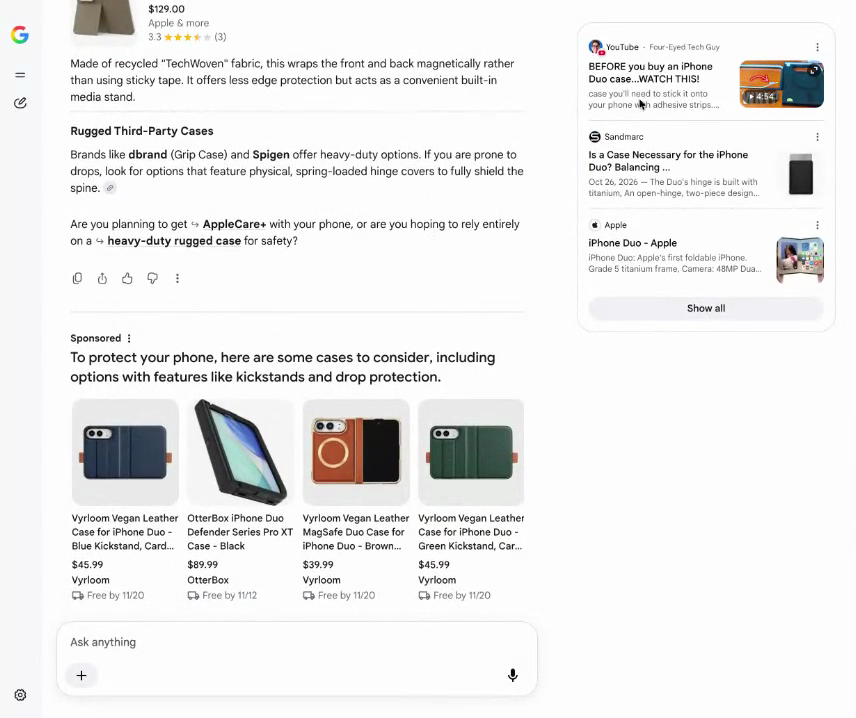
Image source: Barry Schwartz / Search Engine Roundtable
Why Google wants to advertise inside the follow-up question
A conventional search ad is usually attached to an explicit query. A conversational journey may not reveal the buying decision until several turns later. Imagine a shopper who asks for packing advice, narrows the discussion to carry-on luggage and then requests a comparison of lightweight options. An advertiser may be more relevant at the third step than at the first. Google’s new format is designed to put sponsored options near that decision point rather than relying only on the opening search.
There is also a platform incentive. Alphabet executives acknowledged that AI Mode monetizes at a lower rate than traditional search, creating pressure to develop useful commercial placements without undermining the AI experience. Google says AI Mode queries are three times longer on average than traditional searches, based on its own U.S. research. Neither fact tells us that longer prompts will deliver better advertiser ROAS. Lower platform monetization refers to the value Google captures from the experience; advertiser profitability depends on conversion quality, spend, product margin and attribution. Those are different questions.
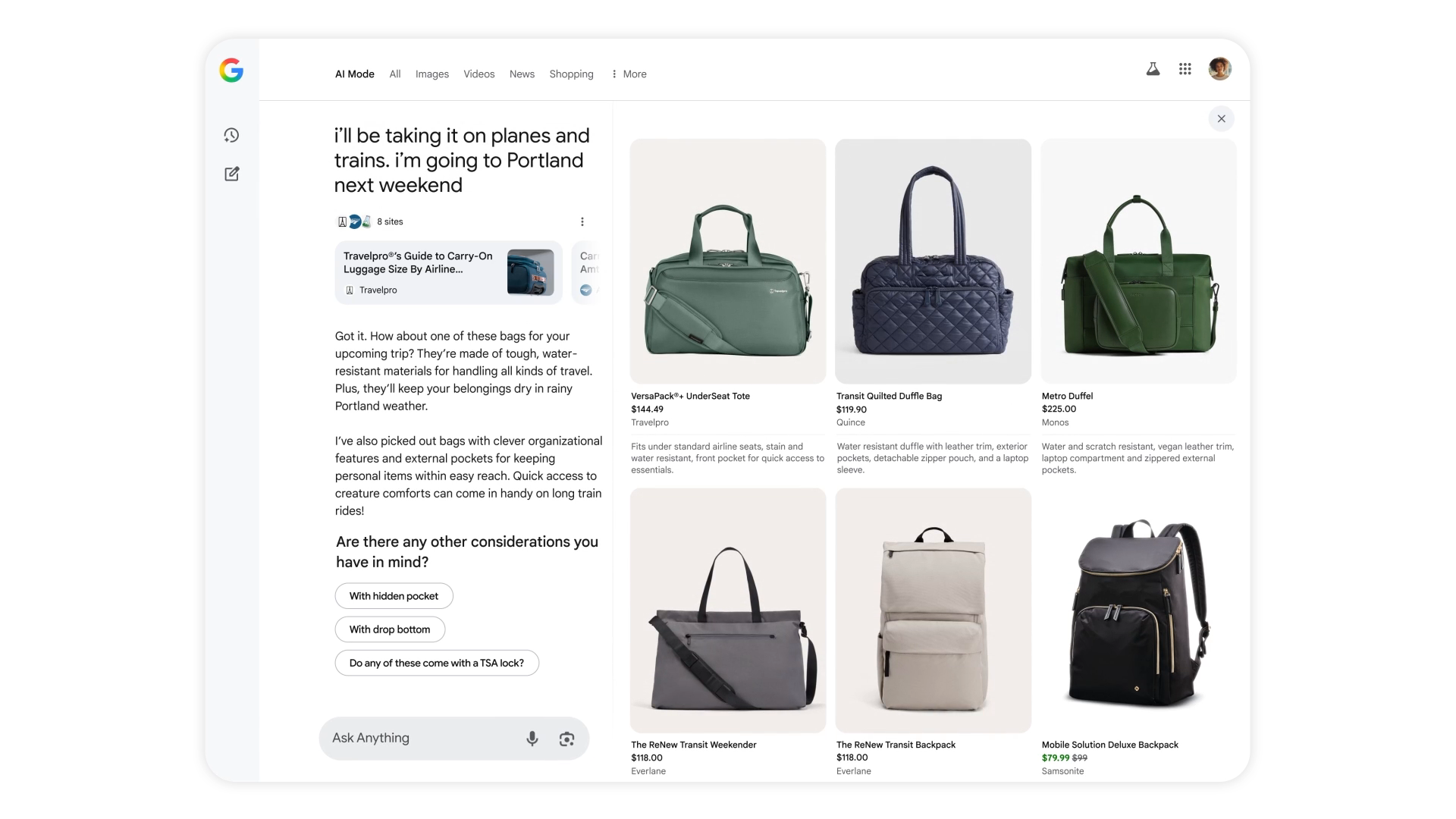
Image source: Google
The reporting paradox: 400-plus accounts, but no visible AI signature
A November 9 Search Engine Land analysis by Eskimoz performance director Rémi Kerhoas examined search-term impressions and conversions from more than 400 Google Ads accounts, using data from Q1 2024 through Q3 2026 across the U.S., U.K. and France. Terms were grouped by word count. If much longer AI conversations were flowing through ordinary search-term reports in meaningful volume, a shift toward longer phrases might have emerged. The study found no clear such shift in Search or PMax data, including cuts for broad match and AI Max.
This is a reporting observation, not evidence that nobody is clicking AI Mode ads. The sample was weighted toward performance advertising, long informational prompts may convert to shorter commercial searches, and a small share of AI inventory might be lost inside much larger campaign totals. More fundamentally, Google says AI-powered searches can be represented in reporting by an approximation of user intent, while sufficiently rare queries can be withheld. The text visible in a report therefore need not match what the shopper typed in a conversation. Kerhoas’s agency sample cannot establish a worldwide share of AI-ad impressions, much less a universal conversion rate.
Google’s own help documentation confirms the central limitation: AI Overview and AI Mode impressions, clicks, costs and conversions are included in standard campaign reporting in aggregate. Advertisers can inspect their overall results, but they cannot isolate an AI Mode placement-level ROAS or choose only AI Mode inventory. This is why claims such as “our AI Mode ads beat Search” are not yet supportable from ordinary Google Ads reports alone.
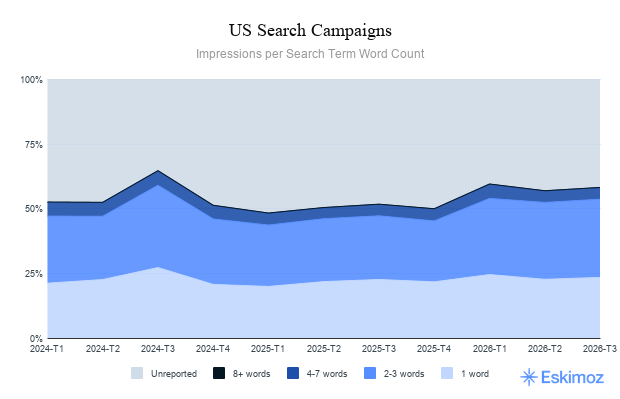
Image source: Eskimoz / Search Engine Land
What advertisers can see—and what they should not infer
| Advertiser question | What is visible today | What is still missing |
|---|---|---|
| Did AI Mode serve my ad? | Eligible campaign results are included in aggregate campaign metrics. | No separate AI Mode placement breakdown or standalone ROAS. |
| What did the shopper ask? | Some search terms appear in aggregated reports. | Rare terms may be omitted; AI queries may be approximations of intent. |
| Can I target only AI Mode? | Standard campaign targeting, negatives and brand exclusions still apply. | No AI Mode-only campaign selection or separate opt-out. |
The table summarizes the reporting capabilities documented by Google Ads Help.
Google has also documented AI-generated explainers that may introduce sponsored options or summarize how an ad relates to a query. Those independent AI explanations are not the advertiser’s editable headlines or descriptions; Google says advertisers cannot individually write, approve or opt out of them. That raises a second, distinct control issue: the presentation around a paid ad can be partly generated by the platform. Clean product pages, accurate Merchant Center data and consistent price, shipping and returns information become relevant not only to conversion, but also to the context around an ad. This does not establish that inaccurate explainers are common; it establishes a reason to audit what shoppers actually see.
A practical 30-day plan for ecommerce teams
In the first week, document what is measurable before changing spend: Search and PMax costs, branded and nonbranded traffic, conversion value, average order value, new-customer rate and contribution margin by product family. Reconcile Google Ads conversions with GA4 and store orders. Identify where broad match, AI Max, Shopping or PMax already participates, and verify account eligibility by country and language. Do not create an “AI Mode” reporting column from guesses about query length.
During weeks two and three, improve the inputs most likely to travel across conventional and conversational search. Fix Merchant Center title and variant accuracy, promotional prices, inventory, shipping promises and return policy links. On key landing pages, answer real product-comparison questions clearly rather than stuffing in long AI-like sentences. Where volume permits, run a controlled change to a landing page, feed attribute or creative theme while holding the rest of the campaign setup steady. Any movement in the aggregate campaign is a result of the whole system, not a separately proven AI Mode lift.
In week four, evaluate incremental business outcomes where credible tests are feasible, or otherwise report before-and-after trends with an explicit limitation. Check profit after discounts and returns, not only clicks or platform-attributed revenue. Flag mismatches between ad wording, AI explanations and the live product offer. A stronger first-party measurement setup and a small set of differentiated product assets are useful whether the eventual conversion comes from AI Mode or a traditional results page. That makes this a robust investment under reporting uncertainty rather than a speculative channel bet.
What would make this opportunity easier to buy
The meaningful next milestones are not more screenshots. Advertisers need a disclosed way to distinguish AI-feature inventory, compare placement-level cost and conversion quality, and understand how conversational intent is represented in reports. Google is expanding ad geographies, but availability and rollout sequence are not the same as reliable performance measurement. Until those gaps close, the right posture is to prepare eligible campaigns and merchant data, monitor changes carefully and resist claiming an “AI Mode ROAS” that the current interface does not provide.
TREND WATCH | WHAT ELSE MOVED
Meta’s AI promotions highlight a control risk
Social Media Today reported a practitioner finding that Meta could surface eligible website-detected discounts in copied Facebook and Instagram ads even when promotions were disabled on the original ad. The account-specific observation does not establish a platform-wide failure. Merchants should review Commerce Manager settings for detected offers, compare live ad claims with current product prices and check expiration dates before peak-season promotions create a customer-service problem.
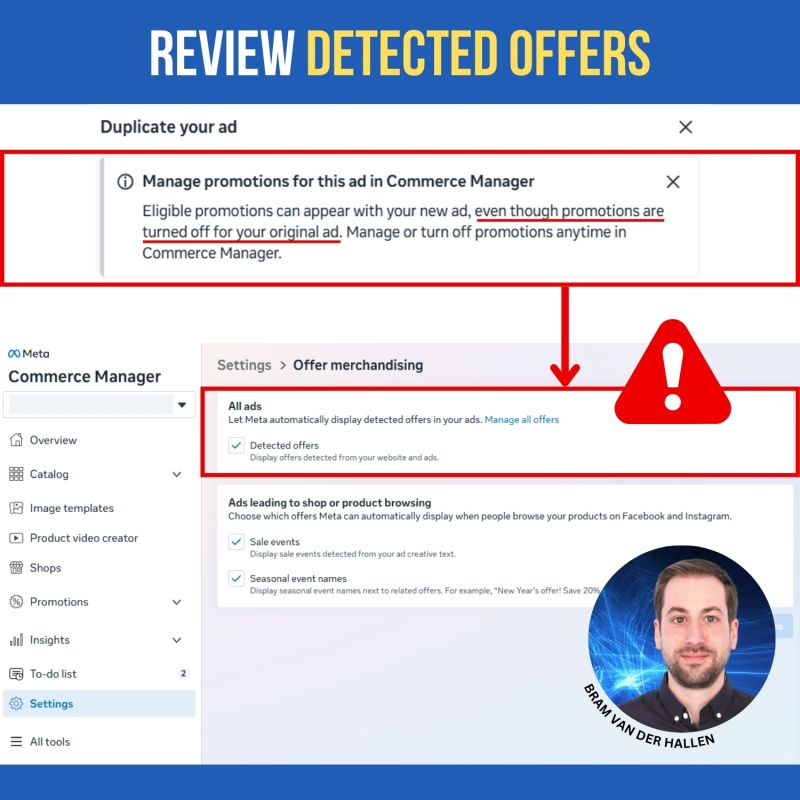
Image source: Bram Van der Hallen / LinkedIn
Google adds budget levers, while AI asset insights remain a beta
Google’s October announcement introduced High and Low channel priority settings, with optional best-effort spend caps for lower-priority inventory as the controls roll out. They are not guaranteed hard limits or universal per-placement exclusions. Separately, some accounts show a beta Asset activity page with weekly AI creative suggestions; Search Engine Journal found no official rollout documentation as of November 9. Test these controls against campaign-level economics instead of treating every new interface card as a proven optimization.
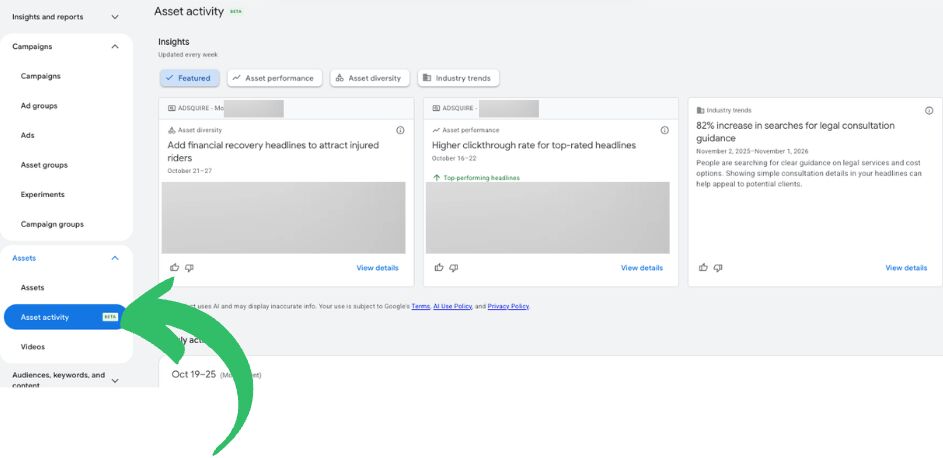
Image source: Anthony Higman / LinkedIn
A Shopify migration can help conversion and still require SEO safeguards
Shopify’s Diptyque case study reports a 14% conversion-rate increase and 37% higher checkout completion after a global migration; these are brand-reported outcomes in a vendor case study, not a universal platform effect. Search Engine Land notes that keeping URLs unchanged does not eliminate migration risk: rendering, canonicals, internal links and HTTP responses can all change. Ecommerce teams should baseline both checkout performance and search visibility before rebuilding, then validate by page template and locale.

Image source: Diptyque / Shopify
SEO experiments and affiliate partners need credible business evidence
A Search Engine Journal guide recommends split-testing groups of comparable pages—not individual visitors—so algorithm shifts and seasonality affect test and control in the same period. In affiliate marketing, a Hello Partner interview argues that the channel must explain its full-funnel contribution to the executives allocating budgets. Both stories point to the same operating discipline: show the decision a channel changes, quantify the value you can defend and disclose what attribution still misses.
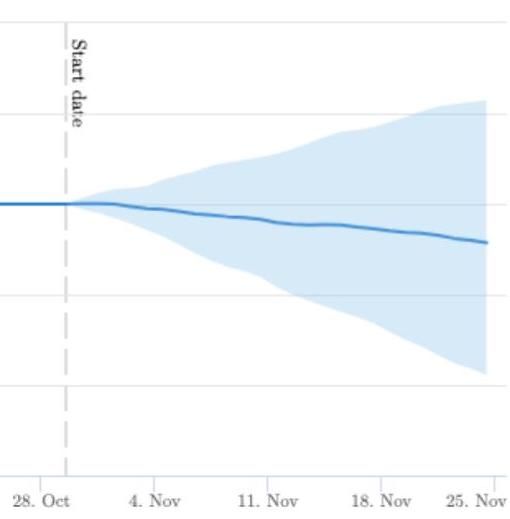
Image source: SearchPilot
THE OPERATOR’S CLOSE
Win the new placement without losing sight of the order
The test for AI search advertising is not whether a brand can appear in a conversation; it is whether that appearance creates profitable demand that would otherwise have been missed. Google’s latest rollout extends the number of moments in which an ad may be useful, while reporting remains too aggregated to identify the value of those moments cleanly. Strengthen your underlying offer, measurement and creative system now. Keep placement-level claims modest until the evidence catches up.
The Beecommercer Team