

How to use this guide
Social media operations means consistently helping the intended audience understand a problem, assess their options and take an appropriate next step, then using real feedback to improve content, products and service. This guide follows that business journey. It covers daily publishing alongside audience research, teamwork, comments and direct messages, creator partnerships, website journeys and performance reviews.
The guide is for ecommerce, B2B, service businesses and content brands. The practical platform sections focus on Instagram, Facebook, TikTok, YouTube, LinkedIn and Pinterest, with guidance on when to consider X, Threads and Chinese platforms. The same research, production and review methods can support different industries, but their buying cycles, conversion actions and supporting evidence need separate designs.
Where to start. Teams building a programme from scratch can work through the chapters in order. Teams already publishing but seeing inconsistent results should prioritise audience research, content structure, conversion tracking and diagnosis. For new staff training, combine the 90-day plan in Chapter 15 with the working templates in Chapter 16.
About the images. The illustrations include browser interfaces, product demonstrations and historical interface examples; captions explain the relevant limits. Example accounts and figures do not represent the performance of the author, the reader or the fictional case brands. Interfaces can vary by language, region, permissions and product updates, so follow what your current account actually displays. None of the interface images was generated with AI.
How to interpret the advice. Publishing frequency, working timeframes, topic scores and testing windows are adjustable working suggestions, rather than platform rules. Tuhe and Qiaoxu are fictional teaching brands, and all figures in their cases are illustrative calculations.
Connect operating goals to business results
What social media operations includes
A complete programme identifies audience needs, develops content, organises production, publishes and distributes it, handles interactions, supports conversion and reviews the results. Posting is only one part. Even a large view count may offer little business value if people cannot understand where the product fits, direct messages go unanswered or the promised information is missing from the website.
Social touchpoints rarely follow a single linear funnel. Someone may see a short video, search for the brand, read reviews and eventually buy after an email or sales conversation. Content must be useful in the moment while remaining consistent across those touchpoints. Conflicting specifications, pricing conditions, case definitions or service promises make decisions harder.
In practice, distinguish brand-owned accounts, unsolicited mentions by users or the media, creator partnerships and paid distribution. Their control, costs and measurement differ. A brand controls its own posts but cannot demand that real users say only positive things. Creator content needs agreed collaboration and usage rights; paid distribution needs a separate record of budget and results. These categories help explain which investment produced which result.
Choose a primary outcome for each business model
First identify the one business problem that matters most this quarter, then choose a primary outcome and two or three diagnostic measures. The outcome should correspond to behaviour the business owner can verify. For example, a qualified B2B lead must meet agreed company and need criteria; every resource downloader is not automatically a sales opportunity.
| Business model | Example primary task | Example outcome measures | Supporting diagnostics |
|---|---|---|---|
| Ecommerce | Help new customers choose an appropriate product and complete a purchase | Valid orders; net sales; contribution margin | Product visits; add-to-cart actions; fit enquiries |
| B2B | Help target companies understand the problem and begin a sales conversation | Sales-accepted leads; qualified meetings; opportunities | Case reading; resource requests; engagement from target roles |
| Local or professional services | Explain capabilities and service boundaries and encourage bookings | Valid bookings; attended appointments; sales | Relevant local enquiries; booking-page visits |
| Content brands | Turn a single content interaction into an ongoing relationship | Valid subscriptions; retention; paid memberships | Return visits; viewing depth; subscription-page visits |
Follower and engagement counts can be useful, but explain why they matter. A service business covering one city may gain little from nationwide entertainment exposure. For an advertising-funded content brand, viewing scale can directly support the business model; viewing quality, audience composition and repeat visits should then also inform its goals.
Write goals as tasks you can check
An actionable goal might be: ‘Over the next 12 weeks, build a content-to-consultation journey for companies coordinating inventory across multiple warehouses, generate a group of valid enquiries accepted by sales and identify which topics deserve further investment.’ Add the business definition, baseline, budget, owner and assessment period. Without historical data, use the first four weeks to establish a baseline before setting numerical targets, rather than borrowing another industry’s growth rate.
A new account usually needs to validate audience problems, establish reliable production and connect the next steps. An account with existing traffic needs to locate bottlenecks in visits, enquiries, purchases or repeat purchases. They should not have identical scorecards. In a long sales cycle, weekly reports can track qualified enquiries while quarterly reviews assess opportunities and revenue, but the programme cannot remain focused on leading signals indefinitely.
Chapter output. Write a one-page goal brief covering whom you serve, the business problem, the definition of the main outcome, where the data lives, who verifies it and how often it is assessed. Every content proposal should explain how it supports a task in that brief.
Use audience research to guide topics
Understand buying situations and decision barriers
Age, location and interests describe an audience but are insufficient for planning content. Purchase triggers, use situations, existing alternatives and unresolved concerns are more useful. Two consumers of the same age may need a lightweight commuter bag and a long-distance travel bag respectively. Within one company, users, procurement staff and final approvers may also have different concerns.
Start interviews with a recent real experience: what triggered the search for a solution, what they tried first, where comparisons became difficult, which information changed the decision and what remained unsatisfactory after use. Ask for specific actions and examples, rather than only asking what content they like. Saying they value professional content does not mean they will watch a ten-minute brand introduction without a practical demonstration.
Begin with a small number of purchasers, non-purchasers and former customers, develop hypotheses and then broaden validation. Sample size depends on business complexity; a few interviews do not represent the market. Record ‘one person mentioned this’ separately from ‘this recurs across multiple sources’, so one strongly worded comment does not redirect the whole programme.
Build a question bank and an evidence library
The question bank preserves the customer’s language; the evidence library stores material that can support an answer. Questions may come from support, sales, internal site search, return reasons and public comments. Evidence may include specifications, real demonstrations, authorised interviews, test records or reliable research. Connect the two explicitly, or topics can become opinions without support.
| Record field | Example entry | Purpose |
|---|---|---|
| Original customer question | Will my laptop still fit with its protective case on? | Preserve the language of a real decision |
| Situation and stage | A commuter comparing two backpacks | Identify the content task |
| Origin and date | A support record with an anonymised reference | Keep a verifiable basis |
| Evidence needed | Internal dimensions; measurement with the case fitted; insertion and removal demonstration | Guide filming and review |
| Destination | Sizing guide; comparison page; support knowledge base | Reduce repeated explanations |
Keep only sensitive information necessary for the analysis. A public comment does not automatically authorise the brand to use someone’s name, photograph and words as a commercial endorsement. Internal analysis can record de-identified themes. Before publicly featuring a customer review, confirm suitable permission, context and authenticity.
Study how competitors explain decisions
Select direct competitors, alternative solutions and strong content creators. Examine how each presents problems, shows evidence, addresses objections and suggests the next step. Use an individual item or series as the unit of research, recording the topic, format, headline promise, evidence, action and visible engagement. Public platform figures rarely establish profitability; label unavailable information as unknown.
For example, if a competitor’s backpack video receives many comments, check whether people discuss fit, challenge the demonstration or enter a giveaway. These sources may produce similar comment counts but very different value. Do not ignore unknown advertising spend, the creator’s existing audience or publication timing and conclude that a particular style must work.
For weekly social listening, regularly check brand terms, category questions, alternatives and recurring complaints. Classify findings as product problems, information gaps, service problems or new needs. Repeated delivery-time questions may first require clearer website and profile information, followed by content. Continually explaining a fixable page defect in posts consumes both content and support capacity.
Use trend tools to supplement research
Trend tools help reveal discussion contexts and wording. The TikTok Creative Center interface shown here includes region, industry, time range and hashtag analysis controls. Match those filters to your target market. A trending hashtag list does not directly measure demand size or keyword search volume.
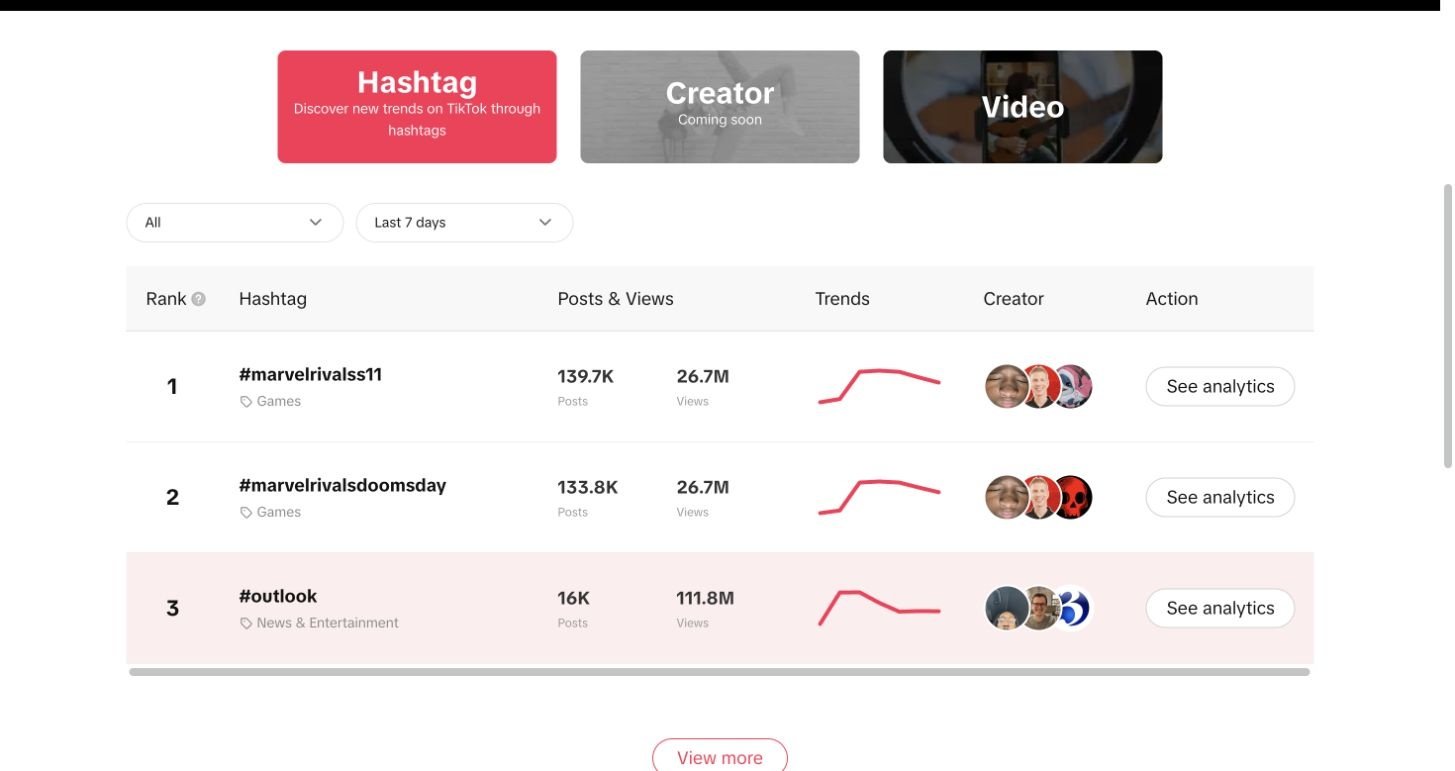
Reading the image and applying it. Confirm the region, then the industry and time range. This capture selects the United States and displays the last seven days; URL parameters do not override the filters shown in the interface. After noting relevant topics, inspect representative content and its discussion context, then return to your own question bank to judge suitability. The gaming and news topics shown are the results at that moment, rather than recommendations for every brand.
TikTok’s Creator Search Insights also offers ways to research search topics and content gaps. If your account has access, compare what people are looking for with what existing content explains. Availability varies by region and account, so check your actual interface. Every trend still needs validation through content and business feedback.
Choose platforms and establish account foundations
Give each platform a role
Platform selection should consider whether your audience is present, whether the medium suits the explanation, whether people can take the next step and whether the team can sustain production. The table suggests starting points to test, rather than restrictions imposed on particular industries. A small team can begin with one primary platform and one supporting channel, then expand once the process works.
| Platform or channel | Tasks to test first | Content starting point | What to check |
|---|---|---|---|
| Product understanding; everyday situations; brand relationships | Demonstration videos; carousels; Stories | Fit questions; saves and shares; off-platform actions | |
| Community discussion; customer communication; activity management | Questions and answers; demonstrations; group discussions | Useful discussion; direct messages; completed service handoffs | |
| TikTok | Problem discovery; quick demonstrations; reaching relevant new audiences | Short situational videos; comparisons; answers | Viewing quality; search intent; meaningful visits |
| YouTube | Complex explanations; search needs; continued viewing | Tutorials; reviews; cases; detailed videos | Clicks and retention; related videos; business actions |
| Professional trust; nurturing B2B demand | Methods; cases; expert perspectives | Audience roles; qualified leads; opportunities | |
| Visual inspiration; planning and shopping entry points | Situational images; checklists; guide entry points | Saves; outbound clicks; landing-page outcomes | |
| X and Threads | Opinion exchange; industry conversations; timely feedback | Perspectives; short analyses; discussion replies | Conversation quality; relevant people; return visits |
| Xiaohongshu and Douyin | Situational explanations and decision content for Chinese markets | Usage accounts; comparisons; demonstrations of problems | Eligible regions; commercial rules; real needs |
| WeChat Official Accounts and Channels | A lasting Chinese-language content library; relationships; service journeys | Article series; videos; live questions and answers | Subscription quality; compliant next steps; subsequent contact |
An equipment brand explaining a complex installation might use short videos to attract relevant questions, a complete YouTube demonstration to develop understanding and its website for specifications and service information. A B2B business might connect expert LinkedIn perspectives to cases and evaluation checklists. These combinations follow user tasks and the cost of explanation, and should be refined using your own data.
Chinese platforms have their own requirements for off-platform referrals, commercial partnerships, verification and content. Research, production and review methods can transfer, but overseas linking, direct-message and collaboration workflows should not simply be copied. Check current official rules and the functions available to the account before implementing a particular action.
Explain your offer in one profile
A profile should first tell a stranger whom you serve, how you help and where to go next. Ecommerce profiles can explain the main uses and service entry point; B2B profiles can name the companies and problems they serve; content brands can define their subject and subscription value. The main action should match the current stage, rather than simultaneously requesting a purchase, comment, follow, group signup and booking.
The fictional brand Tuhe might write: ‘Backpacks for commuting with a laptop and short trips. We share size tests, packing demonstrations and selection guidance. Start with the laptop-fit guide.’ The fictional software brand Qiaoxu might write: ‘Helping multi-warehouse teams improve inventory coordination. Reconciliation methods, implementation cases and system evaluation checklists. See whether this fits your business.’ These are positioning drafts; replace them with real capabilities and evidence before use.
Pinned content or prominent profile areas should help newcomers assess suitability quickly. Consider one introduction to the brand and audience, one strong piece of capability evidence and one explanation of the next step. Content brands can instead feature where to start reading, representative work and how to subscribe. Check the actual interface for whether pinning is supported and how many items it allows.
Make account management transferable
Record account links, business ownership, administrators, recovery methods, authorised tools and backup contacts. Use an email address and recovery process the organisation can maintain, and enable suitable two-factor authentication. Collaborate through individual permissions rather than sharing the main password in group chats. When someone leaves, review the platform, scheduling tools, asset library and third-party authorisations, rather than changing just one password.
When choosing an account type, check commercial use, analytics, links and music rights. TikTok positions Business Accounts for business activity and distinguishes its commercial music library from the general library intended for personal entertainment. A popular sound available to someone else is not automatically cleared for brand promotion. Review existing content and business needs before switching account types.
Instagram’s professional dashboard includes a Best Practices educational area covering creation, engagement, reach, monetisation and guidelines, and may offer account-specific suggestions. Use it to review functions and rules periodically, while interpreting its suggestions in light of your audience and business goals.
Turn content strategy into producible topics
Build content pillars around customer decisions
Content pillars should define the continuing tasks you help people complete. Ecommerce series might cover use situations, product comparisons, evidence, use and care. B2B series might cover symptoms, solution trade-offs, implementation evidence and organisational coordination. A subject can then continue helping people at different decision stages.
| User task | Ecommerce example | B2B example | Appropriate next step |
|---|---|---|---|
| Recognise the problem | Why a laptop fits but is difficult to remove | Where inventory discrepancies can arise | Read a full explanation or describe the situation |
| Compare options | Who each of two backpack structures suits | Trade-offs between spreadsheets and system-based coordination | View a comparison or evaluation checklist |
| Assess evidence | A packing, insertion and removal test with its conditions stated | An implementation case with its scope and limits | Check specifications or book a demonstration |
| Use the product and maintain the relationship | Cleaning, care and accessory selection | Team training and operating checks | Read guidance or join a question-and-answer session |
Do not divide content mechanically into equal shares. If people do not understand the problem, add foundational explanations. If visits are strong but purchases are weak, check for missing information on size, delivery, compatibility and service. If existing customers struggle with use, prioritise tutorials and support documentation. Content proportions should follow the barriers rather than a permanent education-versus-promotion ratio.
Promotions need complete conditions, including eligible products, dates, regions and the next step. Brand stories also need specifics: why a structure was chosen, which trade-offs were made and which users a product does not suit. Abstract adjectives without evidence rarely help a buying decision.
Use simple scoring to set priorities
Internally score potential topics for audience relevance, business value, available evidence and production cost. This is a prioritisation aid, rather than a scientific model predicting traffic. A highly relevant question supported by readily available evidence is usually a better first test than a production-heavy trend with no clear business purpose.
Reserve a small amount of each cycle for exploring audiences, formats or perspectives, while retaining enough evergreen content to answer recurring questions. A solo operator might start with one weekly theme, one main piece and two or three derivatives. This is a capacity-planning starting point, to be adjusted for actual effort and results.
Write briefs that explain how to finish the work
Example brief. ID: TH014. Audience: commuters using laptops with protective cases. Question: ‘The specifications say it fits, so why are insertion and removal still awkward?’ Main conclusion: the inner-pocket opening, thickness allowance and insertion/removal angle all affect the experience. Evidence: two real laptops, measurement records and continuous insertion and removal footage. Format: a demonstration of about 45 seconds. Action: view the fit guide. The reviewer checks specifications and demonstration conditions.
The brief should also specify boundaries that cannot be omitted, such as ‘this demonstration covers only these two laptops’, ‘the rain demonstration does not establish a waterproof rating’ or ‘the software case applies only to this version’. Agreeing these before filming reduces rework caused by unsupported claims discovered after editing.
Separate visuals, spoken delivery, subtitles and evidence references in the script. Speech explains causes, visuals show the process and subtitles support silent viewing; they need not repeat one another word for word. Review claims and evidence before debating shots, pacing and style, so aesthetic arguments do not become the only standard.
Develop a series from one topic
For laptop fit, a first video can demonstrate the insertion and removal problem; a carousel can explain measurement; a question-and-answer post can address protective cases; a detailed article can summarise fit limits; and a support piece can explain correct placement. Each item solves a problem independently while offering a route to more detail. Do not split one simple answer across several posts just to increase the count.
Reuse research, filming and evidence, then adapt the opening, pace, cover and action. One B2B interview may support a detailed case, expert perspectives, a methods carousel and sales answers, but people on each channel should not need the full original interview context to understand the new item.
Create content with evidence and a clear next step
Deliver a short video’s promise early
The opening should quickly establish a relevant problem or result, then provide useful information early. Start with a failed use action, a clear difference, a real question or the finished result. Fulfil the opening promise: if the title promises three causes but the video only showcases a product, viewers leaving is unsurprising.
The following shooting script uses the fictional brand Tuhe. Durations are production references rather than platform-optimal lengths; substitute real product details and specifications. The whole item supports one main action: check sizing and fit information.
| Indicative timing | Visual | Spoken point or information | Verification |
|---|---|---|---|
| 0–4 seconds | The zip catches after the laptop is inserted | It fits inside, so why is insertion and removal still awkward? | Show a real problem rather than deliberately creating a fault |
| 4–12 seconds | Measure a bare laptop beside one in a protective case | A protective case changes external dimensions and thickness | Use the same measurement method |
| 12–25 seconds | Continuously show the opening and insertion/removal actions | The stated size is not enough; check the opening and clearance | Do not edit out difficult sections |
| 25–36 seconds | Compare two packing arrangements | Other items change the remaining space | List the items and packing conditions |
| 36–45 seconds | Show where the fit guide is located | Measure against the guide before ordering | Link to the specific guide rather than a generic homepage |
Continued viewing depends on relevance, clarity, pace and evidence. Use retention and comments to investigate causes; every departure is not proof that the opening lacked excitement. If a product needs time to explain, lead with the conclusion and then its conditions, rather than continually speaking faster.
Give each carousel slide a clear job
Carousels suit steps, comparison criteria and common mistakes. A useful structure is a specific question on the cover, the main judgement on slide two, criteria, examples and limitations across the middle slides, then a next step. Let the information determine the length instead of splitting sentences to fill a target slide count.
A seven-slide example on checking backpack fit could present: the specific question; the conclusion to check external dimensions first; how to measure; how to assess the opening; how accessories affect fit; unsuitable cases; and the full guide. Check cover and body slides at phone size rather than shrinking a complete article into unreadable miniature text.
For B2B, a carousel can explain a real process, such as which records to check first when inventory reports disagree. One check and an example per slide can help more than repeated company benefits. Link to documentation for full technical detail, while ensuring the carousel itself provides independent value.
Use long videos to explain complex decisions
A long video needs a clear argument: establish the problem and intended audience, introduce a framework, test it through demonstrations or cases, then explain limitations and actions. Chapters should show how the current problem connects to the next step, rather than merely divide the running time.
The fictional B2B software Qiaoxu might use a detailed video to ask whether inconsistent inventory figures call for better reports or better processes. Open with a discrepancy; work through receipts, transfers, returns and synchronisation timing; distinguish delayed updates from recording errors in the example; and finish with a troubleshooting checklist and consultation criteria. Use test data for software demonstrations and identify it as distinct from a customer’s actual business records.
Live streams and online question-and-answer sessions also need structure. Gather questions beforehand, plan the demonstration order, name the host and technical owner, and decide what can be answered live and what needs investigation. Afterwards, assign unanswered questions and turn useful answers into standalone pieces. The number of live sessions is not the goal; resolved problems and subsequent actions deserve review.
Use visuals and sound to aid understanding
Before filming, decide the viewing situation, composition and safe text areas. A common vertical production master is 1080 × 1920, with 1920 × 1080 as a horizontal starting point. These are production suggestions; check current upload requirements and preview cropping on the platform. Keep important text away from edges and areas usually covered by platform controls.
Proofread captions for names, numbers, product models and technical terms instead of relying entirely on automatic recognition. Prioritise clear speech and consistent volume before adding background music. Keep camera position, light, timing and operating conditions comparable in demonstrations. Explain necessary speed changes, edits or composites so people do not mistake them for actual performance.
Images and text need a clear hierarchy, distinguishable colour contrast and specific alt text; video should communicate its main information to silent viewers too. Brand templates can standardise fonts, colours and logo placement while leaving enough space for evidence. Oversized logos, elaborate animations and repeated introductions reduce the time available to explain the issue.
Operate Instagram, Facebook and TikTok
What recommendation systems can tell you
Meta describes different recommendation systems for placements such as Feed, Stories and Reels, combining multiple signals to predict content value. TikTok also describes interaction, content and user information as recommendation inputs, with viewing behaviour especially important in some situations. This supports improving relevance and viewing experience and observing feedback. It does not establish that a fixed number of hashtags, publication time or video length guarantees distribution.
In routine reviews, distinguish audience mismatch, a broken content promise, account eligibility issues and measurement anomalies. When exposure is low, first check publication status, account notices, visibility and the intended audience, then consider creative changes. Without clear evidence, do not call every fluctuation suppression, or replace diagnosis with repeated deletion and reposting.
Manage publishing and interactions in Meta Business Suite
Meta Business Suite includes content management, scheduling, messages, comments and insights across Facebook and Instagram. Start by selecting the right business assets and confirming connected accounts and staff permissions. Then check the relevant content, Planner, Inbox and Insights functions. Names and layouts can differ between desktop and mobile.
A complete publishing workflow has four checks: confirm the intended Page and account; create the content and preview each platform separately; set the publication time and verify the time zone; and confirm status in both the schedule and the actual published location. If music, native stickers, partnership labels or particular functions are needed, check whether that publishing route supports them and reserve manual publishing time when necessary.
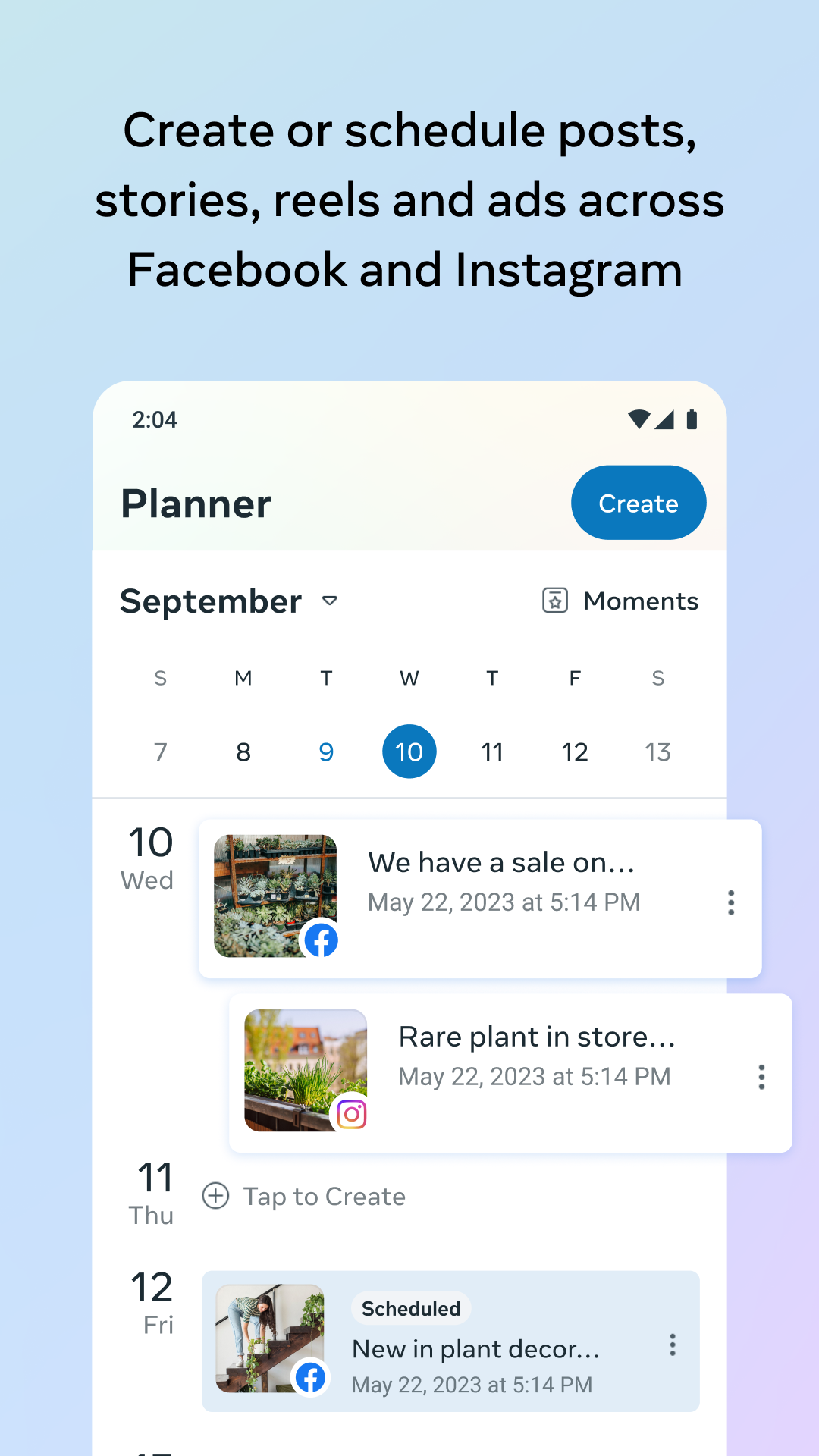
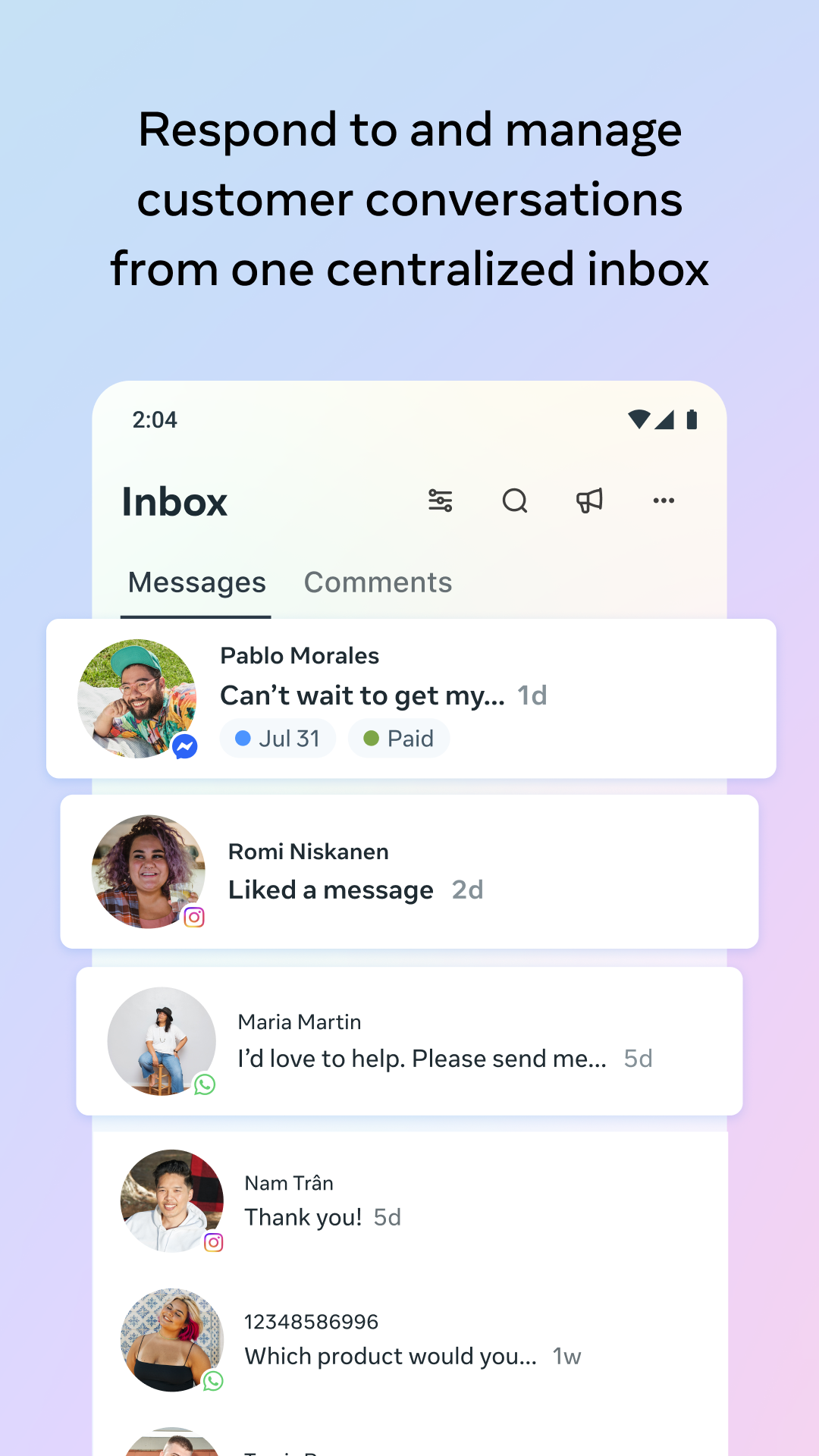
Reading the images and applying them. The left image shows Planner’s calendar and content records, useful for checking continuity and excessive concentration on one day. The right shows the Inbox conversation list, useful for managing pending and followed-up work. Both are application-store demonstrations containing historical examples. They introduce functions rather than establish the exact position of every control in a current account.
Scheduling is not the same as successful publication. Expired authorisation, incompatible assets or a temporary platform problem may prevent a scheduled post appearing. Assign someone on duty to check the actual post, cover, captions, links and comments after publication time. Record the reason for a failure and reschedule it, so several team members do not publish duplicate copies.
Assign jobs to Instagram’s different placements
You might use Reels for situations and demonstrations, carousels for decision criteria, Stories for follow-up questions and timely information, and prominent profile content to introduce the brand. This is a suggested division of tasks, rather than a rule limiting a format to one stage. Review the audience and subsequent actions for each format.
If the account has Trial Reels, use them to explore new subjects. The feature initially shows content to non-followers, lets you review performance and then decide whether to share it with everyone. Some followers may still encounter it through routes such as direct-message sharing. It supports exploration, but is not a strict A/B test with random audience allocation.
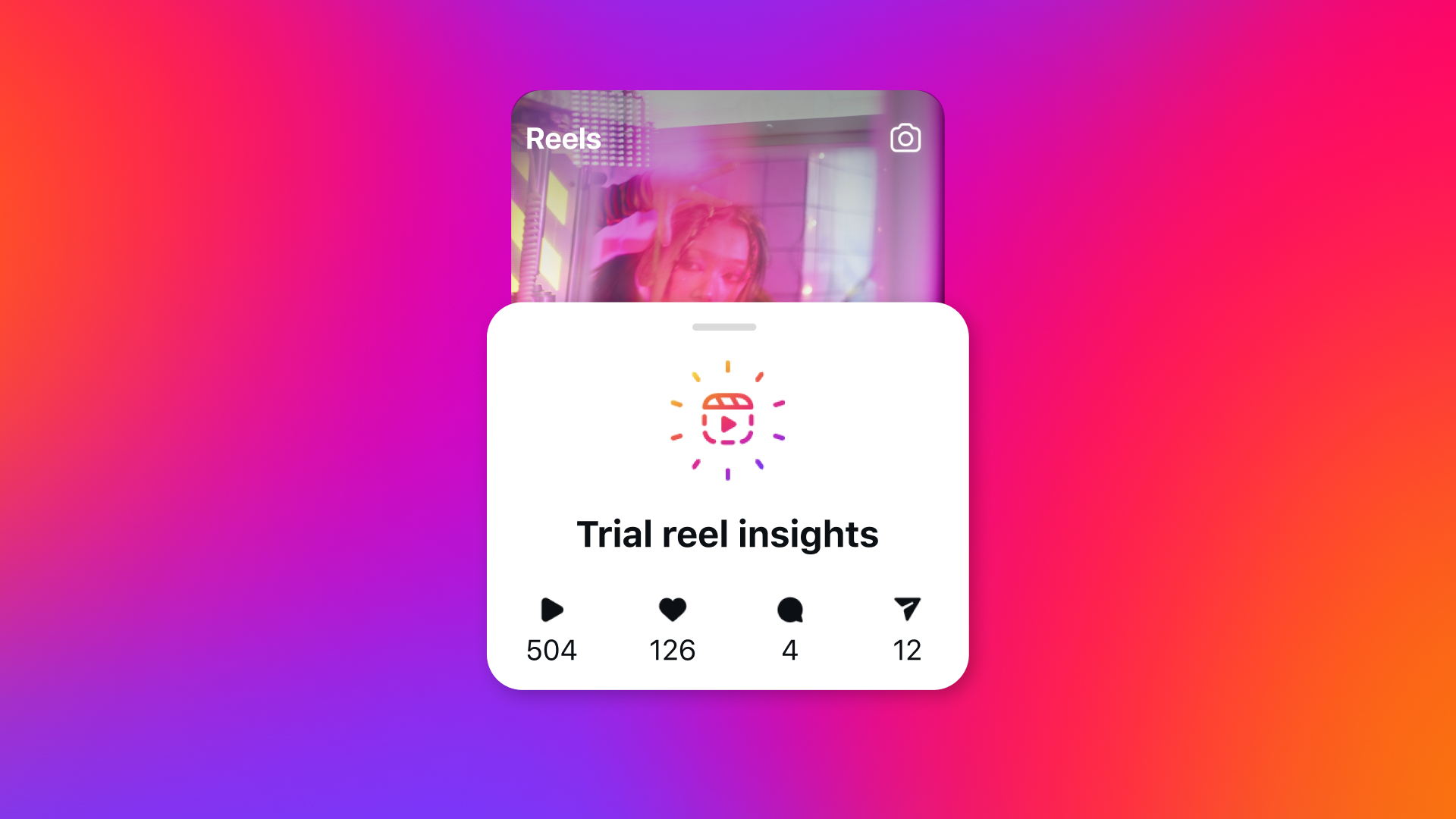
Reading the image and applying it. Trial reel insights shows views, likes, comments and shares in this demonstration. Record the topic, length, publication time and next-step link in actual trials, and compare repeated attempts at the same age after publication. One highly viewed trial does not establish better customer fit; also examine relevant comments, profile actions and website data.
Separate content research from production on TikTok
TikTok Studio covers content creation, scheduling and management, comments and analytics, with differences between the web and app versions. Use Studio for your own content and feedback, Creative Center for public trend and creative research, and bring their findings into your content records.
For organic content, study the problem, situation, expression and comments. For advertising, also inspect the value proposition, evidence, offer and action. TikTok Top Ads has filters such as industry, objective and time range, and explains that the collection contains only a subset of advertisements authorised by advertisers. It can teach creative structure, but cannot establish total market ad spend or competitor profit.
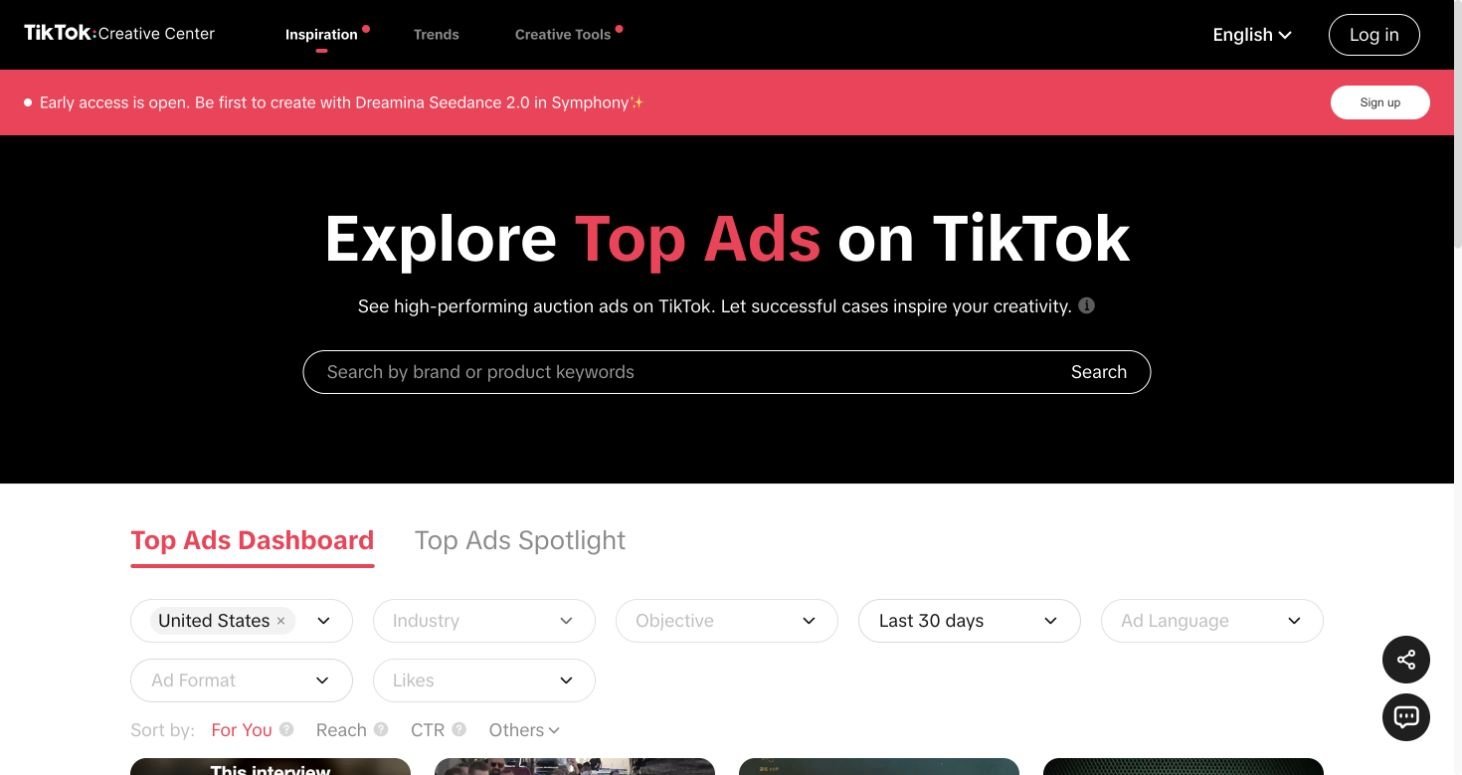
Reading the image and applying it. Choose the country or region, then industry, objective and time range, rather than mixing advertisements serving different jobs. The public interface shown has limited visibility when signed out. For each example, record the opening promise, main evidence, action and conditions, then develop a test appropriate to your own product.
For brand content, review music rights and commercial disclosure together, as discussed in Chapter 10. Do not overlook commercial rights to borrow a popular sound, or automatically treat promotion of your own brand as non-commercial because you paid no advertising fee.
Operate YouTube, LinkedIn and Pinterest
Develop discovery and continued viewing on YouTube
Build YouTube series around clear questions. Identify search or viewing intent, write the title and thumbnail promise, then fulfil it in the video. The title and thumbnail should complement each other: the title explains the question and value, while the thumbnail communicates one important difference or result. Avoid packing many specifications into a small image.
Before uploading, check the video, title, description, subtitles, chapters, cover and next step. Offer prerequisite tutorials to beginners and subsequent content to people who already understand the problem. Connect a series through knowledge dependencies, such as measuring before choosing, rather than merely arranging videos by publication date.
For measurement, open Analytics in YouTube Studio and separate formats in Content. For an individual video, examine its Reach, Engagement or retention reports as appropriate. Shorts, long videos and live streams serve different viewing situations; total views alone cannot identify which format has greater business value.
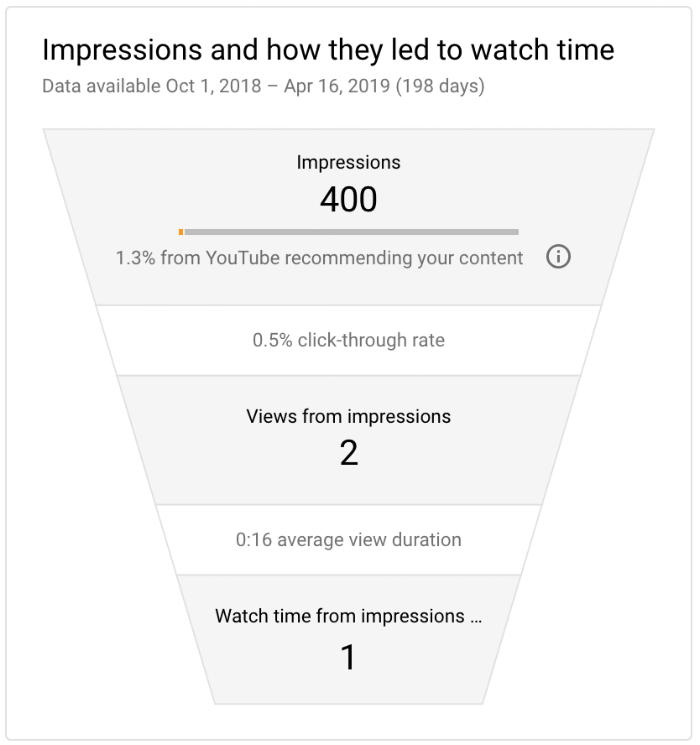
Reading the image and applying it. This historical demonstration connects thumbnail impressions, impressions click-through rate, views from those impressions and watch time. First assess discovery by relevant viewers, then continued viewing after entry. These are not recommended targets. Thumbnail CTR covers eligible impressions only; total views divided by impressions is not a substitute calculation.
If clicks are reasonable but people leave quickly, review a delayed opening, an exaggerated title or unclear sound. Retention spikes may reflect rewatching or sharing, but can also indicate confusion that prompts repeated viewing. Drops can reflect skipping or leaving. Return to the specific footage rather than scoring content from the curve’s shape alone.
A change in definitions. Verified as of November 19, 2026, YouTube states that public watch-page view counts include television co-viewing estimates from November 2026; the same guidance defines views across formats as counted when playback starts. Record definition changes in comparisons over time, and also examine engaged views, retention and business results. Do not attribute all growth following a counting change to better content.
Connect company evidence and professional judgement on LinkedIn
A company Page can bring together product facts, cases, events and team information, while experts or leaders explain decisions, methods and experience through personal accounts. This is an editorial division of work. Employee content needs their authorisation and real judgement, rather than many accounts mechanically copying the same text to manufacture discussion.
Structure a professional post around the business problem, method, evidence and limits, then a next step. For example, an inventory software company can locate where discrepancies arise, show checks and applicability limits, and offer an evaluation checklist. Even without opening the link, readers should gain a judgement they can apply.
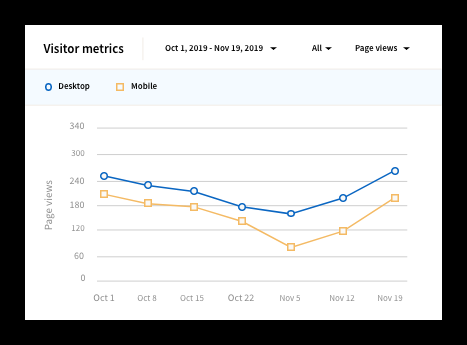
Content performance helps assess topics and expression, while visitor and follower information helps assess whether the audience resembles the intended roles. LinkedIn Clicks includes clicks on content, the company name or logo and other specified elements; it is not simply website visits. Its engagement rate likewise uses its particular click and interaction definitions.
Reading the image and applying it. This historical demonstration shows visitor metrics, dates and device categories. It explains Page visit trends, rather than proving off-platform form submissions or sales. Check the audience information available in the current account, then use the website and CRM to verify subsequent behaviour. The example dates are from 2019, rather than current business performance.
Personal accounts also have aggregated content analytics, which should be recorded separately from company Page analytics; some new functions may roll out gradually. If expert discussion outperforms the company Page, first check whether their tasks and audiences differ, rather than requiring the personal account to duplicate the Page.
Connect Pinterest inspiration to relevant destinations
Pinterest can test content entry points based on visual inspiration and planning. A homeware brand might create small-space storage ideas, moving checklists and layouts for different floor plans, each linking to the relevant guide or collection. The title, image and destination should address the same question, rather than promising a specific solution and opening a generic homepage.
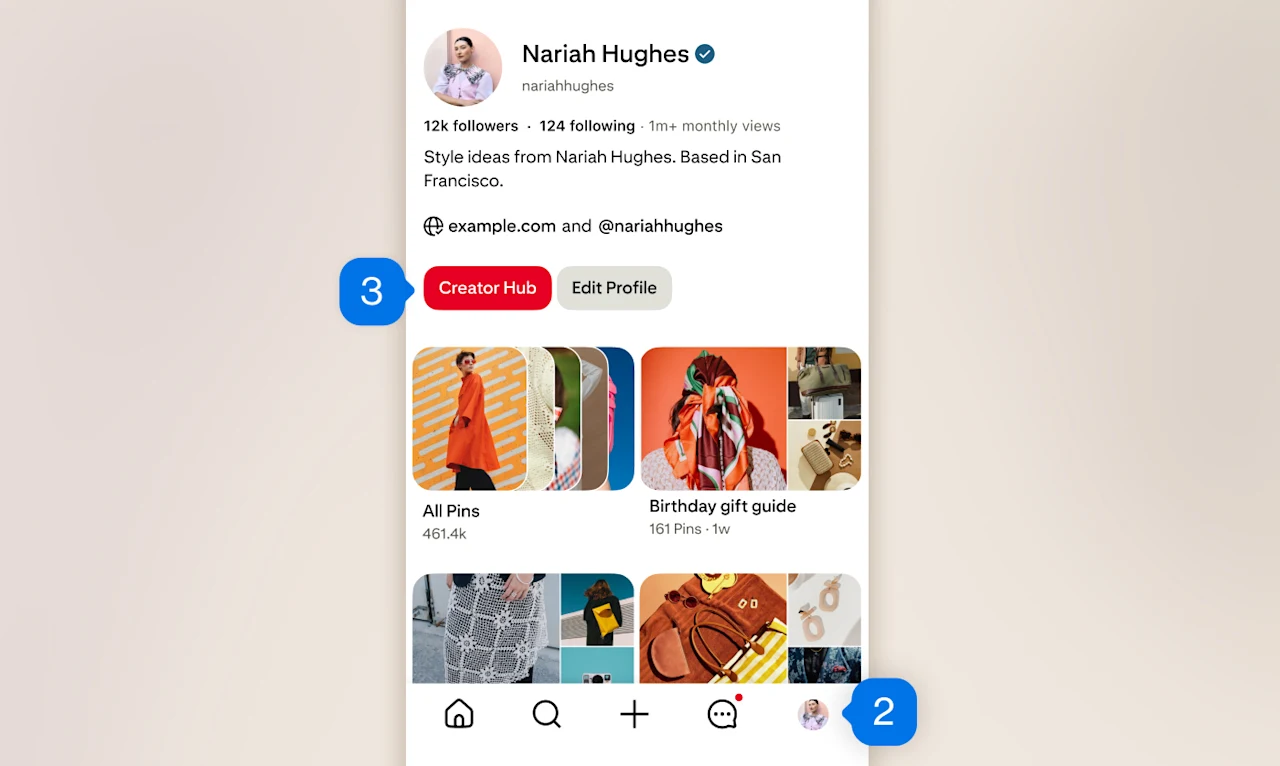
Pinterest Analytics requires a business account. Saves represents saving to a board; Pin clicks primarily reflects opening a Pin’s details; Outbound clicks represents actions leading off Pinterest. These serve different tasks, and outbound clicks still need comparison with website sessions and outcomes.
Reading the image and applying it. The tutorial example enters Creator Hub through the profile. From there, review content and audience summaries and investigate using the available date, content or source filters. Interfaces vary by account and version; the people and data shown are demonstration examples.
Content with many saves and few outbound clicks may satisfy inspiration collection without providing a clear reason to visit. Strong outbound clicks with weak purchases calls for checking the destination, product suitability and service conditions. Pinterest reports can distinguish organic, paid and associated subsequent activity; confirm those filters before calling a change organic growth.
Build a publishing calendar and cross-platform workflow
Track tasks and status in the content calendar
A usable calendar records the content ID, customer question, topic, format, main action, evidence assets, producer, reviewer, platform, publication time, landing page and review date. Statuses might be research, production, awaiting review, scheduled, published and awaiting evaluation. Assets lacking evidence or permission should not move directly into the scheduled column.
Group work needing similar concentration, such as research, filming and editing, then adapt each item to its platform. Batch production reduces switching, but live stock information, offer conditions and news still need checks close to publication. Evergreen reserves can cover approval delays, but cannot replace fact-checking.
| Example schedule | Main work | Record to retain |
|---|---|---|
| Monday | Review the previous week and select this week’s questions | Topic decisions; test hypotheses; owners |
| Tuesday | Complete scripts and confirm evidence | Briefs; review comments; asset lists |
| Wednesday | Batch filming and production | Original assets; versions; permission records |
| Thursday | Review and adapt to each platform | Final copy; links; publication previews |
| Friday | Check schedules and early feedback | Publication status; problems; next week’s changes |
| Every staffed day | Handle comments, direct messages and publishing exceptions | Service handoffs; outstanding work |
This is a work-planning example, rather than a requirement to publish Monday to Friday. The market’s time zone, holidays and the team’s coverage should determine actual timing. A period with historically high views may still be unsuitable if nobody can respond to serious enquiries after publication.
Complete four types of pre-publication check
- Facts and permissions. Verify specifications, prices, policies, case figures, music and the permitted use of customer assets.
- Presentation and readability. Check phone previews, cropping, subtitles, volume, the cover and whether important text is obscured.
- Actions and measurement. Open the real link and check the landing page, UTMs, form, booking or purchasing action.
- Schedule and responsibility. Confirm the account, time zone, publication time, approval, duty coverage and contact for exceptions.
Keep these checks in the same content record where possible. If copy lives in chat, assets on a personal computer and the link in another spreadsheet, nobody may know which version is final. Update the version or timestamp after material changes, and confirm that changes to scheduled content were actually saved.
Help people find content in platform search
Begin social search work with the audience’s actual wording. Naturally express the product category, use situation and problem in titles, descriptions, speech and subtitles, helping people understand the content. Hashtags supplement context; do not stuff unrelated popular terms into copy. No fixed hashtag count guarantees distribution. TikTok’s explanation of search recommendations itself identifies multiple inputs, including the match between a query and content.
Localisation includes units, price presentation, cultural context, examples and service conditions. Translation alone does not complete it: delivery information must match the actual service in that region, and size demonstrations should use familiar units. A native-speaking reviewer who understands the business can add more value by checking claims than by polishing tone alone.
Keep reused content traceable
An asset register should at least record the original file, product version, filming date, permitted uses, regions, expiry and published locations. This lets you find affected content after product changes, repricing or permission expiry. Review evergreen material too, especially interface tutorials, specifications, delivery policies and prices.
Rewrite openings and actions for cross-platform publication and recheck visuals and subtitles. Do not assume music rights extend across platforms. For partner content, verify that reposting and advertising use fall within the agreement. Retain uncompressed masters for future cropping and updates.
Turn comments, direct messages and communities into a service process
First identify the help the person needs
More comments may indicate valuable content or a product problem. Community work should distinguish ordinary discussion, purchase enquiries, support requests and incidents needing escalation, then route them to someone able to help. Speed is only one dimension: resolution, repeat contact and completed handoffs matter too.
| Situation | First response | Next owner | Completion signal |
|---|---|---|---|
| General knowledge or usage question | Answer publicly with the necessary conditions | Community operator | The person understands the next step |
| Purchase or solution enquiry | Understand the situation and give suitable information | Store adviser or sales | A useful answer or completed handoff |
| Order or after-sales problem | Acknowledge publicly and move to a private service channel | Customer support | The case is resolved and the person is informed |
| Product safety, privacy or a major dispute | Retain necessary facts and escalate immediately | Designated business owner | An agreed factual account and handling record |
Do not request addresses, phone numbers, order evidence or payment information in public comments. When necessary, direct people to the established service channel and explain what information is needed and who will follow up. Automated replies can acknowledge receipt and give service hours, but should not replace complex judgement or promise a resolution deadline the team cannot meet.
Reply with facts and a clear next step
Product enquiry example. ‘Fit depends on the laptop’s external dimensions with its protective case fitted. Start by measuring with this guide. If you wish, tell us the model and its dimensions with the case, and we can help assess it against verified specifications.’ This supports a decision and limits overpromising better than saying every product is easy to use.
Support example. ‘We have seen your comments about the insertion and removal problem. To check the version purchased and the circumstances, please submit the order number and photographs through the support link in our profile. Support will respond during our published service hours. There is no need to post personal information here.’ Replace the timing, destination and requested details with what the team can actually provide before using it.
B2B enquiry example. ‘This method applies where several warehouses update at different intervals. To assess whether it fits your process, we need the number of warehouses, current systems and the stage where discrepancies occur. You can also start with our public checklist before deciding whether to book a discussion.’ Do not force every interaction towards a sales call.
Give a community reasons to return
A community can organise around recurring tasks such as weekly questions, work feedback, usage experience or case discussions. Before starting, define why members will return, what the team can offer, which content is allowed and who maintains it. Rapid membership growth without answered questions increases the service burden.
Recurring formats can lower participation barriers, such as ‘one usage problem this week’ or ‘check your process with this method’. Invite real experiences without prompting fabricated praise or requiring positive results only. Useful discussions can become FAQs, but public reuse still needs suitable permission and context.
Handle negative feedback and crises
Distinguish factual complaints, differences of opinion, obvious spam and harassment. Investigate factual complaints, explain what is known, arrange handling and provide updates. Address opinion differences with evidence and limits; deal with obvious spam or impersonation under platform rules. Ordinary criticism should not be removed simply because it affects the brand’s image.
When a product, safety or privacy issue continues spreading, pause inappropriate scheduled promotion and appoint one factual owner and one external approver. Updates should state confirmed information, current actions and the time of the next update. Say when causes remain under investigation instead of reaching conclusions beyond your product, technical or legal authority.
Each week, feed recurring questions into product pages, tutorials, sales explanations and the content plan. If the same issue persists, check whether information is hard to find, wording is unclear or the product itself needs improvement. Reducing the number of recurring problems can be a worthwhile operating outcome.
Expand relevant reach through partnerships and distribution
Grow around relevant audiences
Begin distribution with existing customers, employee experts, partners, industry communities and relevant creators. Contribute useful answers before offering resources where permitted and appropriate. Irrelevant bulk direct messages, copied comments and purchased engagement cannot establish real demand and reduce the usefulness of data and brand relationships.
Brand partnerships can address a shared customer task: a backpack brand and a commuting creator might explain packing, while B2B software and an implementation adviser might diagnose a process. The audiences need not be identical, but should overlap meaningfully. Agree whom to help, deliverables, the action journey and evaluation before starting.
Select creators for fit and evidence
Review the consistency of recent work on similar topics, audience locations and languages, comment quality, commercial content and previous collaboration fit. Total followers cannot replace those checks, and one viral post does not represent normal performance. Creators can supply necessary non-public audience information during discussions, with its dates and scope identified.
In its third-quarter 2026 earnings call, Meta described the global advertiser rollout of Creator Marketing Hub, bringing creator discovery, content organisation and partnership ads activation together. The 2024 Creator Marketplace example below explains the logic of creator and audience filtering, reviewing work and communicating; it is not a button-by-button map of a current account. Check current entry points, features and permissions in your own account. Platform recommendations still need human assessment of fit with the product and audience.
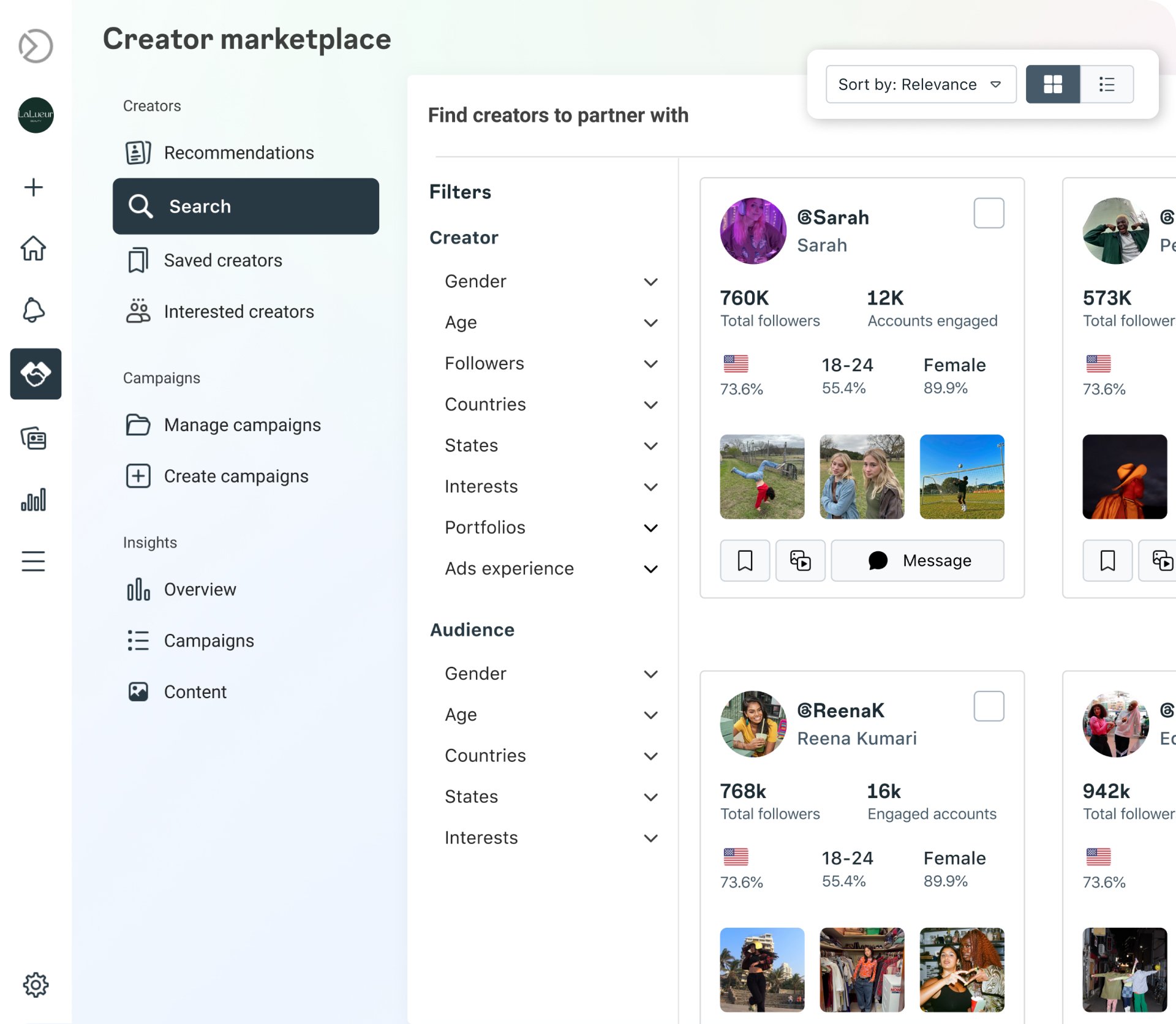
Reading the image and applying it. This historical example shows the older Creator Marketplace search and filtering area. In currently available tools, narrow by the target audience and subject, review work and comments, then confirm deliverables and permissions. Do not mechanically search for the same controls shown in an old image. Example accounts, figures and recommendations are not endorsements of any creator by this guide.
Specify the creative brief and usage rights separately
The brief should state the audience question, product facts that must be accurate, required demonstrations, prohibited invented claims, creative freedom, delivery timing, review scope and revision rounds. Preserve the creator’s expressive strengths by focusing brand review on facts, rights and commercial requirements, rather than rewriting every item as the same brand script.
At minimum, distinguish creator publication, brand-account reposting, website use and paid advertising use. Specify the term, territories, editing rights and asset delivery. Buying one video does not automatically buy permanent rights in every channel. Advertising through the creator’s identity also needs the appropriate platform permission and contractual scope.
Record content quality, relevant audience actions and business results together. Dedicated links and codes help tracking, but a code can be shared and a purchase without a code can still be influenced by content. Code-attributed sales is one observation, rather than a sufficient standalone conclusion.
Check commercial disclosure and music before publishing
TikTok requires its commercial-content disclosure setting when promoting your own business, or promoting a third-party brand in return for payment or other incentives. Own-business and third-party promotions display different labels. Select the setting matching the actual relationship, rather than overlooking your own brand’s commercial promotion because no ad fee was paid.
Check music against the commercial use intended. TikTok’s Commercial Music Library contains music pre-cleared for commercial use; general-library licences do not automatically cover commercial content. Obtain the required rights for other audio. Rights on one platform do not automatically establish permission on another platform, on a website or for every advertising use.
For collaborations aimed at US consumers, also check FTC guidance on clear disclosure of material connections. Payment, free goods, commission or another connection the audience may not know about and that could affect its assessment should be easy to see and understand, rather than hidden in a profile, collapsed description or mass of hashtags. Disclose video endorsements within the video: visually conveyed endorsements need at least visible disclosure, spoken endorsements need at least audible disclosure, and endorsements conveyed through both need both. Repeat disclosures during live streams so later arrivals can see or hear them. Platform partnership labels may assist but do not automatically replace adequate disclosure, and the language must suit the audience. Other markets have their own requirements; follow the target jurisdiction and industry rules for each collaboration.
Evaluate paid amplification separately
Organic performance can help select creative, but advertising also needs a matching objective, audience and destination. Decide whether you seek views, visits, leads or orders, then check the relevant conversion journey and measurement. A well-liked post is not automatically a suitable sales advertisement with comparable results.
TikTok Spark Ads can use your own organic posts or posts authorised by creators, with associated advertising interactions attributed to the original post. Save the organic-stage reporting period before amplification, then examine paid results separately from total post performance. If they cannot be fully separated, state the limitation instead of classifying every view as organic growth.
Increase budget according to acquisition cost, lead quality or contribution margin, and whether the team can handle additional demand. Organic content testing, advertising creative tests and channel incrementality answer different questions. Short-term results in one ad group should not become a long-term content strategy by themselves.
Connect content to conversion measurement
Match the next step to the content’s promise
Choose one main action for each item. People new to a category might read a guide, watch the next item or ask a specific question; people comparing options might visit a comparison or case page; people with a clear need might buy, book or enquire. Asking everyone to purchase immediately ignores their readiness.
An ecommerce landing page should continue the product, situation and language introduced in the content, with clear specifications, applicability limits, delivery and service conditions. A B2B page should explain whom the solution suits, the problem addressed, prerequisites and what contact follows a submission. A content brand’s subscription page should establish the topic, frequency and subscriber benefit.
Record in-platform shops, forms or direct-message sales separately from off-platform purchases. For offline appointments or sales calls, business systems can retain known sources and ask how people heard about the brand, but self-reported sources depend on memory. Platform, website, CRM and store records should complement one another, rather than simply be added together.
Use consistent UTMs on external links
UTMs are source parameters added to URLs to distinguish the platform, channel, campaign and content. They can support traffic acquisition reports, and their values are case-sensitive. Agree naming before bulk publication, so Instagram, instagram and ig do not fragment into separate sources.
| Parameter | Suggested purpose | Fictional example |
|---|---|---|
| utm_source | The specific platform | instagram or linkedin |
| utm_medium | The channel type | social or paid_social |
| utm_campaign | Business campaign or series | 2026q4_commute or inventory_guide |
| utm_content | Content ID and entry point | th014_bio or qs007_case |
These names are examples of a team convention; verify the actual channel grouping in GA4 afterwards. Do not put phone numbers, email addresses or other personal information into parameters. Where an advertising system supports dynamic parameters, use maintainable rules and check the resolved values, so the final URL does not retain unresolved placeholders.
Use Beecommercer UTM Builder to enter the clean destination https://example.com/fit-guide and set the source to instagram, medium to social, campaign to 2026q4_commute and content to th014_bio, following the example below. Leave utm_term blank. Generate the link, check its preview and copy it. The domain and campaign are illustrative; use the actual landing page for publication and verify that parameters survive redirects.
https://example.com/fit-guide?utm_source=instagram&utm_medium=social&utm_campaign=2026q4_commute&utm_content=th014_bioIf several posts share one profile link, its UTMs usually identify that shared entry point, rather than automatically proving which individual post caused a visit. Distinct destinations, different link placements supported by the platform or suitable dedicated codes can supplement tracking. Do not invent post-level attribution in reports. Avoid casually adding marketing UTMs to internal site navigation, where they can confuse source interpretation.
Test the entire journey before publication
- Open the planned link in the actual phone app and confirm the destination, language and mobile experience.
- After a short link, profile-link page or redirect, check that the required parameters remain intact.
- Complete a test action and confirm a successful submission, booking or order. Clicking the button is not the same as success.
- Use debugging tools to check whether events fire, whether they duplicate and whether the business system receives the record.
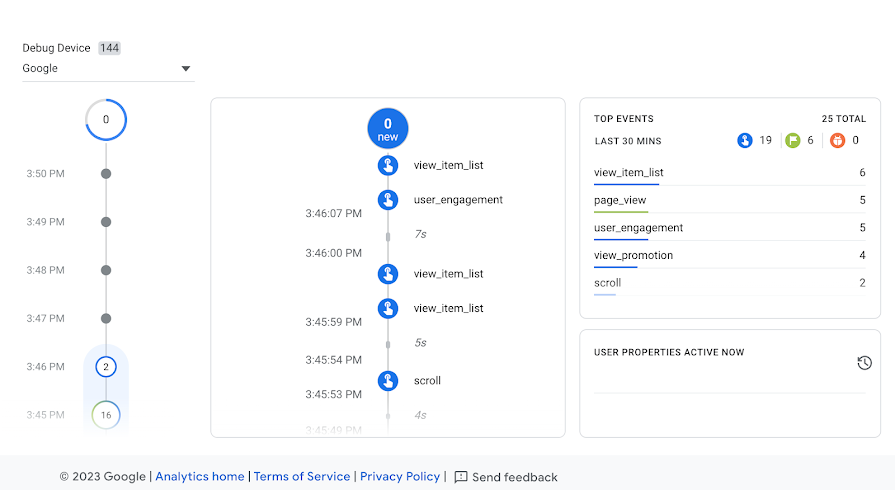
GA4 DebugView shows events and parameters from debugging devices and requires debug mode. Its attribution analysis is limited, so use acquisition reports for formal source analysis. Record conditions where consent or browser restrictions affect collection, rather than bypassing a person’s choices to make the numbers appear.
Reading the image and applying it. The middle event stream helps check action order, while the right area shows recent events and other information. Select the correct device, complete a key action and inspect its parameters. The demonstration data cannot establish that your own purchase or form tracking works correctly.
Read the current session’s source in GA4
Traffic acquisition primarily explains the current session’s origin, while User acquisition concerns a new user’s first acquisition source. To assess social visits, use Session source / medium in the traffic acquisition report with session dimensions such as Session campaign. Navigation can be customised; if the usual menu is missing, check report configuration and access rather than concluding that no data exists.

Reading the image and applying it. The image uses google / organic only to explain the session-source dimension and table structure. For social analysis, select your own sources, such as instagram / social or linkedin / social, and align dates, events and filters. The image does not show social traffic and cannot serve as a social performance case.
Sessions, users, clicks and events are different units. One person can have several sessions, a session can trigger several events and a platform click may not produce a successfully loaded and recorded website session. When clicks and sessions differ, first check definitions, loading, redirects, consent, time zones and filters, rather than demanding identical totals from both systems.
Use business systems to verify outcome quality
Ecommerce reporting should reconcile valid orders, cancellations, refunds and duplicate transactions. For GA4 purchases, send a dynamic, unique, non-empty transaction_id with each order’s purchase event. Repeated transmissions of the same order must use the same value; different orders, including orders from different customers, must not reuse it. Reconcile amounts and currency on a consistent basis. To record a refund in GA4, send refund with the original order’s transaction_id and check the refunded amount and relevant item information; do not assume store refunds synchronise automatically. B2B reporting should distinguish successful submissions, valid needs, sales acceptance, meetings, opportunities and customers, with an entry definition and owner for each stage. For example, a company and use case matching the target, with an explicit business problem, may define a qualified lead for one team, but must be agreed with sales.
A CRM should at least retain lead creation time, known source, campaign or content ID, qualification, follow-up status and business outcome. Names, email addresses, phone numbers and similar personal information belong only in systems and access scopes authorised to process them, rather than ordinary GA4 URLs, event parameters, custom dimensions or User-ID. Approved cross-system functions may use internal identifiers without names, emails or phone numbers, while the linking relationship remains subject to permissions and applicable rules. Explain purposes when collecting information, collect only what is needed and set access and retention limits. Distinguish the contact following a resource download from a marketing subscription under the applicable requirements: downloading is not indefinite marketing permission, and answering a service enquiry does not establish permission for ongoing promotional direct messages. Give the content team recurring reasons for disqualification so it can improve targeting, promises and resources.
GA4’s reporting attribution model affects the allocation of key events and revenue when event-scoped source dimensions are used. It does not change session- or user-scoped dimensions such as Session source or First user medium. Confirm the dimension’s scope before comparing reports, so a model change is not mistaken for a change in channel business performance.
Diagnose performance and improve through tests
Build a small dashboard with explicit definitions
Decide which management questions a dashboard must answer before choosing its metrics. Organise it around distribution, content consumption, actions, business outcomes and investment. Retain platform, content ID, format, topic, publication time and organic or paid status. Many fields can be recorded, while weekly meetings discuss only those affecting the next decision.
| Metric | Definition or calculation used in this guide | Boundary |
|---|---|---|
| Reach | The platform’s estimated deduplicated audience | Audiences usually cannot be deduplicated and added across platforms |
| Impressions or views | Record under the platform’s current definition | Definitions may differ by platform and format |
| Custom engagement rate | Agreed interactions divided by a denominator covering the same scope | State whether reach or impressions is used; do not present it as a native platform metric |
| Outbound click-through rate | Outbound clicks divided by the corresponding impressions | Use only when numerator and denominator cover the same scope |
| Share of sessions with a purchase | Sessions containing a purchase divided by all sessions | Not the number of purchase events divided by sessions |
| Lead qualification rate | Qualified leads divided by the same cohort of deduplicated leads | Use a consistent qualification definition and observation period |
| Cost per qualified lead | Investment in the corresponding scope divided by qualified leads | Explain whether labour, production and tools are included |
| Content production efficiency | Usable content and business outcomes considered alongside working hours | Quantity does not replace quality |
Do not impose one acceptable engagement rate on every industry. Start with your own similar content, stages and audiences, then develop reference ranges. Native platform engagement rates can include different click behaviours, so they cannot automatically be placed in one ranking to identify the best platform.
Aggregate rates by dividing the total numerator by the total denominator over the same scope. For example, items with 10 actions from 100 impressions and two actions from 10 impressions produce 12 ÷ 110, or about 10.91%. Averaging their 10% and 20% rates to obtain 15% would be wrong. Report sample sizes so a high rate from a tiny sample does not conceal overall performance.
Diagnose the stage where the problem occurs
| Observation | Check first | Example next action |
|---|---|---|
| Low distribution and little relevant interaction | Account status; audience question; topic relevance | Check visibility; rewrite the audience and content promise |
| Reasonable clicks but large early viewing losses | Delivery of the title’s promise; opening; audio and visual quality | Give the answer earlier; remove unhelpful setup |
| Strong engagement but few useful visits | Content task; reason to act; available entry points | Explain why a further visit is useful |
| Many clicks but substantially fewer sessions | Redirects; loading; parameters; consent; definitions | Test the complete journey from the actual app |
| Many visits but few purchases | Product fit; destination; price; service conditions | Fix specific barriers and observe subsequent behaviour |
| Many downloads but few qualified leads | Audience; promise; resource topic; qualification criteria | Improve the resource and screening, rather than only increasing traffic |
| Growing views but falling returns | Paid traffic mixed in; audience; costs; counting changes | Separate sources and reconcile business results |
These are diagnostic starting points rather than proof of a cause. Inspect the content, comments, destination and business records before selecting a validating action. Weak purchases might reflect delivery charges or an audience unsuited to the product; those need different responses.
Treat organic content comparisons as directional evidence
Before testing, write the hypothesis, principal change, main metric, observation window and stopping conditions. An example is whether showing the actual result first in comparable selection topics improves viewing quality and fit-guide visits. Keep other conditions as close as possible and prioritise one major change.
Organic posts usually lack random audience allocation, and their audiences, timing and recommendation environments differ. Differences between two posts provide directional evidence, rather than an automatic strict A/B experiment. Repeat the same change across comparable subjects, compare content at the same age after publication and record promotions, external sharing and paid amplification as possible confounders.
Control content age too. Yesterday’s video cannot be compared directly with a month-old cumulative total, and a new long video may need a different observation window from a short one. A seven-day first review and a 28-day reassessment can suit some teams, but long sales cycles and long-tail content need longer.
Consider sample size and business significance together
Suppose content A brings 100 sessions, two of which contain a purchase, and B brings 100 sessions, four of which contain a purchase. A rise from 2% to 4% in purchasing-session share alone does not justify immediately scaling the budget. This compares sessions containing a purchase, rather than purchase events divided by sessions. Results are sparse and sources may differ, so more observation or a stronger experimental design is needed. Without sufficient evidence, ‘supports continued testing’ is more accurate than ‘proven effective’.
A formal randomised experiment needs a tool capable of the required allocation. Predefine the main metric, minimum meaningful change, sample and observation period, rather than stopping as soon as early results look good. For costly decisions, work with analysts on a randomised holdout or an appropriate geographic experiment. A simple before-and-after comparison offers limited evidence.
Attribution and incrementality. Attribution allocates outcomes that have already occurred to touchpoints; incrementality estimates how many outcomes would not have happened without the activity. Platform conversions, GA4 conversions and store orders may describe the same transactions and cannot be added together. An impressive attribution report cannot independently establish additional profit.
Complete ecommerce and B2B review examples
Ecommerce example: how Tuhe addresses a selection barrier
All brands, business figures and outcomes in this case are fictional teaching examples. Tuhe sells commuter backpacks. Its team finds that content mainly presents an urban lifestyle, while comments and support repeatedly ask about laptop fit. It changes the main monthly theme to fit, adding insertion and removal demonstrations, measurements with protective cases, packing lists and a sizing guide, with each item linking to the appropriate destination.
During execution, operations records content IDs, topics, formats, working hours and link entry points; support gathers unresolved questions; and the product owner confirms specifications and limits. The weekly review first checks whether the audience actually needs fit information, then examines shopping behaviour after guide visits. If visits rise without better purchases, investigate product suitability, price, shipping charges and delivery conditions next.
In this fictional month, organic social entry points record 8,000 sessions, including 200 sessions with a purchase. For the calculation, each purchasing session is explicitly assumed to contain exactly one valid order, so there are also 200 orders. Net sales after refunds and other adjustments are USD 24,000. Contribution margin after product, fulfilment and other variable costs is 45%. Allocated content production and operating costs are USD 4,200, tools cost USD 300 and there is no ad spend.
| Item | Calculation | Result |
|---|---|---|
| Share of sessions with a purchase | 200 ÷ 8,000 | 2.5% |
| Average net sales per order | 24,000 ÷ 200 | USD 120 |
| Contribution before operating investment | 24,000 × 45% | USD 10,800 |
| Total content and tool investment | 4,200 + 300 | USD 4,500 |
| Attribution-based contribution remaining | 10,800 − 4,500 | USD 6,300 |
| Allocated cost per attributed order | 4,500 ÷ 200 | USD 22.50 |
Allocated cost per attributed order is not new-customer acquisition cost, because existing customers may place some orders. The remaining contribution is not net profit, because not all fixed expenses are included. Nor is it incremental profit: some people might have purchased without this content. The table helps assess whether the investment and attributed outcomes warrant further investigation.
A reasonable decision is to keep testing the fit topic, improve answers to recurring questions and assess content costs and order quality. One month cannot establish that the topic caused all revenue, and another store should not borrow the 45% contribution margin. Calculate refunds, fulfilment, payment and after-sales costs for the actual products.
B2B example: how Qiaoxu turns downloads into valid needs
This is another fictional teaching situation. Qiaoxu supplies inventory coordination software to multi-warehouse teams. Sales finds that some enquirers mistake inventory delays for a reporting-only problem. The content team publishes expert posts, diagnostic carousels, example demonstrations and evaluation checklists around process checks. The resource page explains eligible businesses and the contact to expect after submission.
Operations passes known lead sources to the CRM, and sales records company fit, whether the problem is clear and willingness to discuss further. This fictional 90-day cohort has 2,000 relevant landing-page sessions and 120 form records. After duplicates, invalid submissions and clearly irrelevant records are removed, 84 valid leads remain. Of these, 36 meet the agreed qualification criteria and 24 are accepted by sales; 12 companies complete a first meeting, six become opportunities and two become new customers. From the valid-lead stage onward, this example deduplicates by company, counts each company once at each stage and treats each later stage as a subset of the preceding one.
| Stage | Count | Change relative to the preceding stage | What to assess |
|---|---|---|---|
| Landing-page sessions | 2,000 | Starting point | Whether the audience matches the content promise |
| Form records | 120 | Submission-record-to-session ratio: 6.0% | Not a deduplicated user conversion rate |
| Valid deduplicated company leads | 84 | Valid deduplicated companies divided by form records: 70.0% | Not a form-record validity rate; also investigate duplicates, spam and irrelevant entries |
| Qualified leads | 36 | 42.86% of valid leads qualify | Company and need fit |
| Sales-accepted companies | 24 | 66.67% of qualified leads are accepted | Consistent definitions and timely handoffs |
| Companies completing a first meeting | 12 | 50.0% of accepted leads complete a meeting | Booking and attendance barriers |
| Companies becoming opportunities | 6 | 50.0% of companies met become opportunities | Problem, budget and procurement conditions |
| New customers | 2 | 33.33% of opportunities close | Whether the observation period is mature |
If allocated production, operations and tool investment for the cohort is USD 6,000, allocated cost per qualified lead is about USD 166.67, and allocated cost per company completing a first meeting is USD 500. These figures exclude some sales and implementation costs, so they are not complete customer acquisition costs. If the two customers sign contracts totalling USD 24,000, that is contract value, rather than automatically revenue recognised in this period or profit.
If downloads rise while the proportion of valid companies falls, first revise topics, the resource promise and qualification information. If qualified leads are available but meetings do not happen, check contact speed, urgency and sales conversations. B2B reviews must account for cohort maturity: leads created last week cannot be directly compared on closing rate with leads from three months ago.
Both cases connect content outcomes to customer questions, next steps and costs. Useful weekly meetings produce decisions, such as which evidence to add, which page to change and which investment to stop, rather than merely reading every figure aloud again.
Organise teams, tools and AI support
Allocate resources around tasks and capacity
A solo operator should actively limit work in progress. Begin with one main platform, one weekly theme and one clear action journey, then expand with a few derivative pieces. The fictional 20-hour week below illustrates resource allocation, rather than an industry standard.
| Work | Example weekly hours | Main output |
|---|---|---|
| Audience questions and topic research | 3 hours | Evidence-based content briefs |
| Scripts and factual verification | 3 hours | Drafts ready for filming and review |
| Production and platform adaptation | 6 hours | Usable content and masters |
| Comments, direct messages and service handoffs | 4 hours | Enquiries and support cases with outcomes |
| Data review | 2 hours | Next tests and activities to stop |
| Coordination, archiving and reserve | 2 hours | Permissions, assets and unexpected issues |
If only production receives scheduled time, interactions, review and data work get pushed aside. Small teams can separate content ownership, production, community support and analysis, while still naming one final approver and a publication owner for every item. Product, legal and technical reviewers should participate when relevant, rather than everyone approving everything.
Before outsourcing, specify deliverable formats, source files, revision scope, rights and acceptance checks. A producer can execute the visuals, but the business must still supply genuine product facts. Fluent outsourced copy is not ready for publication if the organisation cannot verify its claims.
Choose tools for actual bottlenecks
Start with the problem: disorganised assets need asset management; confused approvals need tasks and versions; missed direct messages need an inbox and case management; unclear sources need tracking and reporting. A tool connecting many platforms does not necessarily support every account type and native format.
| Category | Assess first | Common limits to check |
|---|---|---|
| Native publishing and analytics | Whether it meets the current primary-platform workflow | Roles, regions, formats and differences between device versions |
| Scheduling and collaboration | Approvals, calendar, failure alerts and exports | Support for music, stickers and partnership functions |
| Production and asset management | Masters, subtitles, versions and rights records | Compression, export specifications, fonts and asset licences |
| Listening and community tools | Coverage, deduplication and service handoffs | Incomplete samples and inaccessible private content |
| Website analytics and CRM | Links between sources, events, qualification and outcomes | Consent, identity matching and attribution scope |
Trial a tool through a real working cycle before assessing hours saved, errors reduced and the availability of portable exports. Include configuration, training, maintenance and permission management alongside subscription fees. Plans and prices change quickly; compare the current official information when purchasing.
Use AI to organise and draft
AI can help classify questions you are authorised to use, suggest topic angles, adapt drafts to different formats, summarise interviews and produce draft subtitles. Supply the audience, task, evidence, tone, boundaries and output structure first. Work based on existing facts is easier to review than invented success stories.
A reusable prompt is: ‘Using only the verified material below, propose five topics for the specified audience. For each, identify the customer question, main conclusion, evidence required and next step. Do not invent product specifications, customer reviews or business results; list missing information as requiring confirmation.’ An operator then selects suitable ideas rather than scheduling every output automatically.
Do not fill evidence gaps with generated quotations, customer reviews, product tests, screenshots or case results. AI demonstrations must not impersonate actual product performance. Before publication, a person must check facts, evidence origins, copyright, personal information, commercial disclosure and action links. Process customer and unpublished business information only within approved systems and workflows.
Generative changes to assets or cloning a voice or likeness require separate checks of agreements and necessary rights; ordinary publication permission must not be expanded into training or cloning permission. Realistic generated or materially altered content also needs the platform’s required labels: TikTok requires labels for generated content containing realistic images, audio or video, while YouTube requires disclosure of realistic, materially generated or altered content. Ordinary topic assistance or subtitle proofreading is not automatically realistic synthetic media.
Check target-market requirements separately. Professional deployers subject to the EU AI Act should assess the deepfake disclosure obligations and applicable exceptions effective from August 2, 2026. A machine-readable marking transition for providers of some older systems is not a blanket extension for content publishers. Within the scope of China’s Measures for Labelling AI-Generated Synthetic Content, publishers using online information-content dissemination services should proactively declare generated or synthetic content and use the platform’s labelling function. Those measures took effect on September 1, 2025.
Maintain a usable knowledge base
Keep positioning, product facts, recurring questions, service policies, validated content patterns, prohibited claims and rights records in the knowledge base. Give every important fact an evidence reference and an update owner, rather than saving only the latest copy without its basis.
When products, services or platform rules change, maintain a list of affected content. Prioritise older tutorials that still attract traffic. Regularly remove unnecessary access, update recovery methods and retain required operating records, so staff changes do not stop the programme.
Build a sustainable operating system in 90 days
Weeks 1–2: establish foundations and test the journey
Review account ownership, permissions, profiles, links, existing content and historical data. Interview customers and business teams, assemble question and evidence libraries, and choose the main platform and business outcome. Test the complete journey from content to the website, form, appointment or sales team, fixing problems affecting experience or recording.
Deliver a one-page positioning brief, an explicit main-outcome definition, account and asset registers, initial content pillars and one verified next-step journey. If these foundations are missing, publishing more can simply scale the problems.
Weeks 3–4: validate capacity and audience questions
Produce a set of pieces around a few core questions, completing briefing, production, review, publication, interaction and evaluation. Record hours, revision counts, relevant feedback and business actions for each item. By month-end, understand what the team can produce reliably, which problems merit further attention and which stages cause most rework.
Do not turn a chance first-month viral hit into a future capacity or revenue budget. A consistent set of definitions and records is more useful for later comparisons. If feedback falls short, revisit the specific customer question rather than immediately changing every platform.
Weeks 5–8: concentrate on a few hypotheses
Choose two or three valuable hypotheses: for example, demonstrating before introducing the product, whether explicit suitability limits improve enquiry quality, or whether a type of case attracts more relevant professional roles. Repeat the tests, use comparable observation windows and improve destination and support documentation around recurring questions.
Once production and the next-step journey are stable, consider relevant creator partnerships or small-scale paid distribution. Agree the budget, permissions, measurement and stopping conditions first. If leads are not followed up or order support is inadequate, fix those business stages before expanding reach.
Days 57–90: decide what to fund and stop
Review results by topic, format, platform and business stage, then allocate resources using production costs, qualified leads, order quality and continuing value. Extend strong content into series; reduce or stop recurring formats with weak, unexplained outcomes; and preserve an observation note for long-cycle content that has not matured.
Document effective processes for handoff, including fact review, asset rights, link naming, exception handling, the metric dictionary and weekly reporting. The 90-day objective is an operating system that learns and adjusts, rather than a guaranteed follower or revenue total.
| Stage | Core deliverables | Questions to answer before advancing |
|---|---|---|
| Weeks 1–2 | Positioning; question library; measurement and account foundations | Whom do we serve, and how are results recorded? |
| Weeks 3–4 | Initial content and production records | What can we produce reliably, and which feedback matters? |
| Weeks 5–8 | Repeated tests and journey improvements | Which change merits continued validation? |
| Days 57–90 | Investment decisions and transferable workflows | What increases, what stops and who owns each task? |
Reusable working templates
A four-week content calendar
This calendar continues the fictional ecommerce brand Tuhe. Three items a week is only a demonstration rhythm: each addresses a genuine usage question and has one main action. In actual use, add owners, reviewers, scheduled times and time zones, asset links, final links and review dates.
| Week | Content and format | Evidence needed | Main action | Main observation |
|---|---|---|---|---|
| Week 1 | Short video: the laptop fits but is hard to remove | Continuous real insertion and removal footage | View the sizing guide | Relevant page visits |
| Week 1 | Carousel: choose capacity for the laptop and other items | Dimensions and an item list | Save the selection checklist | Saves and guide visits |
| Week 1 | Q&A: measure a laptop with a protective case | A measurement demonstration | Submit a fit question | Valid fit enquiries |
| Week 2 | Short video: access differences between structures | A comparison in the same situation | Read the use-situation page | Subsequent behaviour on that page |
| Week 2 | Image and text: packing for a two-day trip | A complete item list and limits | View packing guidance | Guidance-page visits |
| Week 2 | Carousel: which items are unsuitable | Real footage and specifications | View detailed specifications | Specification-page visits |
| Week 3 | Short video: fit on people of different heights | Authorised models and stated conditions | View wearing examples | Relevant product visits |
| Week 3 | Image and text: cleaning and drying after rain | Verified care requirements | Read the care guide | Problem-resolution feedback |
| Week 3 | Q&A: what is hardest to pack for commuting? | Real questions collected from users | Describe a specific situation | Number of useful topics |
| Week 4 | Carousel: whom each of two versions suits | Actual specifications compared on the same dimensions | Open the comparison page | Shopping decisions after comparison |
| Week 4 | Image and text: delivery, returns and exchanges | Current policies for the region | Read the applicable policy | Changes in service questions |
| Week 4 | Short video: common bag-selection mistakes | This month’s demonstrations and questions | View the full guide | Subsequent behaviour after the guide |
B2B teams can keep the weekly-theme structure, replacing product fit with company situations, specification demonstrations with process or system demonstrations, comparison pages with evaluation checklists and purchases with valid needs and sales acceptance. A content brand can make subscription and continued reading the final action instead.
A brief for one content item
Business task and audience. Which people, in which situation, will this item help with which specific problem? Which business outcome does it support, and why is it worth producing now?
Conclusion and evidence. What judgement should the audience understand afterwards? Where are supporting materials stored? Which specifications, quotations or results have been verified, and which limitations must accompany them?
Presentation and action. Which format will be used, how will the opening establish the problem, how will the body demonstrate it, what is the main next step, and what are the destination and tracking link?
Responsibility and acceptance. Name the producer, factual reviewer, final approver, publisher and post-publication checker. Record the deadline and version, and whether the required asset permissions cover the intended use.
A weekly review template
This week’s results. Under consistent definitions, state the main business metrics, data cutoff and content that has not matured. Identify changes in paid distribution, promotions or statistical definitions.
Content worth continuing. Select a few items whose results can be explained, identifying the audience question, evidence, action and outcome. Do not simply list those with the highest views.
Problems to fix. Locate the issue in distribution, viewing, visits, qualification or sales. List the specific records supporting the diagnosis and state what remains uncertain.
Next week’s decisions. Specify what continues, changes or stops, giving each decision an owner, one main change, an observation metric and a review time.
An experiment record
| Field | Information to record |
|---|---|
| Hypothesis | Why a change may affect a particular behaviour |
| Scope | Platform; format; audience; topic; organic or paid |
| Principal change | The single most important change and conditions kept comparable |
| Metrics and definitions | Numerator; denominator; data source; main metric and necessary guardrails |
| Observation plan | Comparable content age; data maturity; stopping conditions |
| Confounders | Holidays; promotions; external sharing; paid amplification |
| Conclusion | Supports continuation, inconclusive or does not support it, with limitations |
An asset and permissions register
For each asset, retain the source file, author or supplier, filming or acquisition date, relevant product version, permitted platforms, organic or advertising use, territories, term and permission evidence. Keep versions after changes and make published locations traceable when rights expire or facts change. For creator content, separately record platform authorisation so contractual permission and platform settings remain aligned.
Frequently asked questions
How often should we publish?
Start with a frequency the team can sustain for four weeks while completing review and interaction, then adjust for capacity and feedback. More publishing helps only while the content still solves problems and the team can handle subsequent demand. Platform educational suggestions and other people’s experience are not fixed algorithmic requirements.
Should a new account prioritise followers or conversions?
First demonstrate that the intended people consume the content and have a clear next-step journey. Track follower growth while defining business actions from day one. For ecommerce, relevant early fit enquiries can matter more than many unrelated followers. For a subscription content brand, relevant subscriptions and retention are outcomes in themselves.
Can the same content appear on every platform?
Reuse subjects and assets, but recheck the opening, cropping, subtitles, music rights, next step and platform rules. For complex content, create a complete master first, then develop versions that make sense independently in each setting.
Should we buy ads immediately when organic exposure falls?
First examine account status, content relevance, viewing feedback and the next-step journey. Paid distribution can increase reach, but does not automatically fix poor product fit, an unclear content promise or a page that cannot convert. Advertising results become interpretable only once objectives and measurement are explicit.
Why do platform clicks and website sessions differ?
Confirm whether the click actually leads off-platform, then check page loading, redirects, consent, in-app browsers, time zones and report scope. Clicks and sessions use different units and need not be equal. Investigate abnormal gaps by testing the actual journey.
How do we decide whether content deserves further investment?
Consider audience relevance, repeatable performance, business outcomes and cost together. Record the problem solved, why the item was useful and what the next round can test. If results remain insufficient, state the observation limits. Reduce investment in, or redesign, content that repeatedly fails to create relevant value.
What should be checked daily, weekly and monthly?
On staffed days, check actual publication, comments, direct messages and exceptions. Weekly, review content and business feedback and choose the next changes. Monthly, or at a suitable interval, review audiences, costs, asset rights, tracking and important content maintenance. The business cycle determines the rhythm; assign clear owners in the work plan.
With this process in place, an account should be able to explain whom its content serves, where the evidence is, what the next step is, how outcomes are recorded and how feedback will change the next round of work. Applying these questions to each item and review makes operating experience usable across the team.